Does Vitamin C Help With Weight Loss or Gain?
A trial measured weight loss while testing vitamin C with another supplement, but it can’t tell you what vitamin C does on its own.
There’s no clear evidence here that taking vitamin C on its own helps you lose or gain weight. In a 45-day trial of male bodybuilders, the group taking vitamin C with L-arginine had a reduction in body weight while following structured exercise. The study can’t separate vitamin C’s effect from the other supplement or tell us whether the result applies to women. 2
A weight result, but not a vitamin C result
One randomized trial did measure body weight. It enrolled 50 male bodybuilders for 45 days. One group received vitamin C together with L-arginine; the other received a placebo. Everyone followed a structured resistance and aerobic exercise program. The researchers reported a significant reduction in body weight in the supplement group, but the abstract doesn’t give the amount of weight lost or clearly establish that the weight change differed from the placebo group’s. 2
That distinction matters if you’re deciding whether to buy vitamin C for weight loss. The trial tested two supplements together, not vitamin C alone. Its participants were also training. Even though the researchers measured weight, the study can’t tell you whether vitamin C contributed to the change. 2
Why a vitamin C level isn’t a weight-loss test
You may see claims linking vitamin C to metabolism or body size. A review reports that people with type 2 diabetes or metabolic syndrome often have lower circulating and dietary vitamin C levels than healthy controls. It also discusses associations between vitamin C levels and metabolic conditions. Those findings describe people’s nutrient status; they don’t test whether taking a vitamin C supplement changes body weight. 3
Here’s a useful way to read a claim: What did the researchers measure, and what did they give people? A study of vitamin C levels can’t answer what happens when someone takes a supplement. A study of blood sugar can’t, by itself, answer what happens to body weight. And the body-weight trial above gave participants vitamin C plus L-arginine. 2 3
What about weight gain or women’s life stages?
The bodybuilder trial doesn’t show that vitamin C alone causes weight gain, either. It also included no women, so it can’t answer questions about weight during pregnancy, postpartum recovery, perimenopause, or postmenopause. Those situations deserve attention on their own terms, not an assumed vitamin C effect drawn from a trial in male athletes. 2
If your weight has changed, the scale can’t tell you the whole reason. Body weight includes muscle, bone, fat, and water. If you’re gaining or losing weight without trying, it’s worth discussing the change with a healthcare provider rather than assuming a vitamin supplement explains it. 1
For a weight-management decision, the takeaway is simple: don’t treat a link between vitamin C status and metabolic health, or a weight change during a combined supplement trial, as proof that extra vitamin C will change your weight. 2 3
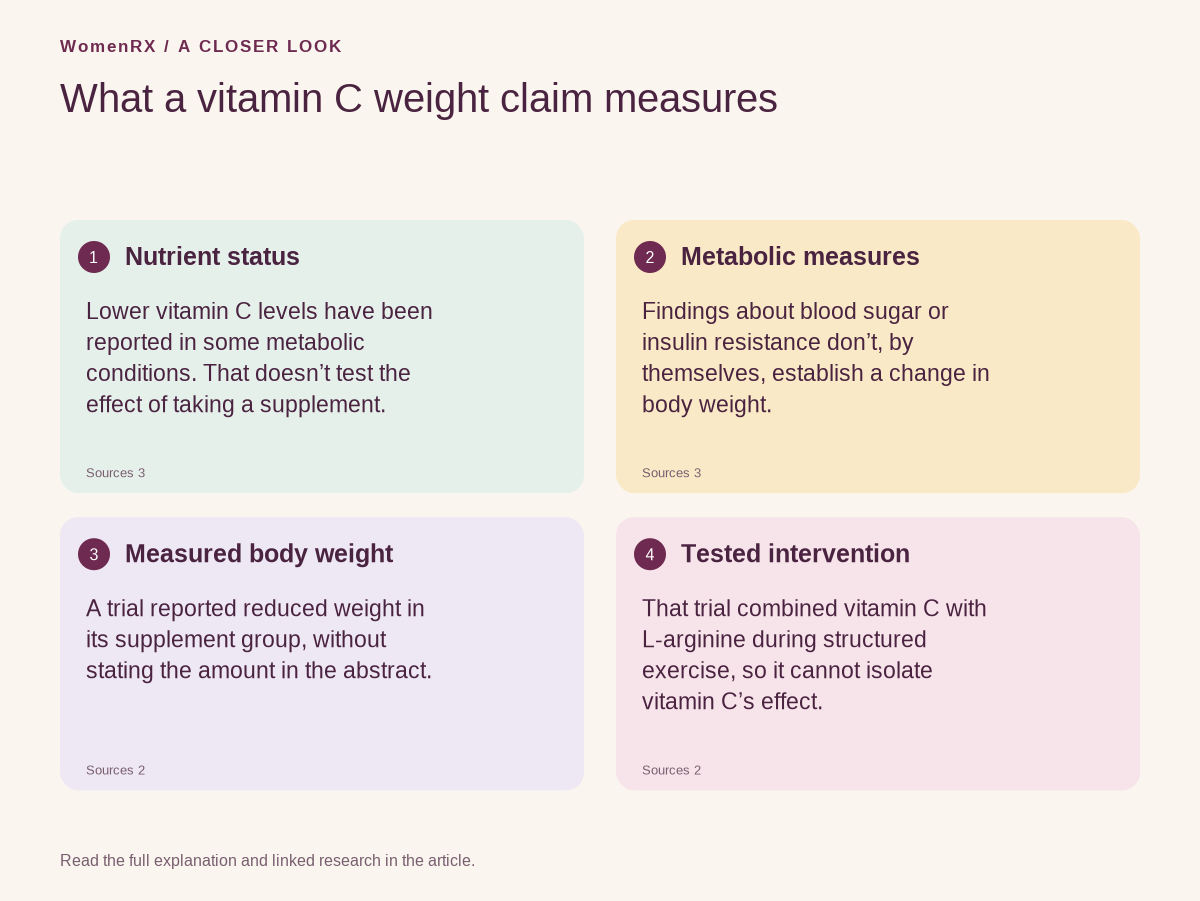
What a vitamin C weight claim measures
Nutrient status: Lower vitamin C levels have been reported in some metabolic conditions. That doesn’t test the effect of taking a supplement.3
Metabolic measures: Findings about blood sugar or insulin resistance don’t, by themselves, establish a change in body weight.3
Measured body weight: A trial reported reduced weight in its supplement group, without stating the amount in the abstract.2
Tested intervention: That trial combined vitamin C with L-arginine during structured exercise, so it cannot isolate vitamin C’s effect.2
Read the figure as text
These distinctions show why related findings don’t all answer the same question.- Nutrient status: Lower vitamin C levels have been reported in some metabolic conditions. That doesn’t test the effect of taking a supplement.3
- Metabolic measures: Findings about blood sugar or insulin resistance don’t, by themselves, establish a change in body weight.3
- Measured body weight: A trial reported reduced weight in its supplement group, without stating the amount in the abstract.2
- Tested intervention: That trial combined vitamin C with L-arginine during structured exercise, so it cannot isolate vitamin C’s effect.2
Sources you can check
- Body Weight: MedlinePlusAccessed 2026-09-25Return to first citation
- The combined effect of L-arginine and Vitamin C supplementation on nitrogen balance, body composition, maximal oxygen uptake, and anabolic-catabolic hormones in male bodybuilders: A randomized double-blind clinical trial.Athar SS, Ghavamzadeh S, Zayer B, Yekta Z, Hasaniani L. · Journal of diabetes and metabolic disorders · 2026Return to first citation
- Pathophysiological Role and Therapeutic Potential of Vitamin C in Metabolic Syndrome and Type 2 Diabetes Mellitus.Argano C, Orlando V, Maggio D, Pollicino C, Torres A, Cangialosi V, Biscaglia Manno S, Corrao S. · Metabolites · 2025Return to first citation