Does Vitamin B6 Help You Lose or Gain Weight?
Vitamin B6 has a role in metabolism, but the reported weight change in a study of midlife women can’t be attributed to B6.
Vitamin B6 helps the body use nutrients, but that doesn’t mean taking extra B6 will change your weight. In one study of midlife women, weight fell during 12 weeks of a supplement containing B6 and four other nutrients. The study can’t tell us whether B6 contributed to the change, and it doesn’t answer whether B6 alone helps with weight loss or gain. 2
Vitamin B6 can sound promising when a supplement claim mentions “metabolism.” Your body does use B6 in processes involved in handling nutrients. But a nutrient’s normal job is different from a demonstrated effect of taking more of it. To know whether a B6 supplement changes weight, a study needs to test a weight outcome in people taking B6 and make it possible to separate B6’s effect from other explanations. 2
What a weight study found
A retrospective study examined health records from 52 women aged 45 and older who had suboptimal micronutrient intake. They took a supplement containing vitamins B6, B12, D3, and K2, plus magnesium. Their average body weight was 1.4 kg lower after 12 weeks than it had been at the start. 2
That is a measured weight change, but it isn’t a measured B6 effect. Everyone in the reported analysis took the five-nutrient combination, and the researchers compared their measurements before and after supplementation. Without a comparison that isolates B6, the study can’t establish whether B6, another ingredient, or something else accounts for the change. It also offers no basis for using B6 alone to gain weight. 2
A useful way to read a “supports metabolism” claim is to ask two separate questions: Does this nutrient have a role in metabolism? And did a human study show that supplementing it changed body weight? The first does not answer the second. In this study, weight was measured, but B6’s individual contribution was not. 2
Your reason for considering B6 matters
Taking B6 in response to a diagnosed deficiency is a different question from taking it to move the number on the scale. The women in the study were described as having suboptimal micronutrient intake, not as receiving treatment for diagnosed B6 deficiency. Its results therefore can’t tell you whether correcting such a deficiency changes weight. 2
The life stage matters, too. The participants were women aged 45 and older, but the reported findings don’t separate perimenopausal from postmenopausal participants. They don’t establish a menopause-specific effect. Pregnancy wasn’t studied, so this result shouldn’t be used to explain weight changes during pregnancy either. A study conducted in women doesn’t, by itself, show that B6 has a weight effect unique to women. 2
If your weight has changed without you trying, avoid assuming a vitamin explains it. Scale weight includes muscle, bone, fat, and water, so a change doesn’t reveal its cause. An unexpected gain or loss is worth discussing with a health care provider, particularly if it’s sudden. 1
For a B6 product marketed for weight loss or gain, look past the word “metabolism.” Check whether the cited research tested B6 by itself, measured body weight in people, and studied people in a situation like yours. The reported midlife study meets the weight-measurement test, but not the B6-by-itself test. 2
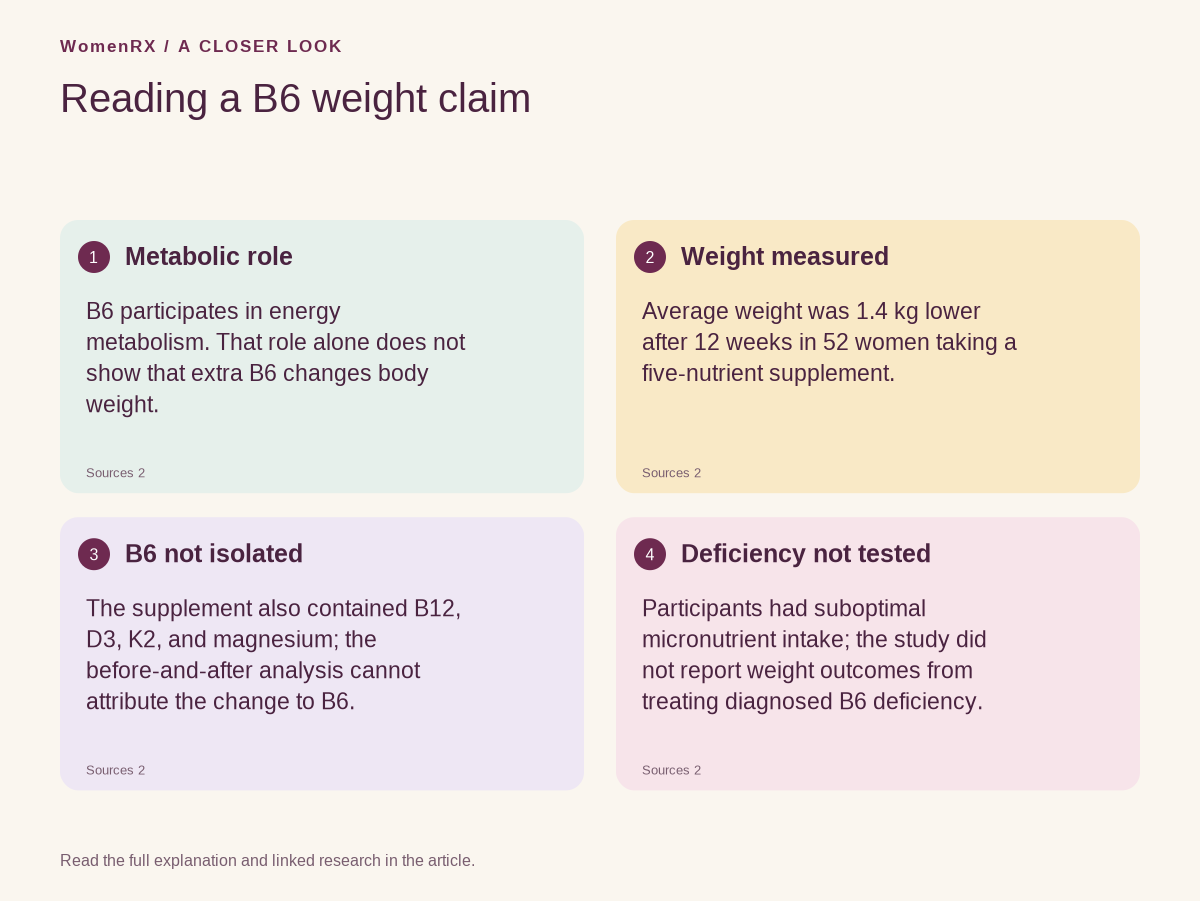
Reading a B6 weight claim
Metabolic role: B6 participates in energy metabolism. That role alone does not show that extra B6 changes body weight.2
Weight measured: Average weight was 1.4 kg lower after 12 weeks in 52 women taking a five-nutrient supplement.2
B6 not isolated: The supplement also contained B12, D3, K2, and magnesium; the before-and-after analysis cannot attribute the change to B6.2
Deficiency not tested: Participants had suboptimal micronutrient intake; the study did not report weight outcomes from treating diagnosed B6 deficiency.2
Read the figure as text
These distinctions show what the midlife study measured and what remains unanswered about taking B6 for weight change.- Metabolic role: B6 participates in energy metabolism. That role alone does not show that extra B6 changes body weight.2
- Weight measured: Average weight was 1.4 kg lower after 12 weeks in 52 women taking a five-nutrient supplement.2
- B6 not isolated: The supplement also contained B12, D3, K2, and magnesium; the before-and-after analysis cannot attribute the change to B6.2
- Deficiency not tested: Participants had suboptimal micronutrient intake; the study did not report weight outcomes from treating diagnosed B6 deficiency.2