Sertraline and Weight Change: What the Research Shows
Sertraline may be linked with weight change over time, but study averages can’t predict what will happen to you.
Sertraline can be associated with weight gain, but the amount varies and the evidence doesn’t let anyone predict your individual response. A large U.S. study found small average differences between antidepressants at six months; a separate two-year study found average weight gain was 5.9 lb greater in the sertraline group than in the fluoxetine group. Neither result proves what caused one person’s change. 4 6
What the studies can, and can’t, tell you
The clearest recent comparison followed 183,118 people starting one of eight antidepressants in U.S. health systems. At six months, sertraline was the reference medicine: average weight differences for the other medicines were small, ranging from 0.41 kg more with escitalopram to 0.22 kg less with bupropion, compared with sertraline. That design helps compare medicines, but it does not give a simple prediction of how much weight a person taking sertraline will gain. The study was observational, adherence was low, and weight measurements were incomplete. 4
A separate retrospective study looked at weight two years after adults started antidepressants. Compared with fluoxetine users, average weight gain was 5.9 lb greater in the sertraline group; the difference was statistically significant. This is a comparison between groups, not proof that sertraline caused that gain in each person. It also doesn’t mean everyone taking sertraline will gain weight. 6
These results aren’t a clean contradiction. The studies used different follow-up periods, comparison medicines, and populations. The six-month study estimated differences among several medicines relative to sertraline; the two-year study compared each medicine with fluoxetine. Together, they suggest that weight patterns can look different over time and depending on what sertraline is compared with. They don’t establish a personal forecast or a precise dose-related effect. 4 6
Why your own weight may change
A change on the scale while taking sertraline doesn’t establish that the medicine is the cause. Body weight includes water, muscle, bone, and fat, and everyday factors can affect it too. 3 You can also mention any mood symptoms or routine changes that happened around the same time; that context may help structure the discussion, but these studies don’t establish that either caused the weight change.
Treatment length matters when interpreting research: a result at six months doesn’t answer exactly what may happen after two years. Dose may be worth discussing if your weight changed after a medication adjustment, but the available studies don’t establish a dose-response relationship, so don’t assume that lowering the dose would solve the problem. 4 6
These two comparison studies don’t report weight outcomes specifically for women or for people in perimenopause. They therefore can’t establish whether sertraline has a distinct weight effect in women or whether its effect differs during cycling years or perimenopause. 4 6 A small postpartum study included 60 women with prior depression and compared sertraline, nortriptyline, and placebo; average weight change from 2 to 17 weeks after birth was −1.8 lb across groups, and weight at week 17 did not differ significantly by treatment. That narrow postpartum finding shouldn’t be used to predict weight change at other life stages or during longer treatment. 5
How to raise the concern without losing sight of treatment
You don’t have to choose between taking a weight concern seriously and valuing the mental-health benefit of treatment. Antidepressants can take several weeks to work fully, and treatment choices can be revisited if side effects are difficult to manage or the medicine isn’t helping. 2
For a medication appointment, bring a short, factual picture rather than trying to explain the change yourself:
- When you started sertraline, and when any dose changes happened.
- When you first noticed the weight change, and whether it has continued.
- Whether the change feels sudden or gradual; unexplained or sudden weight change is worth discussing. 3
- Any changes in mood, appetite, activity, sleep, or other medicines that seem relevant to you.
- How well sertraline is helping, including what has improved and what hasn’t.
You might ask: “Could sertraline be contributing, and what else should we consider?” “How should we weigh this against how well it’s treating my symptoms?” “If we consider another option, what tradeoffs should I expect?” Those questions leave room to consider other explanations and the benefit of treatment, instead of treating a study average as your answer.
Don’t stop sertraline suddenly or change how you take it on your own. Stopping can cause withdrawal symptoms; if you want to stop or switch, ask the prescriber who manages your treatment to plan the change with you. 1 2
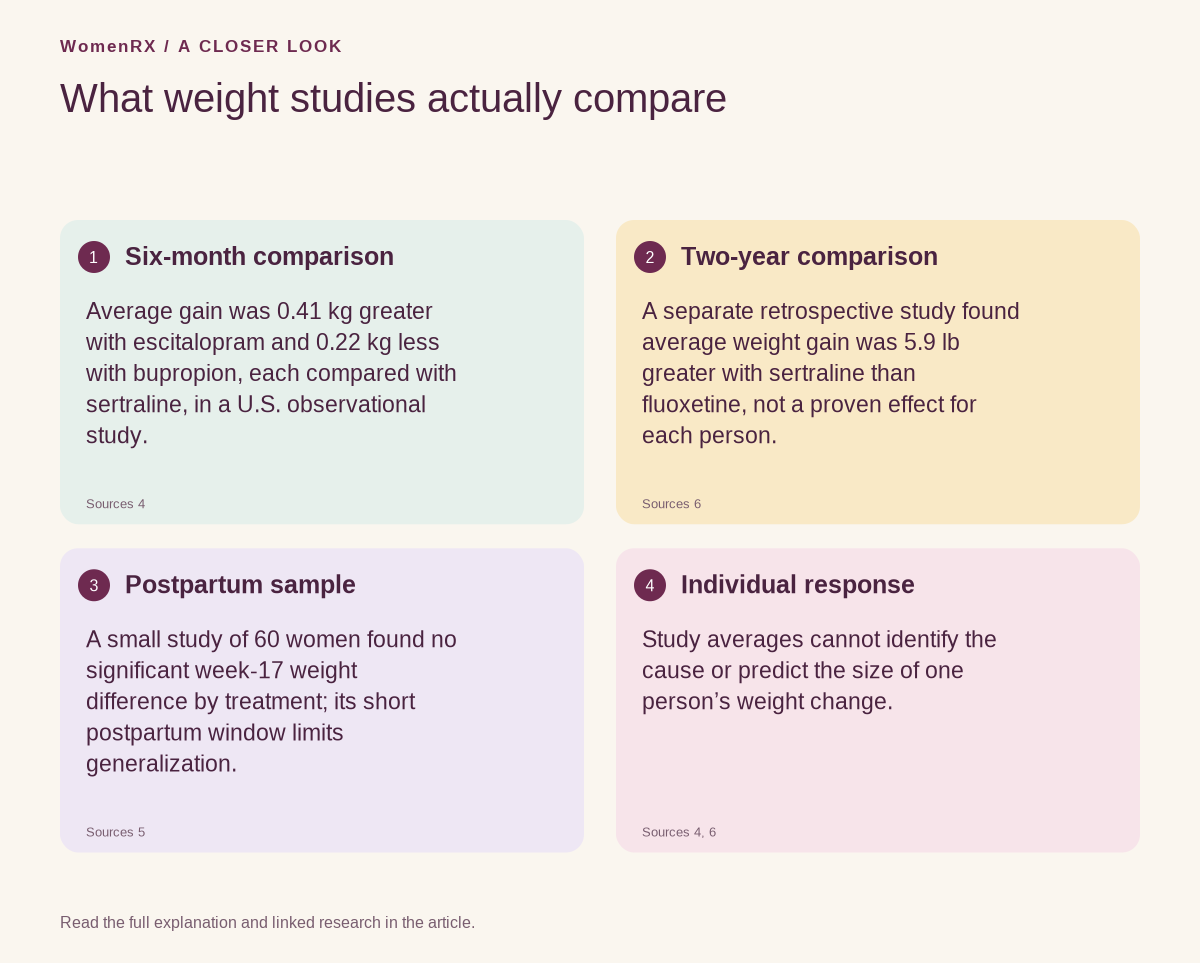
What weight studies actually compare
Six-month comparison: Average gain was 0.41 kg greater with escitalopram and 0.22 kg less with bupropion, each compared with sertraline, in a U.S. observational study.4
Two-year comparison: A separate retrospective study found average weight gain was 5.9 lb greater with sertraline than fluoxetine, not a proven effect for each person.6
Postpartum sample: A small study of 60 women found no significant week-17 weight difference by treatment; its short postpartum window limits generalization.5
Individual response: Study averages cannot identify the cause or predict the size of one person’s weight change.46
Read the figure as text
The follow-up period and comparison medicine change what a study result means. Neither group average predicts an individual response.- Six-month comparison: Average gain was 0.41 kg greater with escitalopram and 0.22 kg less with bupropion, each compared with sertraline, in a U.S. observational study.4
- Two-year comparison: A separate retrospective study found average weight gain was 5.9 lb greater with sertraline than fluoxetine, not a proven effect for each person.6
- Postpartum sample: A small study of 60 women found no significant week-17 weight difference by treatment; its short postpartum window limits generalization.5
- Individual response: Study averages cannot identify the cause or predict the size of one person’s weight change.46
More questions, answered
Does weight gain mean sertraline isn’t working?
No. Weight change by itself doesn’t show whether sertraline is helping your symptoms. Discuss both the weight change and your treatment response when reviewing what to do next. 2
Should I stop sertraline if I’m gaining weight?
Don’t stop suddenly or adjust your treatment on your own. Stopping sertraline can cause withdrawal symptoms; if you want to stop or switch, ask the prescriber managing your treatment to help plan the change. 1 2
Sources you can check
- Sertraline: an antidepressant medicine - NHSAccessed 2026-09-25Return to first citation
- Antidepressants - NHSAccessed 2026-09-25Return to first citation
- Body Weight: MedlinePlusAccessed 2026-09-25Return to first citation
- Medication-Induced Weight Change Across Common Antidepressant Treatments : A Target Trial Emulation Study.Petimar J, Young JG, Yu H, Rifas-Shiman SL, Daley MF, Heerman WJ, Janicke DM, Jones WS, Lewis KH, Lin PD, Prentice C, Merriman JW, Toh S, Block JP. · Annals of internal medicine · 2024Return to first citation
- Weight changes in postpartum women with remitted depression.Gracious BL, Hanusa BH, Wisner KL, Peindl KS, Perel JM. · The Journal of clinical psychiatry · 2005Return to first citation
- Long-Term Weight Change after Initiating Second-Generation Antidepressants.Arterburn D, Sofer T, Boudreau DM, Bogart A, Westbrook EO, Theis MK, Simon G, Haneuse S. · Journal of clinical medicine · 2016Return to first citation