Kefir: Protein, Fermentation, and Choosing a Product
Kefir can provide dairy protein, but added sugar and culture claims are worth checking on the specific bottle you buy.
Compare kefir by the serving you’ll actually drink: check protein, added sugar, the milk base, and any live-culture claim. For example, Lifeway’s current Whole Milk Plain Kefir label declares 10 grams of protein and 0 grams of added sugar per cup; the maker also claims live and active cultures. Those are product declarations, not amounts or cultures to assume for every kefir. 7
Kefir isn’t one standardized recipe. It’s a fermented milk drink, and its microbial composition can vary with the grains used, the milk, fermentation conditions, and storage. So two products called kefir shouldn’t be assumed to have identical cultures or effects. 3
For a useful comparison, start with what matters in your glass: protein, added sugar, the milk base, and any information the product gives about its cultures. These checks help you compare what products say about themselves. They don’t independently verify whether a particular drink contains live cultures.
Compare the product, not the name
Protein: Dairy products are a source of protein. 1 A historical USDA entry for plain low-fat Lifeway kefir lists 9.2 grams of protein per 243-gram cup. That’s a concrete example, not a measurement of the Lifeway product sold now or a protein amount to assume for other kefirs. 6 For a current example, Lifeway’s Whole Milk Plain Kefir label declares 10 grams per 240-mL cup. It’s a different product from the historical low-fat entry, so the two numbers don’t show a change in formulation. To compare two kefirs you might buy, look at the protein each states for the amount you’d realistically drink. 7
Added sugar: The current Whole Milk Plain Kefir label declares 0 grams of added sugar and 10 grams of total sugar per cup. Those numbers answer different questions: zero added sugar doesn’t mean a drink contains no sugar. 7 Compare added-sugar amounts on other current packages using equivalent serving sizes. The historical USDA entry above gives carbohydrate but no added-sugar amount; a missing entry isn’t zero. 6 A flavor name alone won’t give you a useful comparison.
Milk base: Check what the kefir is made from. If you avoid a particular ingredient or milk, don’t assume every kefir uses the same base. The type and composition of milk are among the factors that can differ in kefir production. 3 The current Lifeway example lists milk among its ingredients and states that it contains milk, even though the maker describes it as lactose-free. Those are separate considerations if you’re avoiding lactose versus milk itself. 7
Cultures and processing: The timing of pasteurization matters. In one human trial, researchers made kefir by adding cultures to milk that had already been pasteurized. That illustrates why “made with pasteurized milk” doesn’t mean the finished kefir was pasteurized after fermentation. It also doesn’t, by itself, confirm live cultures in the drink you’re buying. 3 Lifeway describes its current Whole Milk Plain Kefir as containing live and active cultures and lists pasteurized milk and cultures among its ingredients. That’s a claim about this product, not independent testing or proof of a health benefit. 7 If a different package mentions processing but leaves you unsure about cultures in the finished drink, ask its manufacturer. Another human trial explicitly described its fermented dairy drink as containing live and active kefir cultures; that description shouldn’t be assumed to apply to every kefir. 5 Kefir’s microbial mix can vary, so don’t assume two drinks will have the same effects. 3
For example, if you’re choosing between a plain product declaring 10 grams of protein and 0 grams of added sugar per cup and another kefir, compare the second label for the same amount before deciding which better fits your preferences. Then check the milk base. If cultures are your reason for buying one, compare what each maker actually says about the finished drink. The first product’s numbers and culture claim come from Lifeway’s current Whole Milk Plain Kefir label; they aren’t a benchmark that every plain kefir meets. 7
What digestive research can, and can’t, tell you
Small human trials have reported changes in gut bacteria after people consumed kefir, but results differ by group, product, and study. In a trial involving 22 adults with metabolic syndrome, participants received kefir or unfermented milk for 12 weeks. Some metabolic measures changed within the kefir group, but those measures did not differ significantly between groups. Among the assessed microbiota results, changes in sub-phylum bacterial populations also did not differ significantly between groups. 3
Another randomized trial studied 21 professional female soccer players aged 18-29. The kefir group drank 200 mL daily for 28 days, while the comparison group continued its usual diet. The researchers reported changes in microbial diversity and in the abundance of certain bacteria. That’s a finding in a small, specific group over a short period, not proof that kefir improves digestion for women generally. 2
A trial of 65 healthy young adults used lactose-free kefir for six weeks and reported a decrease in gastrointestinal symptoms after the intervention. That result doesn’t establish that regular kefir is tolerated by someone with lactose intolerance, or that every lactose-free kefir will have the same effect. If you need to avoid lactose, look for a product explicitly labeled lactose-free rather than relying on the word “kefir.” 4
Taken together, these studies suggest that particular kefir products may change gut bacteria or symptoms in particular groups. They don’t show that all kefir products produce the same changes, or that kefir is a reliable treatment for digestive symptoms.
Match your choice to your reason
If you want a convenient dairy food with protein, compare products and decide whether the stated sugar amount and milk base suit you. If you’re choosing kefir for its cultures, check what the package says about live cultures in the finished drink and ask the manufacturer if that’s unclear. Its microbial makeup can vary, so research on one kefir doesn’t establish the same effect for another. 3 If lactose is a concern, a lactose-free label is more relevant than assuming fermentation makes a product suitable.
The women-only trial discussed here involved young professional soccer players. It doesn’t establish a menopause-related benefit or a reason to choose kefir for hormonal balance. Pick a product for the nutrition, ingredients, and taste that work for you rather than expecting those unstudied benefits. 2
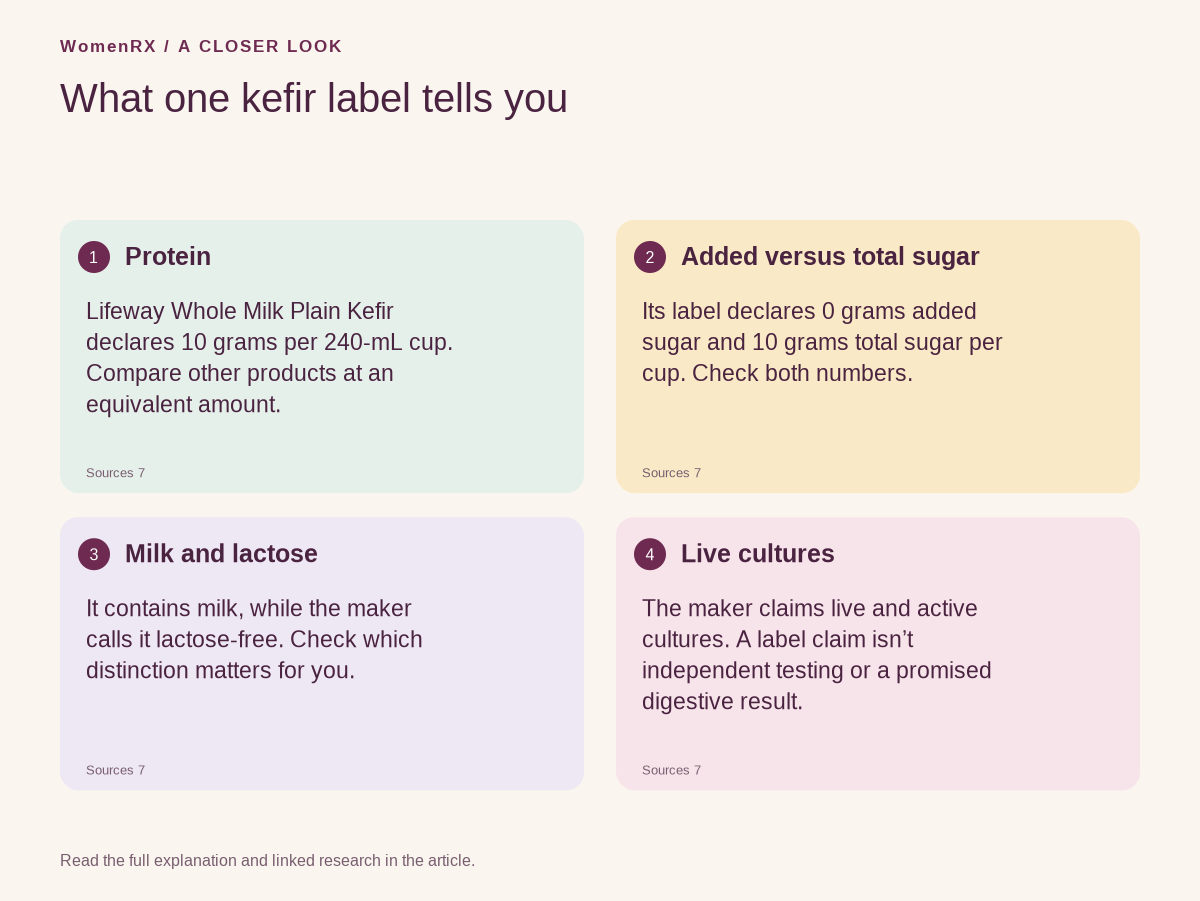
What one kefir label tells you
Protein: Lifeway Whole Milk Plain Kefir declares 10 grams per 240-mL cup. Compare other products at an equivalent amount.7
Added versus total sugar: Its label declares 0 grams added sugar and 10 grams total sugar per cup. Check both numbers.7
Milk and lactose: It contains milk, while the maker calls it lactose-free. Check which distinction matters for you.7
Live cultures: The maker claims live and active cultures. A label claim isn’t independent testing or a promised digestive result.7
Read the figure as text
Use this current product example to see which details to compare on the bottles in front of you.- Protein: Lifeway Whole Milk Plain Kefir declares 10 grams per 240-mL cup. Compare other products at an equivalent amount.7
- Added versus total sugar: Its label declares 0 grams added sugar and 10 grams total sugar per cup. Check both numbers.7
- Milk and lactose: It contains milk, while the maker calls it lactose-free. Check which distinction matters for you.7
- Live cultures: The maker claims live and active cultures. A label claim isn’t independent testing or a promised digestive result.7
More questions, answered
Does kefir reliably improve gut health?
Trials have reported changes in gut bacteria in adults with metabolic syndrome and young female soccer players. A separate trial using lactose-free kefir reported fewer gastrointestinal symptoms in healthy young adults after the intervention. Those findings don’t establish a dependable digestive benefit for everyone. 2 3 4
Does kefir have a proven menopause or hormone benefit?
The women-only trial discussed here involved professional soccer players aged 18-29 and didn’t study menopause or hormonal outcomes. It can’t answer whether kefir has a menopause-related benefit. 2
Sources you can check
- Dietary Proteins: MedlinePlusAccessed 2026-09-25Return to first citation
- Effects of Kefir Consumption on Gut Microbiota and Athletic Performance in Professional Female Soccer Players: A Randomized Controlled Trial.Öneş E, Zavotçu M, Nisan N, Baş M, Sağlam D. · Nutrients · 2025Return to first citation
- Effects of Regular Kefir Consumption on Gut Microbiota in Patients with Metabolic Syndrome: A Parallel-Group, Randomized, Controlled Study.Bellikci-Koyu E, Sarer-Yurekli BP, Akyon Y, Aydin-Kose F, Karagozlu C, Ozgen AG, Brinkmann A, Nitsche A, Ergunay K, Yilmaz E, Buyuktuncer Z. · Nutrients · 2019Return to first citation
- Effects of Kefir Consumption on Gastrointestinal Health, Biochemical Parameters, Sleep, and Mental Well-Being in Healthy Young Adults: a Randomized Controlled Trial.Bakırhan H, Ozyurek Arpa F, Pehlivan M, Kalkan I. · The Journal of nutrition · 2026Return to first citation
- Consumption of a fermented dairy beverage improves hippocampal-dependent relational memory in a randomized, controlled cross-over trial.Cannavale CN, Mysonhimer AR, Bailey MA, Cohen NJ, Holscher HD, Khan NA. · Nutritional neuroscience · 2023Return to first citation
- USDA SR Legacy: Kefir, lowfat, plain, LIFEWAY (FDC 170904)Accessed 2026-09-25Return to first citation
- Lifeway Whole Milk Plain Kefir: current declared nutrition and culturesAccessed 2026-09-25Return to first citation