Why Walking Calorie Estimates Don’t Always Match
Two tools can give different calorie estimates for the same walk because they use different inputs and may count different kinds of energy use.
A walking calorie number is an estimate, not a measurement of exactly what your body used. First check whether it shows gross energy, which includes the energy you’d use at rest, or net energy, which subtracts resting energy. Then compare the walk details and inputs each tool uses. In one study, treadmill walking had higher measured energy expenditure than walking on an overground track at matched speeds.2
A calculator says one thing. Your watch says another. Before deciding which number to trust, check what each one is trying to count. A difference may come from the definition of “calories burned,” the details entered about your walk, or the way a device turns sensor readings into an estimate.
First, check what the number includes
Gross walking energy is the total energy your body uses during the walking period. Net walking energy subtracts the energy you’d use at rest over that period. Researchers use both measures, and a study comparing treadmill with overground walking explicitly calculated net expenditure by subtracting resting metabolic rate from gross expenditure.2
Picture a walk during a time you otherwise would have spent sitting. A gross figure counts all energy used while you walked. A net figure aims to describe the amount above your resting energy use. The gross number will therefore be higher for the same measured walk. Neither is automatically wrong, but they answer different questions. If a calculator or watch doesn’t say whether its figure is gross or net, don’t assume its number is directly comparable with another tool’s.2
Then compare the walk each tool thinks you took
Speed matters, but the setting matters too. In a crossover study of 20 healthy young adults, including 10 women, researchers measured higher gross and net energy expenditure on a treadmill than on an overground track at the matched walking speeds they tested. The treadmill walks also involved faster cadence and shorter average steps and strides. That finding doesn’t give you a correction factor for your own walks; it shows why treadmill-based measurements may not transfer directly to overground walking on a track.2
A device also has to infer energy use from the information it collects. In a laboratory study of 20 young, physically active adults, one armband overestimated walking energy expenditure compared with indirect calorimetry. Prediction equations that added speed and heart-rate information improved the estimates by the study’s measure of error. Those results apply to that device and test, not every watch, but they make the central point: a reading can change when the prediction method or its inputs change.5
Body mass is worth checking in a calculator’s settings, too. In a treadmill study of children and adolescents, body mass and walking speed were among the variables associated with measured gross walking energy expenditure. That finding supports paying attention to the inputs; it doesn’t establish a precise body-mass adjustment for every adult walk.1
Does being a woman change the calculation?
There isn’t a reason in these walking studies to treat “for women” as a guarantee of a better estimate. The treadmill-versus-overground study included women and men, but its reported energy-expenditure finding was for the group, not a separate formula for women.2 For a useful comparison, start with the concrete details a tool uses, such as your current body mass and the pace or movement information it has, rather than assuming a sex-labeled calculator is more personal.15
Pregnancy is a situation where a simple assumption can be especially misleading. In a study of 35 pregnant women walking at a self-selected pace, walking speed was strongly associated with net oxygen-use rate, yet gross and net walking energy expenditure did not differ significantly between trimesters.3 In a separate study following 23 women with obesity from about 15 to 30 weeks of pregnancy, resting metabolic rate rose on average while self-selected walking speed and the measured metabolic cost of walking decreased.4 More body mass during pregnancy, in other words, didn’t translate into a straightforward rise in walking cost in that group. Neither study supplies a universal pregnancy adjustment for a calculator.34
Use the estimate for perspective, not precision
If you want to compare your own walks, keep the comparison consistent: use the same tool and settings, check that your body mass entry is current, and distinguish a treadmill session from an overground walk. Look at the walk itself alongside the number, including how long you went and whether your pace changed. This won’t make the calorie figure exact, but it makes differences easier to interpret.125
A calorie estimate is less useful as a food allowance. The armband study found error even under controlled laboratory conditions.5 If a tool identifies its estimate as gross or net, use that definition when comparing numbers. You can give a walk credit for being a walk without treating its displayed calories as an amount you need to eat back or earn.
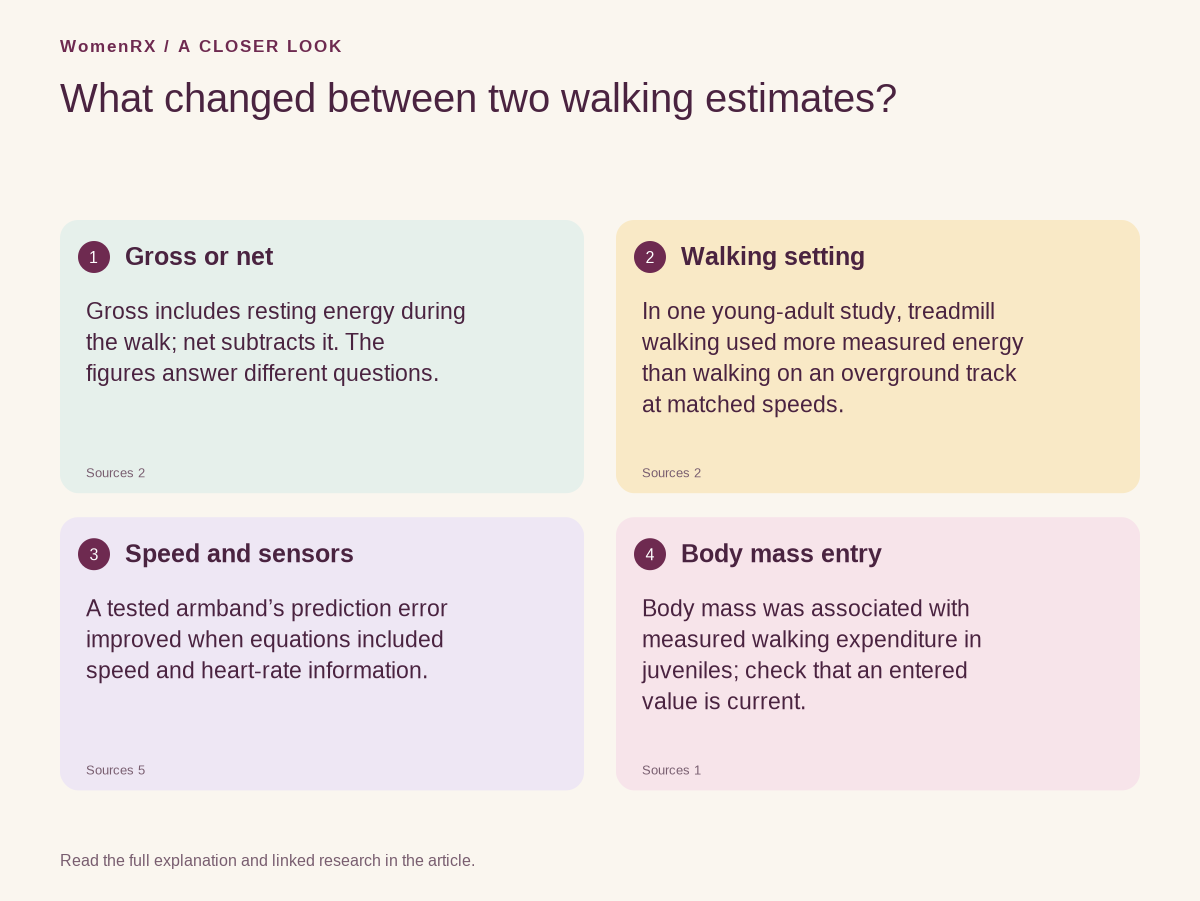
What changed between two walking estimates?
Gross or net: Gross includes resting energy during the walk; net subtracts it. The figures answer different questions.2
Walking setting: In one young-adult study, treadmill walking used more measured energy than walking on an overground track at matched speeds.2
Speed and sensors: A tested armband’s prediction error improved when equations included speed and heart-rate information.5
Body mass entry: Body mass was associated with measured walking expenditure in juveniles; check that an entered value is current.1
Read the figure as text
Compare these features before treating different calorie numbers as a disagreement about the same walk.- Gross or net: Gross includes resting energy during the walk; net subtracts it. The figures answer different questions.2
- Walking setting: In one young-adult study, treadmill walking used more measured energy than walking on an overground track at matched speeds.2
- Speed and sensors: A tested armband’s prediction error improved when equations included speed and heart-rate information.5
- Body mass entry: Body mass was associated with measured walking expenditure in juveniles; check that an entered value is current.1
More questions, answered
Is a treadmill’s calorie number the same as an outdoor walking estimate?
Not necessarily. In 20 healthy young adults, researchers measured higher gross and net energy expenditure on a treadmill than on an overground track at matched speeds. The study did not compare consumer treadmill and outdoor calorie estimates, so it cannot predict the gap between yours.2
Sources you can check
- Pelvic breadth and juvenile locomotor energetics: Implications for the obstetrical dilemma hypothesis across human growth in past and present humans.Zorrilla-Revilla G, Prado-Nóvoa O, Davy KP, Carretero JM, García-González R. · Anatomical record (Hoboken, N.J. : 2007) · 2026Return to first citation
- Use Treadmills with Caution: Walking Energy Expenditure and Metabolic Cost Are Elevated Compared to Overground Across Multiple Speeds in Healthy Young Adults.Das Gupta S, Kamishita K, Kondo M, Kobayashi Y. · Journal of functional morphology and kinesiology · 2026Return to first citation
- Relationship between gait kinematics and walking energy expenditure during pregnancy in South African women.Krkeljas Z, Moss SJ. · BMC sports science, medicine & rehabilitation · 2018Return to first citation
- Changes in resting and walking energy expenditure and walking speed during pregnancy in obese women.Byrne NM, Groves AM, McIntyre HD, Callaway LK, BAMBINO group. · The American journal of clinical nutrition · 2011Return to first citation
- Accuracy of the SenseWear Armband during Short Bouts of Exercise.Wedge RD, McCammon M, Meardon SA. · Sports (Basel, Switzerland) · 2024Return to first citation