How to Estimate Your Fertile Window From Cycle Signs
Cycle dates give you a starting point, while changing cervical mucus can help you notice fertile days as they approach.
Count cycle day 1 as the first day of your period. Your usual cycle length can suggest when to start watching for fertility signs, but it can’t pinpoint ovulation. When discharge becomes thinner and stretchy, treat that change as a clue that fertile days may be near. If cycle lengths vary, rely less on a predicted date and more on signs you see now.73
Start with a range, not a day
A fertile window is tied to ovulation, not to a fixed date on the calendar. Conception can occur from about five days before ovulation until shortly afterward. That’s why noticing signs before an egg is released is more useful than trying to identify one perfect day.2
To put your cycle dates to work, mark the first day of each period as day 1 and count through the day before the next period. Look at your usual cycle lengths rather than assuming you have a 28-day cycle. Ovulation often occurs roughly 10 to 16 days before the next period, so an estimate based on cycle length is only a place to begin watching for signs. You won’t know your next period’s start date in advance, and ovulation can shift from cycle to cycle.17
For example, if your periods tend to start about 28 days apart, you might pay closer attention to changes in discharge in the days leading up to the middle of your cycle. Day 14 is a familiar estimate for a 28-day cycle, not a rule. If your cycles are shorter or longer, that midpoint shortcut is less useful. And if their lengths vary substantially, a calendar prediction may miss the days you care about altogether.75
Let changing mucus update the estimate
As ovulation approaches, rising estrogen affects cervical mucus. Discharge around that time often becomes thinner and stretchy, sometimes resembling raw egg white. You can notice what you see or feel during ordinary bathroom visits and compare it with your own pattern earlier in the cycle. A shift toward that thinner, stretchier discharge is a practical cue that fertile days may be approaching, even when the calendar suggested a different time.347
If you’re trying to conceive and want to time sex, that change is a reason to consider the current days rather than waiting for an app’s predicted ovulation date. Keep in mind that mucus is a clue, not confirmation that ovulation happened. In a study of 528 women without known subfertility, researchers used daily observations made with a standardized, taught method; mucus patterns varied both among women and across cycles. You don’t need to make your discharge match someone else’s description exactly for your observations to be useful.3
There’s also a difference between recognizing a change as it happens and identifying a “peak” afterward. In mucus research, the peak day is defined as the last day of estrogenic-quality mucus and used to estimate ovulation. You can only know which day was last once the pattern changes again, so a peak day is not an advance appointment with ovulation or proof that it occurred.3
When the signs and calendar disagree
Suppose an app marks this weekend as fertile, but you notice thinner, stretchier discharge earlier in the week. Don’t dismiss the observation just because it arrived ahead of schedule. A calendar uses past dates; mucus reflects changes in the current cycle. Conversely, a predicted fertile day without a noticeable mucus change doesn’t establish that ovulation is happening then. An audit of fertility apps found that many relied only on menstrual dates, and the American Society for Reproductive Medicine cautions that apps have limits in predicting the fertile window.56
If you rarely notice a clear mucus pattern, or your cycles change length from month to month, you don’t have to solve the exact ovulation date to keep trying. Sex every two or three days throughout the cycle is one approach that avoids depending on a narrow prediction. Irregular cycles can sometimes mean ovulation isn’t happening regularly; if your periods are irregular and you’re having trouble getting pregnant, bring that up in a fertility evaluation rather than assuming you simply missed the right day.1
The useful distinction is this: cycle length helps you decide when to start paying attention, while a change in mucus can shift your attention to what’s happening now. Neither sign alone confirms ovulation.367
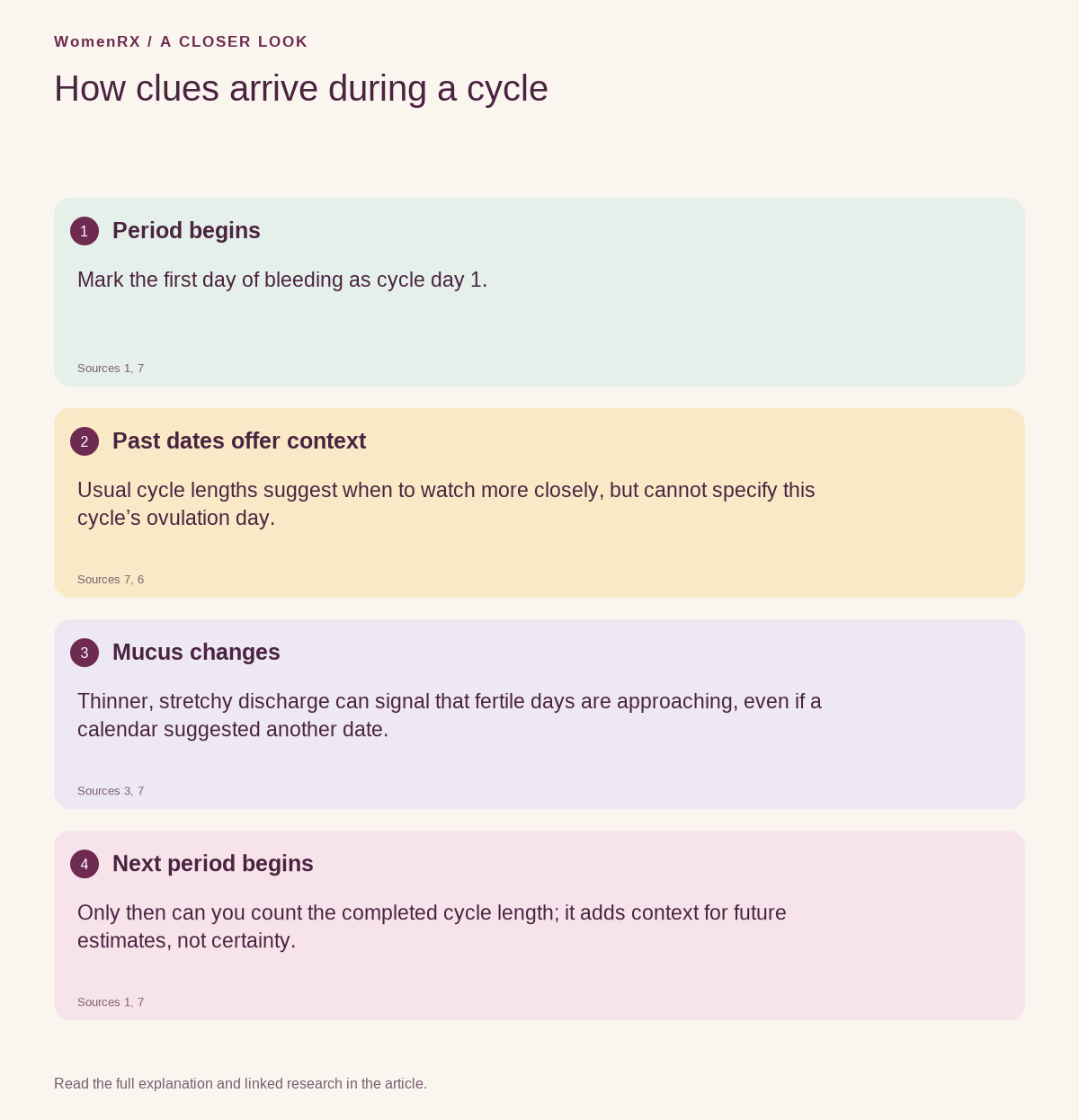
How clues arrive during a cycle
Period begins: Mark the first day of bleeding as cycle day 1.17
Past dates offer context: Usual cycle lengths suggest when to watch more closely, but cannot specify this cycle’s ovulation day.76
Mucus changes: Thinner, stretchy discharge can signal that fertile days are approaching, even if a calendar suggested another date.37
Next period begins: Only then can you count the completed cycle length; it adds context for future estimates, not certainty.17
Read the figure as text
These are observations and estimates, not fixed dates on a universal cycle calendar.- Period begins: Mark the first day of bleeding as cycle day 1.17
- Past dates offer context: Usual cycle lengths suggest when to watch more closely, but cannot specify this cycle’s ovulation day.76
- Mucus changes: Thinner, stretchy discharge can signal that fertile days are approaching, even if a calendar suggested another date.37
- Next period begins: Only then can you count the completed cycle length; it adds context for future estimates, not certainty.17
More questions, answered
Would an ovulation test help if my mucus pattern is unclear?
A urine ovulation test offers a different kind of timing clue by detecting a hormone change. In a review of randomized trials, timing intercourse with urine ovulation detection probably increased the chance of live birth compared with intercourse without ovulation prediction. The review could not establish the same benefit for fertility-awareness methods as a group, including mucus tracking. A test can be an option if you want another clue, but you don’t need one to use the every-two-or-three-days approach.21
Sources you can check
- Irregular periods - NHSAccessed 2026-09-25Return to first citation
- Timed intercourse for couples trying to conceive.Gibbons T, Reavey J, Georgiou EX, Becker CM. · The Cochrane database of systematic reviews · 2023Return to first citation
- Cervical mucus patterns and the fertile window in women without known subfertility: a pooled analysis of three cohorts.Najmabadi S, Schliep KC, Simonsen SE, Porucznik CA, Egger MJ, Stanford JB. · Human reproduction (Oxford, England) · 2021Return to first citation
- Early menstrual cycle impacts of oestrogen and progesterone on the timing of the fertile window.Ecochard R, Bouchard T, Leiva R, Abdullah SH, Boehringer H. · Human reproduction (Oxford, England) · 2024Return to first citation
- Do fertility tracking applications offer women useful information about their fertile window?Ali R, Gürtin ZB, Harper JC. · Reproductive biomedicine online · 2020Return to first citation
- Fertility evaluation of infertile women: a committee opinion (2021) | American Society for Reproductive Medicine | ASRMAccessed 2026-09-25Return to first citation
- Periods and fertility in the menstrual cycle - NHSAccessed 2026-09-25Return to first citation