How Banana Size Changes Its Calorie Estimate
A banana’s calorie estimate depends on how much fruit you eat, not simply whether it looks small or large.
USDA reference data lists raw banana at 89 calories per 100 grams of edible fruit. Among its size-based examples, a small banana has about 90 calories and a large one about 121; the entry also includes extra-small and extra-large categories. For a closer estimate, weigh the banana after peeling and use that edible weight rather than a visual size label. 2
The size label is a starting point
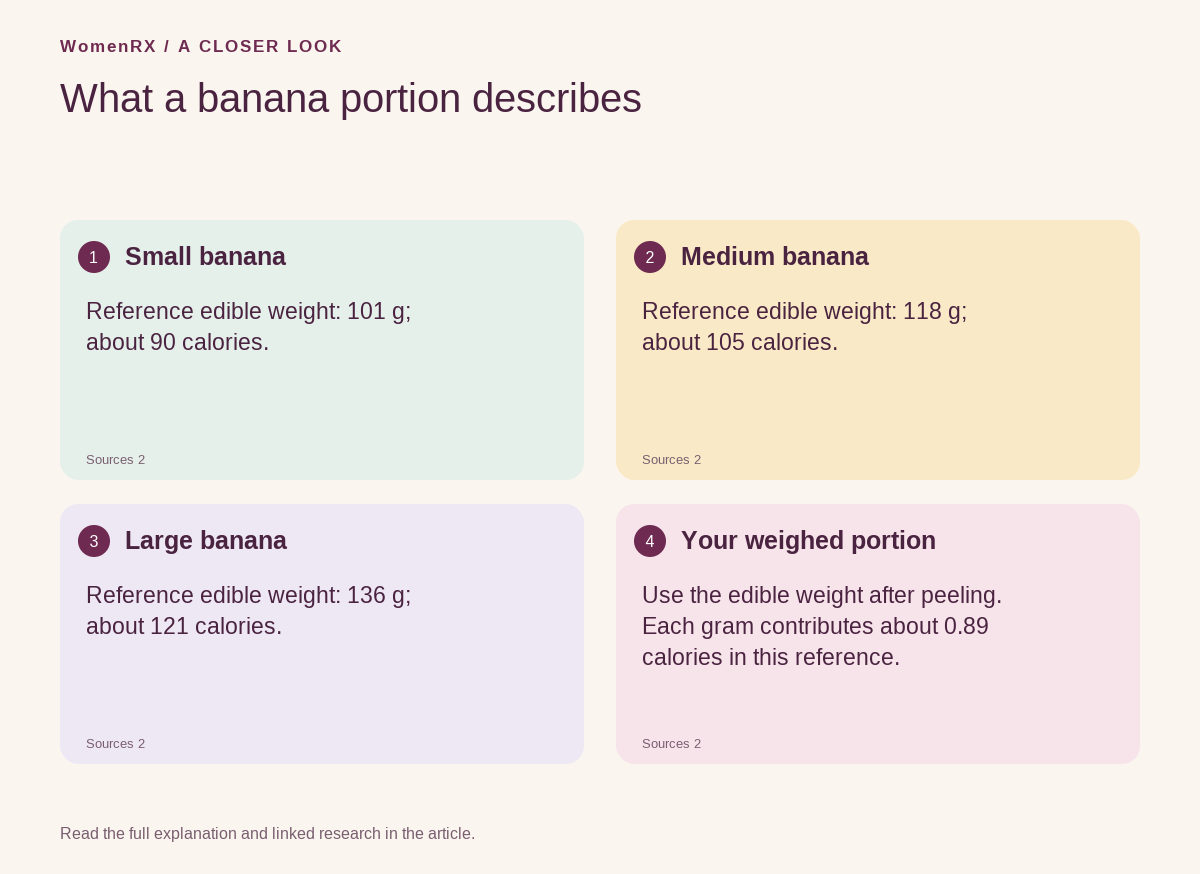
A banana isn’t one fixed-calorie serving. In USDA’s raw-banana reference, a small banana is listed as 101 grams of edible fruit, or about 90 calories. A medium is 118 grams, or about 105 calories; a large is 136 grams, or about 121 calories. Those numbers change because the reference portions contain different amounts of fruit. 2
The labels describe length, not a measurement of the banana in your hand. USDA defines small as 6 to 6⅞ inches long, medium as 7 to 7⅞ inches, and large as 8 to 8⅞ inches. They’re useful for a quick estimate, but each label is paired with a reference weight. Your banana may have a different edible weight even if its length fits the category. 2
If you weigh it, weigh the part you eat
The USDA entry gives 89 calories per 100 grams of raw banana. To estimate another portion, multiply its edible weight in grams by 0.89. For example, 150 grams of banana works out to about 134 calories. Weigh it after peeling so the scale measures the fruit you’re counting. 2
That approach also works when you eat only part of a banana. Instead of deciding whether the remaining piece looks like “half a medium,” weigh the piece you actually eat. If a scale isn’t handy, a size label is still a reasonable way to make an approximate entry. Just treat it as an estimate, not a precise reading of that particular banana. 2
Check what a listed serving means
Different serving descriptions answer different questions. In the same USDA entry, the reference portion called an “NLEA serving” weighs 126 grams and works out to about 112 calories. A cup of sliced banana is listed at 150 grams, or about 134 calories. Neither description tells you the weight of every individual banana or every cup you fill. The gram weight beside the serving is what explains its calorie estimate. 2
So when two calorie counts for “a banana” don’t match, first look at their portion definitions. One may mean a medium fruit; another may mean a different edible weight or a cup of slices. For your own portion, use its edible weight when you have it, or pick the description that comes closest when you don’t. 2
A calorie estimate can help you understand a portion without turning the banana into a verdict on your eating. A healthy eating pattern provides energy and nutrients across the foods and drinks you regularly choose; it doesn’t depend on treating any single food as the whole story. 1
What a banana portion describes
Small banana: Reference edible weight: 101 g; about 90 calories.2
Medium banana: Reference edible weight: 118 g; about 105 calories.2
Large banana: Reference edible weight: 136 g; about 121 calories.2
Your weighed portion: Use the edible weight after peeling. Each gram contributes about 0.89 calories in this reference.2
Read the figure as text
USDA reference portions show why a size label and a weighed portion may produce different calorie estimates.- Small banana: Reference edible weight: 101 g; about 90 calories.2
- Medium banana: Reference edible weight: 118 g; about 105 calories.2
- Large banana: Reference edible weight: 136 g; about 121 calories.2
- Your weighed portion: Use the edible weight after peeling. Each gram contributes about 0.89 calories in this reference.2
Sources you can check
- Nutrition: MedlinePlusAccessed 2026-09-25Return to first citation
- USDA SR Legacy reference composition: bananaAccessed 2026-09-25Return to first citation