Banana Nutrition: What Ripeness and Serving Size Change
A banana offers carbohydrates, fiber, potassium, and vitamin B6, while size matters more than ripeness for the nutrition figures you can reliably compare.
A raw banana provides mostly carbohydrate, along with some fiber, potassium, and vitamin B6. It isn’t a meaningful protein source: a 126-gram reference serving has about 1.4 grams. 613 Choose ripeness for how you want to eat it. The available figures don’t establish a reliable nutrient advantage for a greener or browner banana. 57
What’s in a banana?
For a useful starting point, USDA’s raw-banana reference serving weighs 126 grams of edible fruit. It provides about 112 calories, 29 grams of carbohydrate, 3.3 grams of fiber, and 1.4 grams of protein. That makes a banana a fruit with some fiber, not a stand-in for a protein-rich food. 6
It also contributes potassium and vitamin B6. NIH food tables list about 422 milligrams of potassium and 0.4 milligrams of vitamin B6 for one medium banana. Those tables describe a medium banana, while the USDA figures above describe a 126-gram reference serving, so treat them as useful examples rather than one precisely matched set of measurements. 316
Fiber is one reason a banana can be a satisfying part of a snack. Fruit is a source of dietary fiber, which helps with fullness and digestion, but a banana needn’t supply all the fiber you’re looking for in a day. Other fruits, vegetables, whole grains, nuts, and seeds can contribute too. 26
Should you pick green, yellow, or spotted?
Pick the banana you’ll enjoy and can use. For example, a firmer one may suit slices, while a softer one may be easier to mash into oatmeal. Those are kitchen choices, not reasons to expect one stage to treat a symptom or deliver a proven health benefit.
Ripeness does matter to the fruit’s composition, but the numbers here don’t support a universal rule such as “green bananas have more fiber” or “ripe bananas have less potassium.” A study describing one particular banana cultivar reports starch measurements for green fruit and soluble-solids measurements for ripe fruit. It doesn’t provide a directly comparable nutrition panel for the common ripeness stages you might choose at a grocery store. USDA’s raw-banana reference figures also don’t specify a ripeness stage. 57
So if a banana tastes better to you when it’s just yellow, there’s no reason to force yourself to eat it green for a presumed nutrition upgrade. Likewise, a spotted banana can still be useful for mashing. The dependable way to compare how much banana you’re eating is by the amount of fruit, not by the peel color. 7
Sliced and mashed: the cup-size trap
Slicing or mashing doesn’t turn a banana into a different food. But a cup of each holds a different amount. USDA lists a cup of sliced raw banana at 150 grams and a cup of mashed raw banana at 225 grams. Using its per-100-gram figures, that works out to about 134 versus 200 calories and 3.9 versus 5.9 grams of fiber, respectively. The larger totals reflect more banana in the mashed cup, not a nutrient boost from mashing. 7
That distinction is handy when you’re adding banana to a bowl or a recipe. One sliced banana is still one banana, even if you spread it across a large bowl. A measured cup of mashed banana may take more fruit than you expected. If protein is what you want from that meal, plan on another food to provide it; banana itself contributes little. 67
Is there a special benefit for women?
The banana’s food profile isn’t specific to women. Nutrient needs can change with life stage: for example, the recommended vitamin B6 intake rises during pregnancy, and bananas are one food that contains B6. That doesn’t mean eating bananas has been shown to relieve pregnancy nausea. Research on B6 supplements for nausea is a different question from research on eating bananas. 41
The useful takeaway is simpler: choose the ripeness and form that fit your taste and meal, and use the amount of banana, rather than a claim about peel color, to put its nutrition figures in context. 67
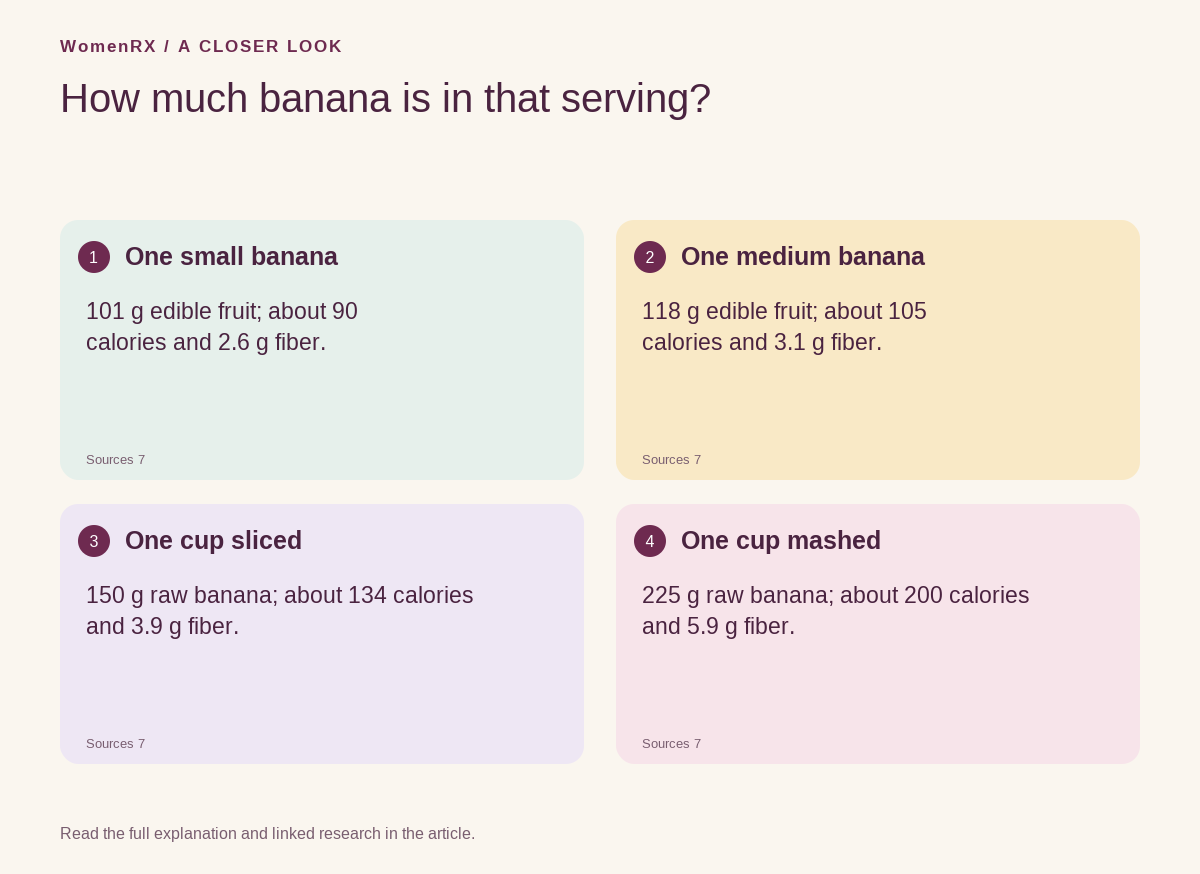
How much banana is in that serving?
One small banana: 101 g edible fruit; about 90 calories and 2.6 g fiber.7
One medium banana: 118 g edible fruit; about 105 calories and 3.1 g fiber.7
One cup sliced: 150 g raw banana; about 134 calories and 3.9 g fiber.7
One cup mashed: 225 g raw banana; about 200 calories and 5.9 g fiber.7
Read the figure as text
These are raw-banana reference amounts. The sliced and mashed cups differ because they contain different weights of fruit, not because mashing adds nutrients.Sources you can check
- Vitamin B6 - Health Professional Fact SheetAccessed 2026-09-25Return to first citation
- Dietary Fiber: MedlinePlusAccessed 2026-09-25Return to first citation
- Potassium - Health Professional Fact SheetAccessed 2026-09-25Return to first citation
- Dietary Supplements and Life Stages: Pregnancy - Health Professional Fact SheetAccessed 2026-09-25Return to first citation
- A Sustainable Approach to Phosphorus Nutrition in Banana Plantations.Cândido HT, Leonel M, Leonel S, Fernandes AM, Souza JMA, Dos Ouros LF, de Jesus PRR. · Plants (Basel, Switzerland) · 2025Return to first citation
- USDA SR Legacy: Bananas, raw (FDC 173944)Accessed 2026-09-25Return to first citation
- USDA SR Legacy reference composition: bananaAccessed 2026-09-25Return to first citation