Sea Moss Supplements: Check Iodine Before the Serving Size
The weight of sea moss in a serving doesn’t tell you its iodine content, so check the label and your own iodine needs before deciding.
There’s no universal sea moss dose established for a health benefit, and a serving’s seaweed weight can’t tell you how much iodine it provides. Seaweed iodine varies widely. Look for the specific species, serving amount, a separately listed iodine amount, and product-specific quality information. Pregnancy, breastfeeding, or thyroid care are good reasons to review the product in the context of your overall iodine intake. 1 2
Seaweed weight and iodine are different numbers
A supplement label might list a serving’s sea moss weight without stating its iodine content. You can’t reliably calculate the iodine from the seaweed weight alone: NIH’s Office of Dietary Supplements reports iodine concentrations ranging from 16 to 2,984 micrograms per gram among commercially available whole or sheet seaweeds. That range isn’t a measurement of every sea moss supplement, but it shows why grams of seaweed aren’t a dependable stand-in for iodine. 1
A small study measured iodine in 30 samples of two red seaweeds, including Irish moss (Chondrus crispus). Those results describe the samples tested, not every product or batch. They can’t tell you the iodine content of a supplement that doesn’t disclose it. 2
An iodine reference and a small analysis of red seaweed samples can help explain label uncertainty, but they don’t establish a sea moss supplement dose for a health benefit. A product’s serving size is not, by itself, a proven effective or safe dose.
A practical label check
- Identify the stated seaweed. Look for a specific species name, such as Chondrus crispus, rather than only “sea moss.” A name helps you see what the product claims to contain; it doesn’t establish iodine content. 2
- Note the serving amount. Record the seaweed amount, but keep it separate from iodine. They measure different things. 1
- Look for iodine listed separately. If the label doesn’t give an iodine amount, you can’t use its seaweed weight to calculate the product’s contribution. Also consider iodine from food and any other supplements. Some multivitamins contain iodine, while some prenatal supplements do and some don’t. 1
- Look for product-specific quality information. Check what testing is described and whether it applies to the product you’re considering. Seaweeds can accumulate contaminants, and a study of 17 New Caledonian species found contaminant levels varied by species, site, and habitat. Those findings don’t establish the quality of products sold in the United States, but they show why broad claims about seaweed aren’t a substitute for product-specific information. 3
When your circumstances matter
Iodine is used to make thyroid hormones, and it’s relevant to fetal and infant development. Breast milk contains iodine, with levels varying according to the mother’s iodine status. If you’re pregnant or breastfeeding, consider the product alongside food and other supplements rather than treating a sea moss serving as a stand-alone iodine target. 1
If you’re being treated for a thyroid condition, ask the clinician managing that care whether a product with a stated, variable, or undisclosed iodine amount makes sense for you. The available research described above doesn’t define a sea moss dose or a specific interaction with thyroid treatment. 1 2
If iodine isn’t listed, the label leaves a central question unanswered. You can still compare the named ingredient, serving size, and quality details, but you can’t determine the supplement’s iodine contribution from the seaweed weight alone.
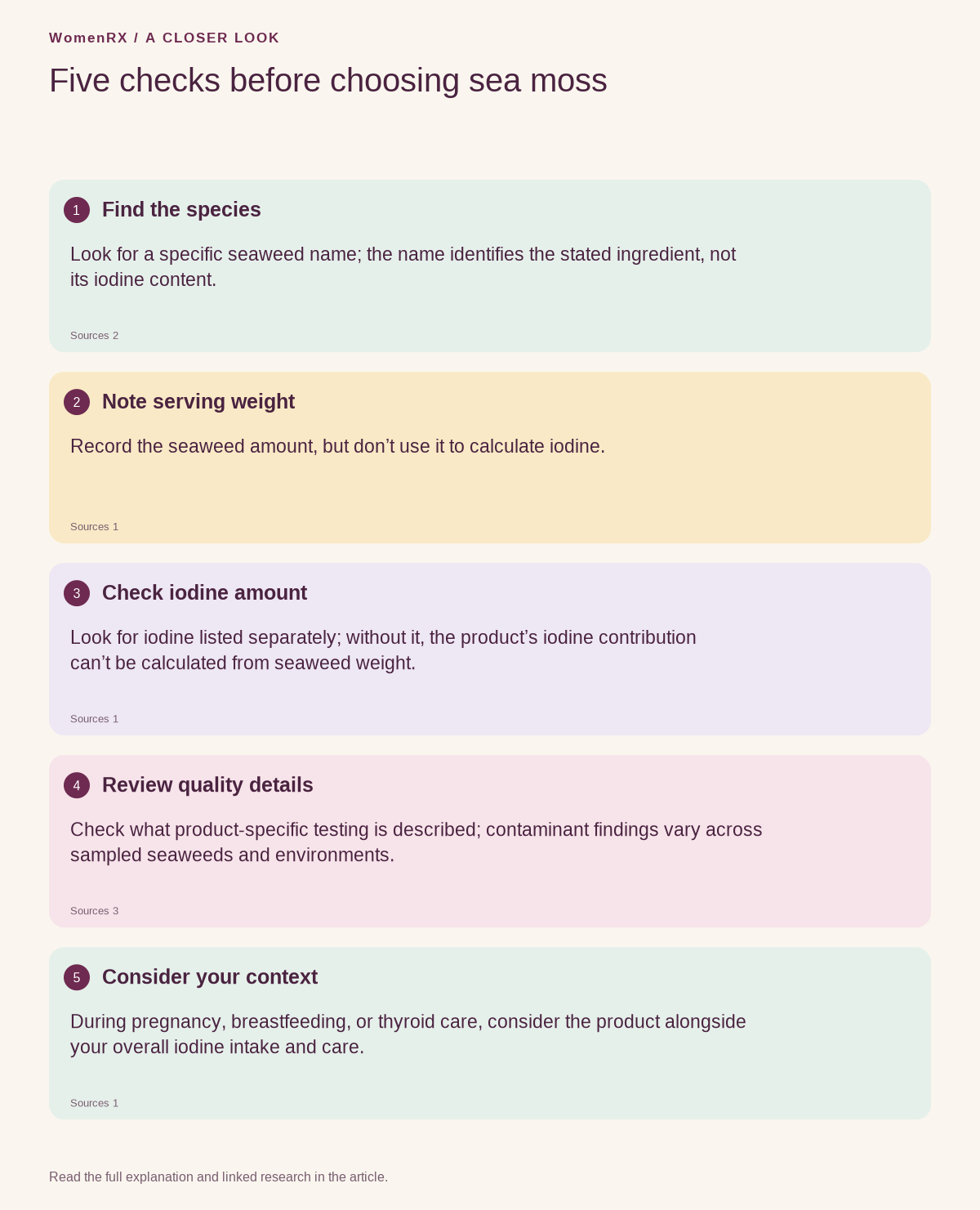
Five checks before choosing sea moss
Find the species: Look for a specific seaweed name; the name identifies the stated ingredient, not its iodine content.2
Note serving weight: Record the seaweed amount, but don’t use it to calculate iodine.1
Check iodine amount: Look for iodine listed separately; without it, the product’s iodine contribution can’t be calculated from seaweed weight.1
Review quality details: Check what product-specific testing is described; contaminant findings vary across sampled seaweeds and environments.3
Consider your context: During pregnancy, breastfeeding, or thyroid care, consider the product alongside your overall iodine intake and care.1
Read the figure as text
Separate the product’s stated seaweed amount from iodine content, then check what the label can and can’t tell you.- Find the species: Look for a specific seaweed name; the name identifies the stated ingredient, not its iodine content.2
- Note serving weight: Record the seaweed amount, but don’t use it to calculate iodine.1
- Check iodine amount: Look for iodine listed separately; without it, the product’s iodine contribution can’t be calculated from seaweed weight.1
- Review quality details: Check what product-specific testing is described; contaminant findings vary across sampled seaweeds and environments.3
- Consider your context: During pregnancy, breastfeeding, or thyroid care, consider the product alongside your overall iodine intake and care.1
More questions, answered
Does “sea moss” on a label tell me which seaweed it contains?
Not necessarily. Look for a specific species name, such as Chondrus crispus. Even when a species is named, that doesn’t tell you the product’s iodine amount unless iodine is listed separately. 1 2
Sources you can check
- Iodine - Health Professional Fact SheetAccessed 2026-09-25Return to first citation
- Risk assessment of iodine intake from the consumption of red seaweeds (Palmaria palmata and Chondrus crispus).Darias-Rosales J, Rubio C, Gutiérrez ÁJ, Paz S, Hardisson A. · Environmental science and pollution research international · 2020Return to first citation
- Assessment of contaminant concentrations and nutritional value of New Caledonian seaweeds.Lagourgue L, Payri CE, Zubia M, Robert V, Waeles M, Vanderklift MA, Steven A, Mattio L. · Marine pollution bulletin · 2025Return to first citation