Sea Moss Supplements: What to Check Before You Buy
Sea moss can contain iodine, but its name alone won’t tell you the amount or whether a supplement will help your thyroid.
Sea moss may add iodine to your diet, but it isn’t a proven way to improve thyroid function or immunity. If you’re considering a product, check its seaweed species, iodine amount for the serving you’d take, and batch-specific results for iodine and contaminants. Without those details, it’s hard to judge what you’re getting, especially during pregnancy or breastfeeding or if you have a thyroid condition. 145
First, decide what you want it to do
Sea moss, also called Irish moss when it refers to Chondrus crispus, is a red seaweed. It contains minerals, including iodine. Iodine helps your body make thyroid hormones, so getting enough matters. But a supplement’s nutrient content doesn’t show that taking it improves thyroid function when your iodine intake is already adequate. Nor is sea moss a proven way to prevent infections or improve general wellness. 15
If your goal is iodine, the useful question is not “Does sea moss have minerals?” It’s “How much iodine would this serving add to what I already get?” Iodized salt, seafood, dairy foods, and eggs can contribute iodine; some multivitamins and prenatal supplements contain it too. If you eat few or none of those foods, your intake may deserve a closer look, but sea moss isn’t the only possible source. 1
Why the iodine number matters more than the seaweed name
Iodine content differs substantially among seaweed species. The NIH Office of Dietary Supplements reports a wide range in commercially available whole or sheet seaweeds, but that range cannot tell you the iodine amount in a particular sea moss capsule, powder, or gel. An analysis of 30 samples of two red seaweeds, including Chondrus crispus, also found variation. A species name helps identify what’s being sold; it does not replace a measured amount for that product. 12
Check the iodine amount in micrograms, then check what serving that number describes. Is it one capsule, several capsules, a scoop, or a portion of prepared gel? If iodine isn’t stated, you cannot reliably calculate how much the product adds to your daily intake. If a company offers a test result, make sure it identifies the batch and the form you would actually use.
More iodine is not automatically better for your thyroid. Excess exposure can contribute to thyroid problems, including hyperthyroidism in susceptible people. In a non-randomized Norwegian study, 49 habitual consumers of several kinds of seaweed stopped eating seaweed for six weeks. Their median estimated iodine intake fell from 658 to 189 micrograms per day, and median TSH, a blood marker used to assess thyroid function, decreased. This was not a sea moss supplement trial. It does show why adding an uncertain iodine source can matter. 69
For adults in the US, the recommended iodine intake is 150 micrograms a day; the adult upper limit cited in iodine risk research is 1,100 micrograms a day from all sources, not a goal to aim for. If you have a thyroid condition, don’t treat an iodine-rich product as a substitute for your thyroid care. The decision depends on your condition and how much iodine the product would add. 129
Ask for results, not just a “pure” claim
Seaweeds can also take up elements you may not want in a supplement. Studies of edible seaweeds have measured arsenic, cadmium, and lead, with composition differing across species and samples. That does not mean every sea moss product contains harmful amounts. It means a general purity claim cannot answer the question for the jar in your hand. 34
Look for batch-specific results that name the product, identify what was tested, and report the findings for iodine and relevant contaminants. For arsenic, a result that distinguishes its chemical forms can be more informative than a total-arsenic number alone: one seaweed analysis found that arsenosugars made up the highest concentrations among the arsenic compounds it detected. Testing makes a product easier to assess; it does not prove a health benefit or guarantee that it suits your circumstances. 3
Use these four checks together:
- Species: Does the label give a scientific name, rather than only “sea moss”?
- Iodine: Is there an amount in micrograms for the serving you’d use?
- Serving: Can you tell whether that amount applies to a capsule, powder, or prepared gel?
- Batch results: Can you see results for that product’s iodine and relevant contaminants?
If a seller cannot answer the iodine and testing questions, passing on the product is a reasonable choice, particularly when you’re trying to meet a specific nutrient need. 134
Pregnancy and breastfeeding change the calculation
Recommended total iodine intake rises to 220 micrograms a day during pregnancy and 290 micrograms a day during lactation. Those figures describe daily intake from all sources, not a sea moss dose. Some prenatal supplements contain iodine and some do not, so checking your existing supplement label is more useful than assuming you need to add seaweed. A product with an unknown iodine amount is a poor way to address a known intake gap during pregnancy. 1
Breastfeeding brings an additional concern: reports have linked excess maternal iodine from seaweed with thyroid suppression in breastfed infants. A sea moss review advises avoiding it during breastfeeding unless its iodine and heavy-metal levels have been shown low enough to be safe. That precaution is about excessive or uncertain exposure, not about avoiding the iodine you and your baby need. 58
A Korean observational study offers a narrower finding, not an all-clear for sea moss: among 81 women who completed a one-year follow-up after postpartum seaweed intake, researchers found no significant difference in maternal thyroid hormone abnormalities across iodine-intake groups. The study involved a different seaweed, had substantial loss to follow-up, and could not rule out effects. It also did not test sea moss supplements or resolve the concern about infant exposure through breast milk. 7
If you’re considering sea moss because you suspect low iodine intake, start with the iodine sources you already use, including any prenatal or multivitamin. If the purpose is to treat a thyroid problem or support pregnancy or breastfeeding, a source with a clearly stated iodine amount gives you a more useful basis for a conversation with your thyroid or pregnancy care team than a wellness claim does. 159
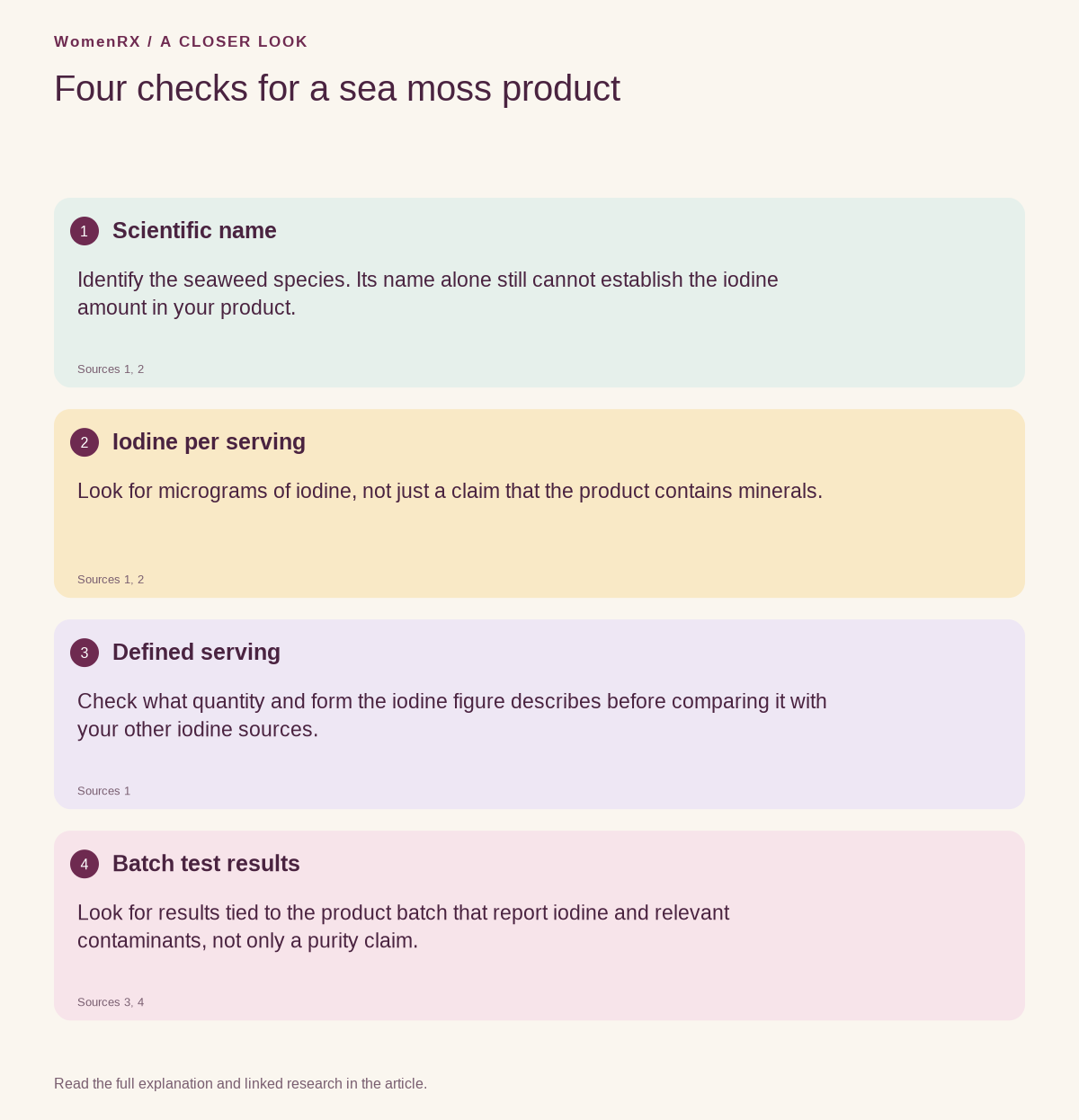
Four checks for a sea moss product
Scientific name: Identify the seaweed species. Its name alone still cannot establish the iodine amount in your product.12
Iodine per serving: Look for micrograms of iodine, not just a claim that the product contains minerals.12
Defined serving: Check what quantity and form the iodine figure describes before comparing it with your other iodine sources.1
Batch test results: Look for results tied to the product batch that report iodine and relevant contaminants, not only a purity claim.34
Read the figure as text
These are the details that turn a broad ingredient claim into information you can assess. The same four checks appear in the article text.- Scientific name: Identify the seaweed species. Its name alone still cannot establish the iodine amount in your product.12
- Iodine per serving: Look for micrograms of iodine, not just a claim that the product contains minerals.12
- Defined serving: Check what quantity and form the iodine figure describes before comparing it with your other iodine sources.1
- Batch test results: Look for results tied to the product batch that report iodine and relevant contaminants, not only a purity claim.34
More questions, answered
Does sea salt provide the iodine I need?
Not necessarily. Specialty salts, including sea salt, are usually not iodized; the label should say whether iodine or iodide has been added. Most salt in commercially prepared foods is not iodized either. 1
Sources you can check
- Iodine - Health Professional Fact SheetAccessed 2026-09-25Return to first citation
- Risk assessment of iodine intake from the consumption of red seaweeds (Palmaria palmata and Chondrus crispus).Darias-Rosales J, Rubio C, Gutiérrez ÁJ, Paz S, Hardisson A. · Environmental science and pollution research international · 2020Return to first citation
- Determination of water-soluble arsenic compounds in commercial edible seaweed by LC-ICPMS.Llorente-Mirandes T, Ruiz-Chancho MJ, Barbero M, Rubio R, López-Sánchez JF. · Journal of agricultural and food chemistry · 2011Return to first citation
- Essential and toxic elements in seaweeds for human consumption.Desideri D, Cantaluppi C, Ceccotto F, Meli MA, Roselli C, Feduzi L. · Journal of toxicology and environmental health. Part A · 2016Return to first citation
- Sea Moss2006Return to first citation
- Impact of habitual seaweed consumption on iodine nutrition and thyroid function: a non-randomized pre-post clinical study.Aakre I, Vogt EC, Myrmel LS, Lundebye AK, Helland OB, Henjum S, Dahl L, Markhus MW, Sleire SN, Løkken SJ, Rosendahl-Riise H. · European journal of nutrition · 2026Return to first citation
- Seaweed-Derived Iodine Intake During the Korean Postpartum Period: A 1-Year Follow-Up Study.Choi J, Lee SA, Yoon NY, Lee HJ. · Healthcare (Basel, Switzerland) · 2026Return to first citation
- Iodine2006Return to first citation
- Iodine and Hyperthyroidism: A Double-Edged Sword.Braverman KD, Pearce EN. · Endocrine practice : official journal of the American College of Endocrinology and the American Association of Clinical Endocrinologists · 2025Return to first citation