What to Check Before Taking Sea Moss Long Term
A sea moss label may not tell you how much iodine you’ll get, so check the ingredient, serving details, and product-specific test results before making it a regular habit.
Before taking sea moss regularly, check whether the ingredient is identified as Chondrus crispus, what form and serving size the product has, and whether its iodine amount and contaminant test results are available for the specific product or batch. Seaweed iodine varies, and limited sample studies can’t establish a safe long-term amount for every product. Pregnancy, breastfeeding, and thyroid health are reasons to review the exact product with your care team. 1 2 3 4
Start with what the product actually names
A review identifies sea moss, also called Irish moss, as Chondrus crispus. That’s a useful detail to look for in the ingredient list. Gracilaria is a different red seaweed: a study measured iodine in samples from four growing areas, but that study does not establish that Gracilaria is an ingredient in products sold as sea moss. Keep results for one seaweed species separate from claims about another. 2 4
Also note the product form, serving size, and any other seaweed ingredients. A dried seaweed, powder, or prepared product may be hard to compare by name alone. If the species or amount per serving isn’t clear, ask the manufacturer for those details rather than assuming the front label tells the whole story.
Look for iodine in micrograms per serving
Iodine helps the body make thyroid hormones, but the amount in seaweed varies substantially. The NIH Office of Dietary Supplements reports wide differences among seaweed species. In a study of 30 red-seaweed samples, iodine was measured in Irish moss and dulse; a separate study found different iodine measurements among Gracilaria samples from four cultivation areas in Indonesia. These findings show why a product name alone can’t reliably tell you its iodine content. They don’t predict the amount in the product you have. 1 3 4
If the label states iodine, note the amount in micrograms (mcg) per serving. If it doesn’t, ask whether the manufacturer can provide an iodine result for the finished product and, if possible, the batch being sold. Without a measured amount, the contribution is unknown, not necessarily zero.
For context, the recommended iodine intake is 150 mcg per day for adults and 220 mcg per day during pregnancy. These recommendations cover total daily intake from all sources; they aren’t a target for sea moss. For adults, the tolerable upper intake level is 1,100 mcg per day for total iodine intake. That’s an upper limit, not a recommended amount or a sea moss-specific safe dose. 1 3 Some prenatal supplements contain iodine and some do not, so check the specific label rather than assuming. 1
Ask what contaminant testing covers
A review notes that sea moss can contain heavy metals, including arsenic, lead, cadmium, and mercury, associated with the water where it was grown. That does not tell you the level in a particular product. 2
If you’re considering regular use, ask the seller whether it can provide test results for the specific product or batch, what substances were tested, and whether the results apply to the finished product. A general “lab tested” statement doesn’t tell you what was measured or what the results were. Testing information can help answer questions about a particular product, but it can’t establish safety for every person or prove that use over years is safe.
Put your own iodine needs in context
If you have a thyroid condition, take the product label and any available test results to your care team before making sea moss a regular part of your routine. The practical question is how this product might add to the iodine you get from food and other supplements. The available evidence here doesn’t establish a single safe long-term sea moss amount for people with thyroid conditions.
During pregnancy, iodine needs are higher, but sea moss is not a dependable way to meet them when the product’s iodine amount is unknown. Check your prenatal supplement’s label and discuss your overall iodine intake with your pregnancy care team. 1
Breastfeeding deserves particular care too. The review describes thyroid suppression in breastfed infants after mothers consumed excess iodine from seaweed. It advises avoiding sea moss during breastfeeding unless iodine and heavy-metal levels have been shown to be low enough to be safe. 2
What a long-term decision can, and can’t, rely on
Before deciding about regular use, gather the species name, product form, serving size, iodine amount if available, and any batch-specific test results. Note how often you intend to use it and share those details when discussing it with a care professional, especially if pregnancy, breastfeeding, or thyroid health is relevant.
This research measures particular seaweed samples, not every product on the market or the effects of taking a given product for years. For example, one study assessed 30 red-seaweed samples, while another tested Gracilaria from four growing areas. Neither establishes a safe long-term amount for all sea moss products. If key details such as the iodine amount or test results are unavailable, that uncertainty is part of the decision, not a reason to guess. 3 4
Sea Moss: Details to Check
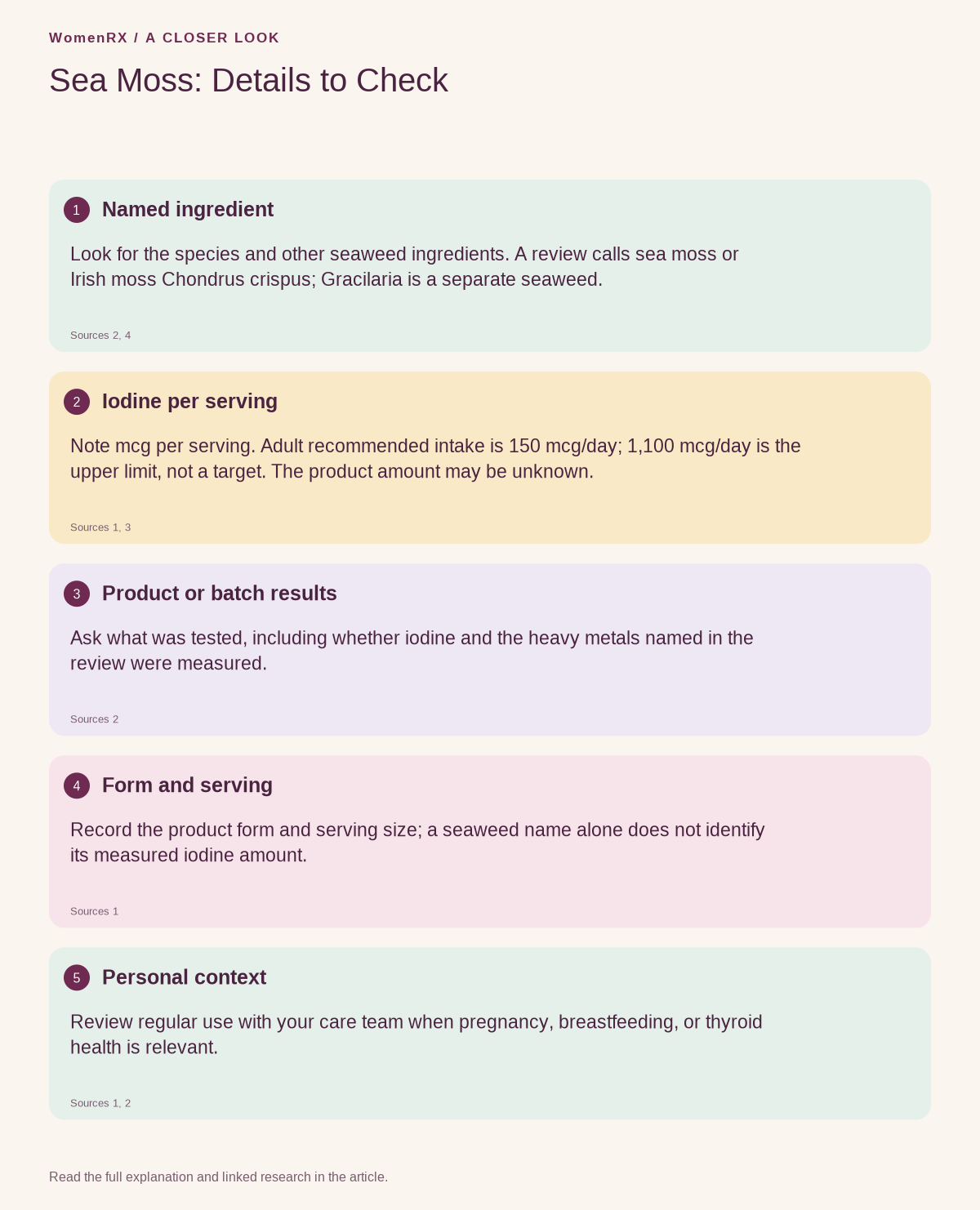
Named ingredient: Look for the species and other seaweed ingredients. A review calls sea moss or Irish moss Chondrus crispus; Gracilaria is a separate seaweed.24
Iodine per serving: Note mcg per serving. Adult recommended intake is 150 mcg/day; 1,100 mcg/day is the upper limit, not a target. The product amount may be unknown.13
Product or batch results: Ask what was tested, including whether iodine and the heavy metals named in the review were measured.2
Form and serving: Record the product form and serving size; a seaweed name alone does not identify its measured iodine amount.1
Personal context: Review regular use with your care team when pregnancy, breastfeeding, or thyroid health is relevant.12
Read the figure as text
Use these checks to distinguish what a product label or test result tells you from what remains uncertain.- Named ingredient: Look for the species and other seaweed ingredients. A review calls sea moss or Irish moss Chondrus crispus; Gracilaria is a separate seaweed.24
- Iodine per serving: Note mcg per serving. Adult recommended intake is 150 mcg/day; 1,100 mcg/day is the upper limit, not a target. The product amount may be unknown.13
- Product or batch results: Ask what was tested, including whether iodine and the heavy metals named in the review were measured.2
- Form and serving: Record the product form and serving size; a seaweed name alone does not identify its measured iodine amount.1
- Personal context: Review regular use with your care team when pregnancy, breastfeeding, or thyroid health is relevant.12
More questions, answered
Can sea moss meet my iodine needs during pregnancy?
It’s not a dependable choice when the product’s iodine amount is unknown. The recommended intake during pregnancy is 220 mcg per day from all sources. Check the iodine amount on your prenatal supplement’s label and discuss your overall intake with your pregnancy care team. 1
Does “natural” tell me how much iodine or heavy metal is in a product?
No. Those words don’t provide a measured iodine amount or tell you what contaminants, if any, were found in a particular batch. Ask the seller for the relevant product or batch results if they aren’t provided. 2
Sources you can check
- Iodine - Health Professional Fact SheetAccessed 2026-09-25Return to first citation
- Sea Moss2006Return to first citation
- Risk assessment of iodine intake from the consumption of red seaweeds (Palmaria palmata and Chondrus crispus).Darias-Rosales J, Rubio C, Gutiérrez ÁJ, Paz S, Hardisson A. · Environmental science and pollution research international · 2020Return to first citation
- Dataset on the chemical composition and bioactive compound of estuarine seaweed Gracilaria from four different cultivation area in Java and Lombok Island, Indonesia.Purwaningsih S, Ramadhan W, Nabila WT, Deskawati E, Baabud HM. · Data in brief · 2024Return to first citation