Sea Moss Benefits: What Human Studies Actually Show
Research on *Chondrus crispus* and *Gracilaria* has examined lab findings, not health outcomes in women taking a supplement.
The available Chondrus crispus and Gracilaria research doesn’t show that taking a sea moss supplement improves health in people. It examines protein composition, gut microbes in a lab model, or isolated cells. Those findings can suggest questions for future research, but they aren’t proof of a benefit for women, or for any particular sea moss product. 1 2 3
Start with the species, not the promise
“Sea moss” isn’t a single standardized ingredient. The relevant research examines Chondrus crispus and Gracilaria corticata, using specific laboratory materials or extracts. A result for one species or extract can’t automatically be applied to another species, a different extract, or a finished supplement. In the Gracilaria study, for example, biological activity varied with how the seaweed was extracted. 3
That matters when you see a broad claim such as “supports gut health,” “boosts immunity,” or “improves skin.” The useful question is not just whether a seaweed-related result exists. It’s whether researchers tested the same species and product in people, and measured the outcome being claimed.
What the research does, and doesn’t, show
Protein and nutrition: Researchers used different methods to extract protein from Chondrus crispus and analyzed the resulting material in the lab. The paper describes protein composition and extraction limitations; it doesn’t test whether eating a sea moss supplement improves nutrition, energy, or another health outcome in people. 1
Gut health: A 2025 study tested three red seaweeds, including Chondrus crispus, using an in-vitro model of human gut microbiota. The researchers reported prebiotic effects for red seaweed samples, with some changes in beneficial microbial species. But this was fermentation in a lab model, not a trial in people taking a supplement. The abstract doesn’t establish that a Chondrus product improves digestion or health in women. 2
Skin, immunity, and cancer claims: Researchers studied extracted sulfated galactans from Gracilaria corticata in cell experiments. Some fractions affected human skin-cell behavior; immune effects were assessed using mouse cells, and melanoma effects using mouse cancer cells. These are early laboratory findings, not evidence that taking sea moss heals skin, changes immunity, or treats cancer in a person. 3
The distinction is easy to lose in wellness marketing: a study may use human cells without studying human participants. And even a result from a related seaweed does not establish a benefit from a sea moss supplement.
What this means for women
The research above doesn’t measure outcomes in women taking Chondrus or Gracilaria supplements. It therefore can’t tell you whether a claimed effect differs by sex or applies during the cycling years, pregnancy, postpartum, perimenopause, or after menopause. There’s no basis here to describe a sea moss benefit as women-specific.
That isn’t proof that no other human study exists. It means these lab findings can’t answer the practical question: does this particular sea moss product improve a health outcome in women?
A quick way to check a claim
When you encounter a benefit claim, look for four details:
- Species: Does the study name Chondrus crispus or a specific Gracilaria species, or is it about a different seaweed?
- Material: Did researchers test a whole seaweed, an extracted compound, or the finished supplement being sold?
- Study setting: Were participants given the product, or were cells or gut microbes studied in a lab?
- Outcome: Did the study measure the health result being promised, rather than a related lab marker?
If a claim skips these details, the evidence may be several steps removed from the product and outcome that matter to you. The clearest conclusion from this research is narrow: it offers laboratory observations, not clinical proof of sea moss supplement benefits.
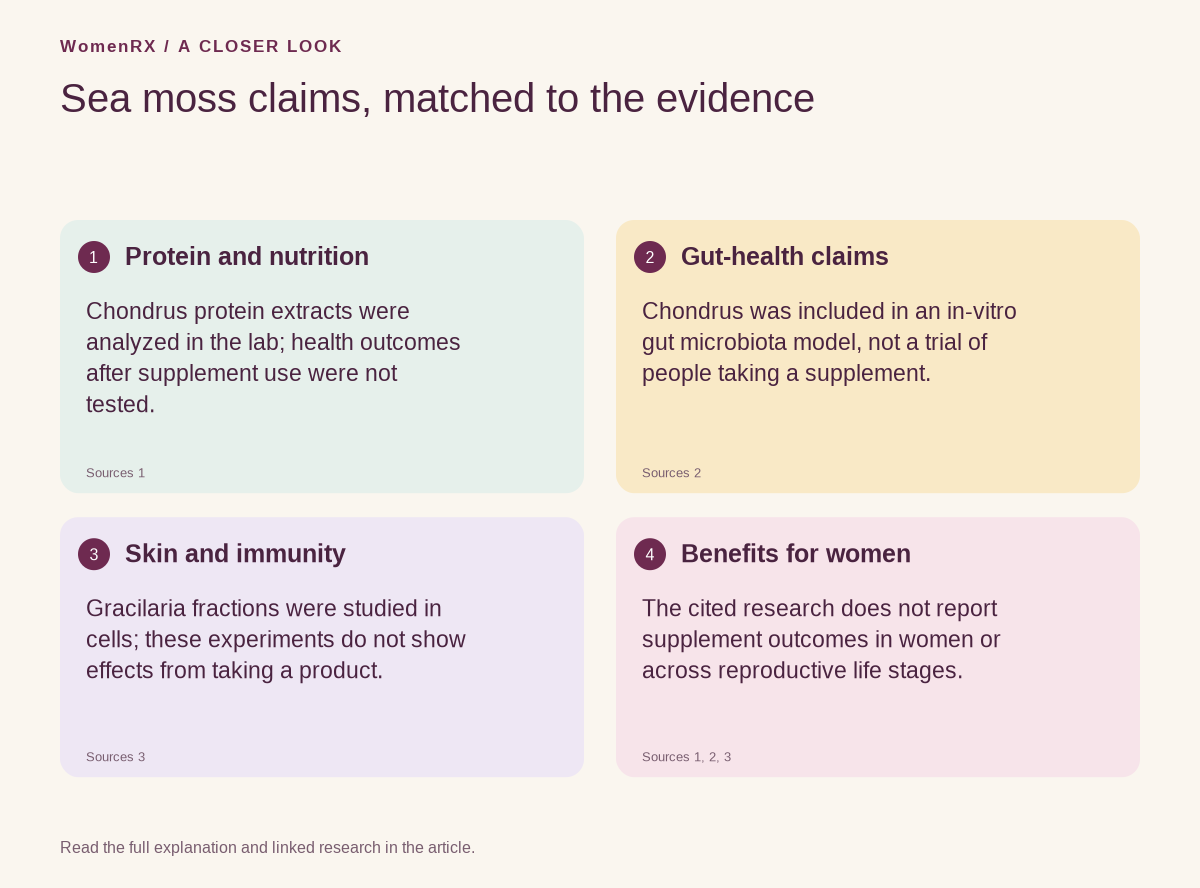
Sea moss claims, matched to the evidence
Protein and nutrition: Chondrus protein extracts were analyzed in the lab; health outcomes after supplement use were not tested.1
Gut-health claims: Chondrus was included in an in-vitro gut microbiota model, not a trial of people taking a supplement.2
Skin and immunity: Gracilaria fractions were studied in cells; these experiments do not show effects from taking a product.3
Benefits for women: The cited research does not report supplement outcomes in women or across reproductive life stages.123
Read the figure as text
These examples show how the study setting limits what you can conclude about a supplement benefit.- Protein and nutrition: Chondrus protein extracts were analyzed in the lab; health outcomes after supplement use were not tested.1
- Gut-health claims: Chondrus was included in an in-vitro gut microbiota model, not a trial of people taking a supplement.2
- Skin and immunity: Gracilaria fractions were studied in cells; these experiments do not show effects from taking a product.3
- Benefits for women: The cited research does not report supplement outcomes in women or across reproductive life stages.123
More questions, answered
Does a study using human cells count as a human clinical trial?
No. In the Gracilaria corticata research, human skin cells were studied in the lab. That is different from giving a seaweed supplement to people and measuring a health outcome. 3
Do these studies show a sea moss benefit specifically for women?
No. The cited research doesn’t report health outcomes in women taking Chondrus or Gracilaria supplements, or compare reproductive life stages. It can’t establish a women-specific benefit. 1 2 3
Sources you can check
- Protein extraction from Buckwheat, Chondrus crispus, and Spelt and assessment of nutritional benefits and limitations in vitro.Cain E, Hodgkinson SM, McNabb W, Brodkorb A, Giblin L, Hayes M. · NPJ science of food · 2025Return to first citation
- Modulatory effects of red seaweeds (Palmaria palmata, Porphyra umbilicalis and Chondrus crispus) on the human gut microbiota via an in vitro model.López-Santamarina A, Cardelle-Cobas A, Mondragón Portocarrero ADC, Cepeda Sáez A, Miranda JM. · Food chemistry · 2025Return to first citation
- Sulfated galactans from Gracilaria corticata reprogram metabolism, activate Immunity, promote regeneration, and exhibit anti-melanoma activity.Premarathna AD, Dziubinska-Kuehn KM, Sooäär A, Pushpitha NP, Shormeh Darko CN, Bai RG, Reile I, Tuvikene R. · iScience · 2026Return to first citation