Sea Moss Safety Starts With Iodine and the Label
Iodine varies among seaweed species, but that alone doesn’t tell you how much is in a particular sea moss product.
Sea moss isn’t a predictable source of iodine: amounts vary across seaweed species, and the product name alone doesn’t tell you the dose in a particular product or formulation. Iodine is needed to make thyroid hormones, but more isn’t automatically better. Check the species, serving size, iodine amount, and any testing information, and get individualized advice if you’re pregnant, breastfeeding, managing thyroid care, or taking medicines. 1 2 4
Why the species and serving matter
“Sea moss” is a broad product label, not a reliable iodine dose. Iodine levels vary among seaweed species, but that variation doesn’t establish the amount in a particular sea moss product or serving. A named species can help identify what’s in a product, but it doesn’t tell you its iodine content. 1 4
That matters because iodine is required for thyroid hormone production. The recommended intake is a target for meeting nutritional needs, not a safety ceiling. A separate reference, the tolerable upper intake level, describes the highest daily intake unlikely to cause adverse effects. NIH’s iodine fact sheet notes that some iodine supplements contain high doses, sometimes above that limit. If a sea moss label doesn’t state iodine per serving, you can’t reliably compare its contribution with your intake from food and other supplements. 1
This doesn’t mean every sea moss product is harmful. It does mean that an unknown iodine amount is hard to assess, especially if you already use an iodine-containing multivitamin or prenatal supplement.
What to check before buying or using it
Read the full label, not just the front of the package. Look for:
- Species: Does the label identify the seaweed, rather than only saying “sea moss”?
- Serving size and iodine: Is the iodine amount stated per serving? If it isn’t, the iodine dose is unknown.
- Other ingredients: Note added vitamins, minerals, and herbs so a pharmacist or clinician can review the whole product.
- Testing details: If the manufacturer provides testing information, check what it covers and whether it applies to the product or lot you’re considering. A test for metals or microbes does not establish the iodine amount; that would need to be reported separately.
Product quality isn’t identical across the category. In a 2026 study of 66 products bought from major online retailers, researchers found substantial differences in microbial and other product characteristics. They detected arsenic, cobalt, and mercury in dried products; this study doesn’t show that every product contains these substances or establish the risk from a particular product. It did not establish iodine amounts in sea moss products or evaluate a consumer testing checklist. 3
If you have a thyroid condition or take medicine
Because iodine contributes to thyroid hormone production, an unlisted or unmeasured dose is worth discussing before adding sea moss if you have a thyroid condition or have been asked to manage your iodine intake. If you’re preparing for radioactive iodine treatment, follow the low-iodine instructions from your treatment team rather than assuming a seaweed supplement is suitable. 1
There isn’t a specific sea moss-medicine interaction to assume from the product name alone. Products differ, so show a pharmacist the exact label, including the serving size and every added ingredient. That helps them assess the product you’re considering without treating all sea moss products as interchangeable.
Pregnancy and breastfeeding call for an individual check
Iodine needs rise during pregnancy and breastfeeding. NIH lists recommended intakes of 220 micrograms per day during pregnancy and 290 micrograms per day during lactation, compared with 150 micrograms per day for adults who aren’t pregnant or breastfeeding. These are total daily intake recommendations, not suggested sea moss doses. The amount in seaweed can vary, so sea moss isn’t a dependable way to fill a known iodine gap. 1
If you’re pregnant, review sea moss alongside your prenatal vitamin and usual diet with your pregnancy care team. MedlinePlus advises checking with a health care provider before taking herbs or supplements during pregnancy. 2 If you’re breastfeeding, discuss the product as part of your total iodine intake: recommended iodine intake is higher during lactation, and seaweed iodine content varies. 1
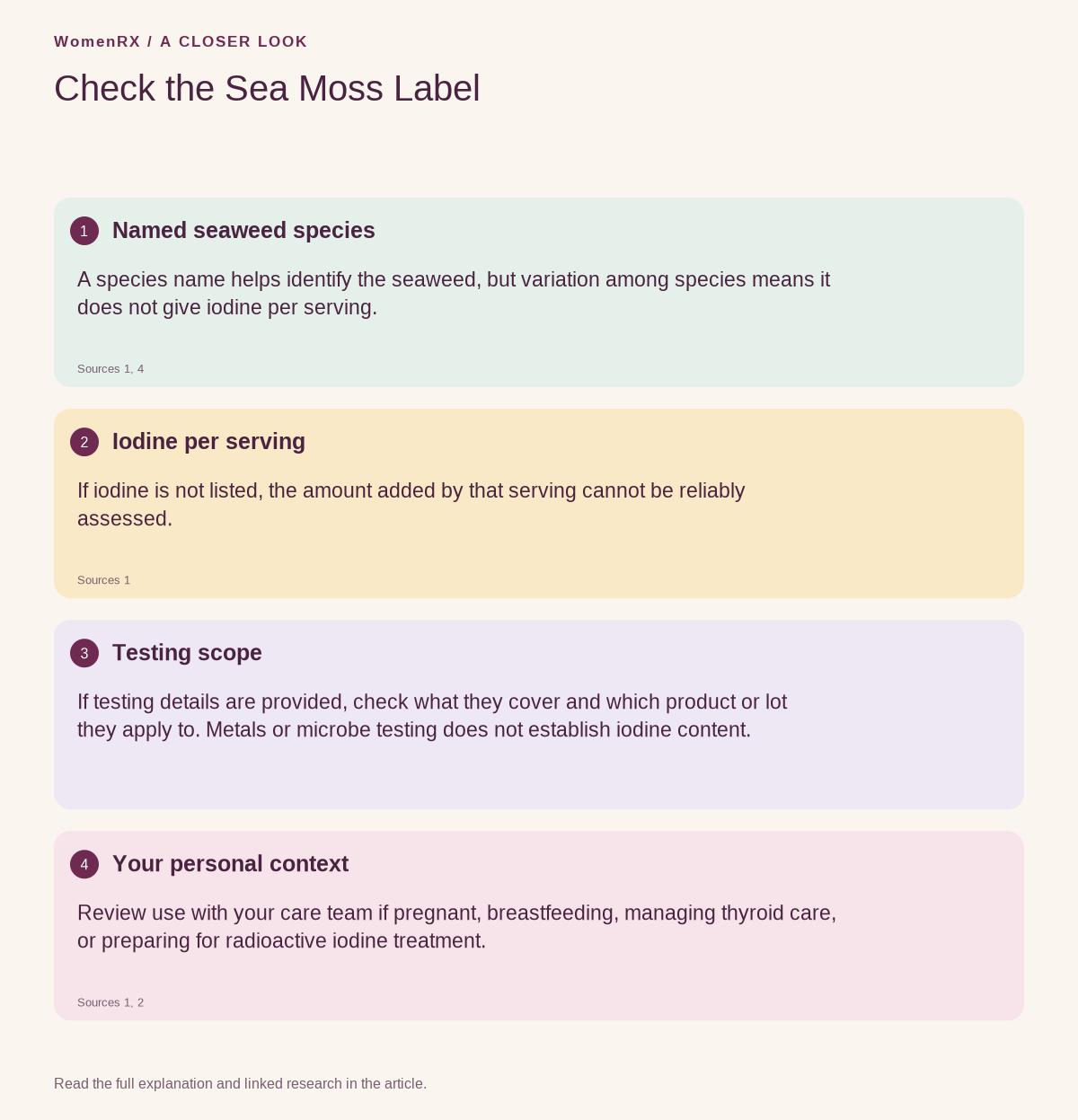
Check the Sea Moss Label
Named seaweed species: A species name helps identify the seaweed, but variation among species means it does not give iodine per serving.14
Iodine per serving: If iodine is not listed, the amount added by that serving cannot be reliably assessed.1
Testing scope: If testing details are provided, check what they cover and which product or lot they apply to. Metals or microbe testing does not establish iodine content.
Your personal context: Review use with your care team if pregnant, breastfeeding, managing thyroid care, or preparing for radioactive iodine treatment.12
Read the figure as text
Use these checks to separate product details from an unknown iodine dose, then consider your own thyroid, pregnancy, breastfeeding, and medicine context.- Named seaweed species: A species name helps identify the seaweed, but variation among species means it does not give iodine per serving.14
- Iodine per serving: If iodine is not listed, the amount added by that serving cannot be reliably assessed.1
- Testing scope: If testing details are provided, check what they cover and which product or lot they apply to. Metals or microbe testing does not establish iodine content.
- Your personal context: Review use with your care team if pregnant, breastfeeding, managing thyroid care, or preparing for radioactive iodine treatment.12
More questions, answered
Does a sea moss product need to list iodine?
If the iodine amount isn’t listed, you can’t tell how much the product adds. Seaweed iodine varies by species, so the product name alone doesn’t provide a usable dose estimate. 1
Is every sea moss product contaminated?
No. A study of 66 products found variation and detected some metals in dried products, but its findings don’t establish that every product is contaminated or that every product poses the same risk. 3
Sources you can check
- Iodine - Health Professional Fact SheetAccessed 2026-09-25Return to first citation
- Pregnancy and Medicines | MedlinePlusAccessed 2026-09-25Return to first citation
- Microbial and Heavy Metal Analyses of Commercially Available Sea Moss and Sea Moss Products.Rejuso A, Çobo M, Curran JE, Wang R, Humiston G, Worobo R, Vegdahl AC. · Journal of food protection · 2026Return to first citation
- Application of mass spectrometric techniques for the trace analysis of short-lived iodine-containing volatiles emitted by seaweed.Kundel M, Thorenz UR, Petersen JH, Huang RJ, Bings NH, Hoffmann T. · Analytical and bioanalytical chemistry · 2012Return to first citation