Sea Moss Products: Check Iodine, Testing and Labels
A useful sea moss label names the species, tells you how much iodine is in a serving, and points to test results for the actual product.
Sea moss isn’t a dependable iodine source unless the product reports a measured amount per serving. Iodine varies widely across seaweed products, so look for the scientific species name, serving size, and iodine amount for that serving. For contaminants, look for numerical results that name each substance tested and match the product or batch. If those details are missing, you can’t assess the amounts from the label alone. 1 2
Start with the species, not the promise
“Sea moss” or “Irish moss” commonly refers to the red seaweed Chondrus crispus. Check whether the label names that species, rather than relying only on “sea moss,” “marine minerals,” or a general claim about seaweed. A scientific name helps you identify what the product says it contains; it does not, by itself, tell you its iodine level or purity. 1 3
That distinction matters because iodine amounts vary across seaweed products. A study of seaweed products sold in the Netherlands found a very wide range of iodine amounts, including across portions. Those results show why the word “seaweed” is not enough to predict iodine content, but they do not establish the iodine amount in a particular sea moss supplement. 2
What an iodine label needs to tell you
Look for an iodine amount in micrograms (µg) per serving, alongside the serving size. A number without a clear serving size is hard to interpret. So is an ingredient list that names sea moss but gives no iodine amount. A product may contain iodine without providing enough information to tell you how much you would get from its suggested serving.
If a report gives iodine in µg per gram instead, multiply that number by the grams you would take. For example, a hypothetical sea moss product measured at 30 µg/g would provide 150 µg in a 5 g serving; two such servings would provide 300 µg. Another product measured at 60 µg/g would provide 60 µg in a 1 g serving, despite having twice the iodine concentration. Compare amounts for the serving you would take, not concentrations alone. These figures illustrate the calculation, not measured amounts for any sea moss brand. Iodine from other foods or supplements also contributes to daily intake. The Netherlands seaweed study used a 600 µg/day upper limit when assessing its participants; that figure is context for the study, not a sea-moss-specific target or a way to judge an individual's intake from one label. 2
Be cautious about treating a general nutrition panel, a statement such as “rich in minerals,” or a test for a different seaweed as an iodine measurement for the product in your hand. Even when a company provides a result, check whether it applies to the same product and serving. The broad variation measured in seaweed products makes a species name or a result from another item a poor substitute for a product-specific amount. 2
“Tested” is not the same as a useful result
Seaweed can take up contaminants from the water where it grows. A review of sea moss describes potential contamination with arsenic, lead, cadmium, and mercury. That does not mean every sea moss product contains concerning amounts; it does mean that a general promise of purity cannot tell you what was measured in a specific product. 1
For a more informative check, look for a test report that identifies the product or batch, names the contaminants tested, and gives numerical results with units. A phrase like “third-party tested” without those details leaves key questions unanswered: what was tested, which contaminants were included, and whether the report matches this product? If the company doesn’t provide the results, the label alone can’t establish the product’s contaminant levels.
Read each reported contaminant separately. Check its name, units, and whether the number is a concentration in the product or an amount per serving. For a hypothetical 5 g serving, a reported lead concentration of 0.2 mg/kg corresponds to 0.2 µg/g and therefore 1 µg per serving. That arithmetic tells you the reported amount, not whether the product is safe. A result for lead says nothing about arsenic, cadmium, or mercury unless those are reported too. 1
There’s another limit: a test result is useful only for what it actually measures. A heavy-metal report doesn’t tell you the iodine amount, and an iodine result doesn’t show that contaminants were assessed. An unexplained “passed” statement doesn’t tell you which contaminants were tested or what limits were used, so it can’t establish that a particular amount is safe for you.
Thyroid health and pregnancy call for individual advice
Iodine is needed to make thyroid hormones, and it also supports fetal brain development. But more is not automatically better: both too little and too much iodine can cause health problems. Seaweed products can deliver very different amounts, which makes an unmeasured product an uncertain way to manage iodine intake. 2 4
If you’re pregnant, planning a pregnancy, breastfeeding, or managing a thyroid condition, don’t use sea moss as a substitute for individualized guidance about iodine. The pregnancy-related need for iodine does not make an unknown amount in a sea moss product a dependable choice. Excess iodine from seaweed has also been linked in reports to thyroid suppression in breastfed infants, so breastfeeding is a particular reason to ask for guidance rather than assume the product is appropriate. 1 4
Compare what a serving actually provides
Before comparing two products, establish what species each claims to contain, then put their iodine figures on the same basis: micrograms for the amount you would take. A higher µg/g figure need not mean more iodine per serving if that serving is smaller. Compare contaminant results substance by substance, using the same serving basis and checking that each report matches the product or batch. A lower reported number for one contaminant does not establish lower amounts of the others, or make up for a missing iodine result. If a product lacks a serving size, measured iodine amount, or relevant contaminant results, the available information cannot support that comparison; missing results are not proof of contamination.
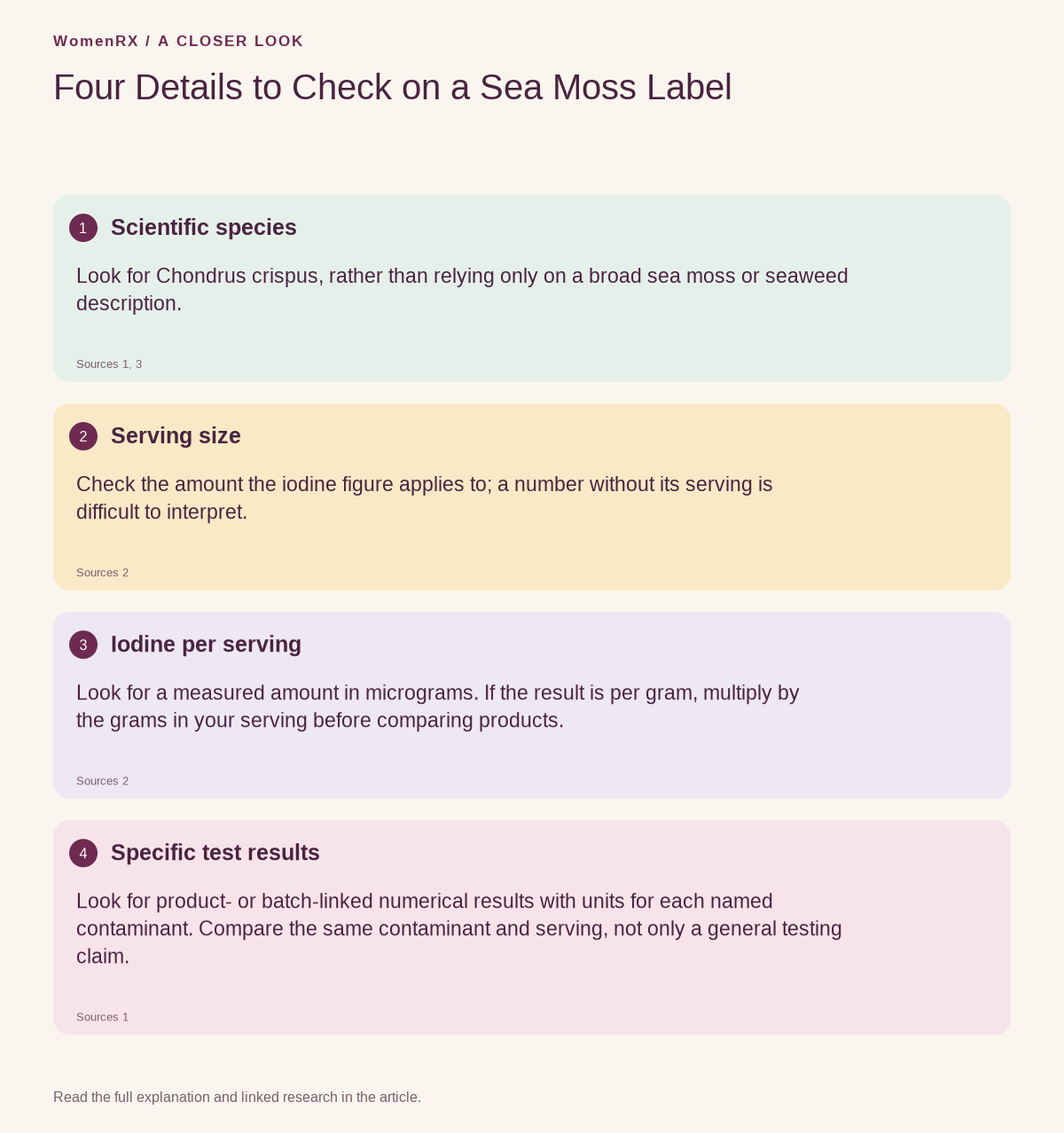
Four Details to Check on a Sea Moss Label
Scientific species: Look for Chondrus crispus, rather than relying only on a broad sea moss or seaweed description.13
Serving size: Check the amount the iodine figure applies to; a number without its serving is difficult to interpret.2
Iodine per serving: Look for a measured amount in micrograms. If the result is per gram, multiply by the grams in your serving before comparing products.2
Specific test results: Look for product- or batch-linked numerical results with units for each named contaminant. Compare the same contaminant and serving, not only a general testing claim.1
Read the figure as text
These details help distinguish a product description from information you can use to assess iodine and contaminant testing.- Scientific species: Look for Chondrus crispus, rather than relying only on a broad sea moss or seaweed description.13
- Serving size: Check the amount the iodine figure applies to; a number without its serving is difficult to interpret.2
- Iodine per serving: Look for a measured amount in micrograms. If the result is per gram, multiply by the grams in your serving before comparing products.2
- Specific test results: Look for product- or batch-linked numerical results with units for each named contaminant. Compare the same contaminant and serving, not only a general testing claim.1
More questions, answered
Does sea moss reliably provide iodine?
Not based on the name alone. Iodine varies widely across seaweed products, and measurements from other products cannot establish the amount in a particular sea moss product. Look for a measured iodine amount per serving. If the result is 30 µg/g and the serving is 5 g, for example, that works out to 150 µg per serving; this is an illustration, not a measurement of sea moss products. 2
Is “third-party tested” enough to judge a product?
Not by itself. To understand what was checked, look for a report that identifies the product or batch, lists the contaminants tested, and gives numerical results with units. A general testing claim doesn’t reveal those details. Compare numerical amounts for the same contaminant and serving, rather than treating a lead result, for example, as a result for arsenic. Sea moss can be exposed to contaminants such as arsenic, lead, cadmium, and mercury. 1
Sources you can check
- Sea Moss2006Return to first citation
- Content, bio-accessibility and intake of iodine from seaweed-containing food products available in The Netherlands.Melse-Boonstra A, Bossink R, Sollie V, den Berg KB, Verhagen N. · European journal of nutrition · 2025Return to first citation
- Impact of habitual seaweed consumption on iodine nutrition and thyroid function: a non-randomized pre-post clinical study.Aakre I, Vogt EC, Myrmel LS, Lundebye AK, Helland OB, Henjum S, Dahl L, Markhus MW, Sleire SN, Løkken SJ, Rosendahl-Riise H. · European journal of nutrition · 2026Return to first citation
- Iodine and Hypothyroidism.Fan X, Guo S, Wu S, Fan Y, Zhang Q. · Endocrine, metabolic & immune disorders drug targets · 2026Return to first citation