When to Take Sea Moss: Does the Time of Day Matter?
With sea moss, the serving’s iodine content and product testing matter more than a time-of-day routine.
Iodine guidance gives daily intake targets, not a best time of day for sea moss. The useful first check is whether the label states how much iodine a serving contains: iodine varies greatly among seaweed species, but that fact alone doesn’t tell you the amount in a particular product. Grossly excessive iodine intake can disrupt thyroid function. Check other iodine sources in your supplements, especially during pregnancy or while trying to conceive, and look for product-specific testing information. 13
Check the iodine amount before the clock
If you’re deciding when to take sea moss, first find out what’s in a serving. Iodine recommendations are expressed as daily intake, not as a sea-moss time-of-day schedule. The guidance doesn’t identify a particular hour as best. If you choose to use a product, follow its directions, but don’t let timing distract from checking the iodine amount. 1
Seaweed iodine amounts vary greatly among species. That doesn’t establish how much iodine is in any particular sea moss supplement. The name “sea moss” or “Irish moss” isn’t a substitute for a stated iodine quantity. If a supplement label doesn’t give that amount, you can’t use the label to work out how much iodine it adds to your day. 1
For context, the US recommended dietary allowances are 150 micrograms for adult women, 220 micrograms during pregnancy, and 290 micrograms while breastfeeding. The same iodine reference reports a World Health Organization recommendation of 250 micrograms per day during pregnancy. These are daily totals from all sources, not suggested sea moss supplement amounts. 1
Why total iodine matters for your thyroid
Iodine is needed to make thyroid hormones, but more isn’t automatically better. Grossly excessive iodine intake can cause thyroid dysfunction. Before adding a sea moss product, count iodine from other supplements too. Some prenatal supplements contain iodine and some don’t, so check the actual label rather than assuming. 13
If you’re pregnant, breastfeeding, or trying to conceive, don’t assume you’re deficient or use sea moss to guess at a need. The daily requirement changes during pregnancy and lactation. Check the iodine listed on your prenatal and any sea moss product, then discuss the combination with your pregnancy-care clinician if the total is unclear. 1
If you are breastfeeding
Breastfeeding deserves particular caution. A review on sea moss notes that it can contain iodine and heavy metals, and advises avoiding it while breastfeeding unless those levels have been shown to be low enough to be safe. 1 If you’re breastfeeding, don’t assume that changing the time you take it addresses that concern.
A label-and-testing check
Before buying, look for the species and all ingredients, including any added kelp or bladderwrack. Some products sold as sea-moss blends include other botanicals, so the front label alone may not tell you what’s contributing to the formula. 2
Check whether the label states iodine per serving and makes clear what counts as a serving. If iodine isn’t listed, treat the amount as unknown, not as zero. The product name alone can’t tell you the iodine contribution. 1
For contaminants, look for testing tied to the specific product batch, with results for heavy metals and microbial quality. This is a practical screening step, not a guarantee of safety. A lab analysis of three macroalgae species, including Chondrus crispus, detected trace arsenic and lead. That finding doesn’t show that every sea moss supplement contains concerning levels, or that any particular product is unsafe. 4
A separate laboratory screening reported microbial material and immune-activating signals in some over-the-counter sea-moss blends. The work used a cell-based assay; it does not establish that consumers became ill or show how common the findings are across products. It does give a reason to look for product-specific quality information rather than relying on a broad “tested” claim. 2
Choose by iodine information and testing, not timing promises
A product is easier to assess when its label identifies the seaweed and blend ingredients, provides an iodine amount per serving, and offers batch-specific testing information. If the iodine amount is missing, the blend is unclear, or you can’t find meaningful testing details, you have too little information to confidently factor that product into your iodine intake. You can choose a more clearly labeled option or skip it; sea moss isn’t necessary to meet iodine needs when those needs are otherwise being addressed. 12
The main takeaway is simple: don’t choose sea moss based on a promise of “best results” at a certain hour. Check what the serving adds, what else you already take, and what the product’s testing actually covers.
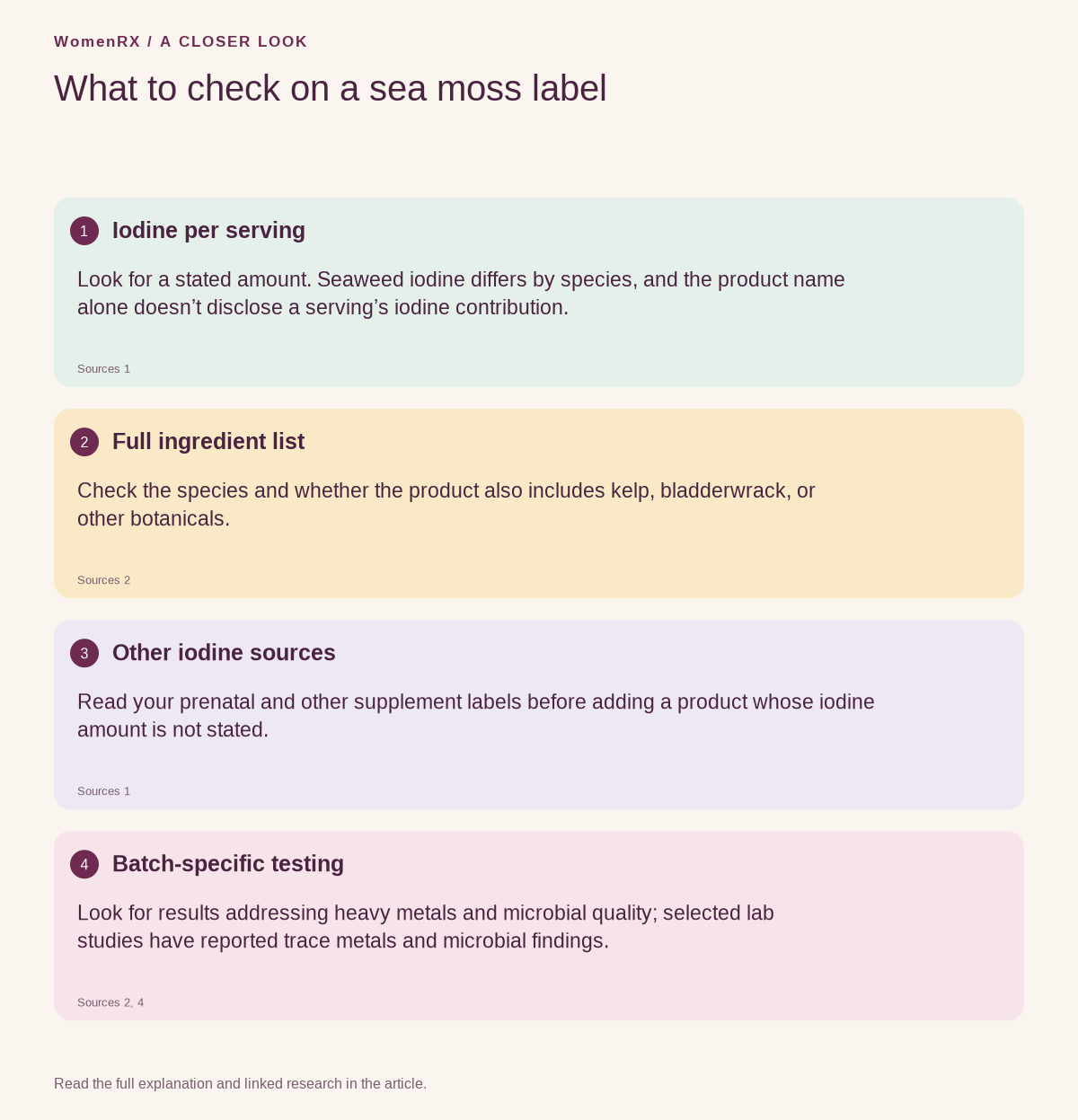
What to check on a sea moss label
Iodine per serving: Look for a stated amount. Seaweed iodine differs by species, and the product name alone doesn’t disclose a serving’s iodine contribution.1
Full ingredient list: Check the species and whether the product also includes kelp, bladderwrack, or other botanicals.2
Other iodine sources: Read your prenatal and other supplement labels before adding a product whose iodine amount is not stated.1
Batch-specific testing: Look for results addressing heavy metals and microbial quality; selected lab studies have reported trace metals and microbial findings.24
Read the figure as text
Use these checks to tell whether a sea moss product’s iodine contribution and quality information are clear enough to assess.- Iodine per serving: Look for a stated amount. Seaweed iodine differs by species, and the product name alone doesn’t disclose a serving’s iodine contribution.1
- Full ingredient list: Check the species and whether the product also includes kelp, bladderwrack, or other botanicals.2
- Other iodine sources: Read your prenatal and other supplement labels before adding a product whose iodine amount is not stated.1
- Batch-specific testing: Look for results addressing heavy metals and microbial quality; selected lab studies have reported trace metals and microbial findings.24
More questions, answered
Can sea moss reliably provide iodine?
The name alone can’t tell you how much iodine a product provides. Iodine varies greatly among seaweed species, and if a product label doesn’t state an iodine amount per serving, you can’t calculate its contribution from the label. 1
What should I check if I’m pregnant or trying to conceive?
Check whether your prenatal contains iodine and whether the sea moss label states its iodine amount. Daily iodine needs are higher during pregnancy and breastfeeding, but that doesn’t mean you’re deficient or that sea moss is the right way to address a gap. 1
Sources you can check
- Iodine - Health Professional Fact SheetAccessed 2026-09-25Return to first citation
- Functional immune boosters; the herb or its dead microbiome? Antigenic TLR4 agonist MAMPs found in 65 medicinal roots and algae's.Mazzio E, Barnes A, Badisa R, Fierros-Romero G, Williams H, Council S, Soliman KFA. · Journal of functional foods · 2023Return to first citation
- Dietary Supplements in Pregnancy and Postpartum: Evidence, Safety Challenges and a Precision Nutrition Framework (GAPSS).Chen J, Duan M, Zhu Z, Su R, Cai J. · Antioxidants (Basel, Switzerland) · 2026Return to first citation
- Metabolomic approach to explore the chemical composition and health benefits of macroalgae: A comprehensive study of Palmaria palmata, Ascophyllum nodosum, and Chondrus crispus.Čmiková N, D Vukić M, L Vukovic N, Havlík J, Issa-Issa H, A Carbonell-Barrachina Á, Jančo I, Vinciguerra V, Garzoli S, Kačániová M. · Food chemistry · 2025Return to first citation
- Sea Moss2006