How Much Sea Moss Should You Take? Start With Iodine
There isn’t a dependable daily sea moss amount unless you know how much iodine the serving contains.
Sea moss products can vary in iodine, so a serving direction alone doesn’t tell you how much iodine you’ll get. Look for an iodine amount per serving, count other sources such as a prenatal or multivitamin, and check whether the company can provide testing for iodine and heavy metals. If you’re pregnant, planning pregnancy, breastfeeding, or receiving thyroid care, review the product with your care team before using it. 1 2
Start with iodine per serving, not scoop size
There’s no reliable universal daily amount of sea moss to recommend from the product name alone. Seaweed iodine levels vary greatly, and a serving instruction such as “one scoop” doesn’t tell you the iodine dose unless the label gives an amount. Even the measured iodine content of commercially available seaweeds varies widely; those figures are not a sea-moss-specific estimate for your product. 1
If the label doesn’t state iodine per serving, you can’t work out how much that serving adds to your day. Ask the manufacturer for the amount in the specific product, ideally with a report tied to the product’s batch. If the amount can’t be confirmed, it’s hard to assess the product’s iodine contribution.
Count the rest of your iodine sources
Iodine comes from more than supplements. Sources include iodized salt, dairy, eggs, seafood, some breads, and other supplements. A multivitamin or prenatal may contain iodine, but not all do. Check each label rather than assuming a product contains it, or doesn’t. 1
For context, the recommended daily intake is 150 micrograms for adult women, 220 micrograms during pregnancy, and 290 micrograms while breastfeeding. These are total daily intake recommendations, not sea moss serving targets. They also don’t mean that taking more iodine is better. 1
A useful label check is to write down the iodine amount from every supplement you use, then note regular food sources. If a sea moss product doesn’t disclose its iodine amount, don’t guess at its contribution or treat its serving directions as an iodine measurement.
Check where it comes from and what was tested
Sea moss, also called Irish moss, is a red seaweed identified as Chondrus crispus. A review notes that sea moss can contain iodine and heavy metals, including arsenic, lead, cadmium, and mercury, associated with the water where it was grown. 2 Check whether the company identifies the seaweed species and where it was grown or harvested. Knowing the origin gives you useful product information, but origin alone doesn’t establish contaminant levels.
Ask whether the company can provide a recent, batch-specific test report that lists iodine and heavy metals. A vague statement such as “tested for purity” doesn’t tell you which substances were measured or what the results were. The information here doesn’t establish a particular testing standard or guarantee that a product is safe.
Give thyroid care and pregnancy extra attention
Iodine is needed for thyroid hormone production, so a sea moss product with an unknown or variable iodine amount is worth reviewing if you’re being treated for a thyroid condition. Bring the actual label and any testing report to the clinician managing your thyroid care. This is a product-specific conversation, not a reason to assume sea moss will help or harm every thyroid condition. 1
If you’re planning pregnancy or are pregnant, check whether your prenatal contains iodine and discuss any sea moss product before adding it. Pregnancy raises the recommended intake to 220 micrograms daily; breastfeeding raises it to 290 micrograms. 1 A review reports cases in which excess iodine from maternal seaweed consumption was associated with thyroid suppression in breastfed infants. Those reports don’t tell us how often this happens or establish the risk from every sea moss product, but they make an unknown iodine amount a poor guess during breastfeeding. 2
A quick label-and-suitability check
- Iodine amount: Is the amount listed per serving, not just the serving size?
- Duplicate sources: Do a prenatal, multivitamin, or other supplement also contain iodine?
- Species and origin: Does the company identify the seaweed species and where it was grown or harvested? Origin alone doesn’t confirm contaminant levels. 2
- Testing details: Can the company provide batch-specific results for iodine and heavy metals?
- Your context: Are you receiving thyroid care, planning pregnancy, pregnant, or breastfeeding? If so, review the product and its documentation with your care team.
If the iodine amount and testing details aren’t available, you don’t have enough information to assess the product’s iodine contribution or the contaminants tested for. Choosing a product with clear, specific documentation, or not adding it, is more useful than trying to find a universal sea moss dose.
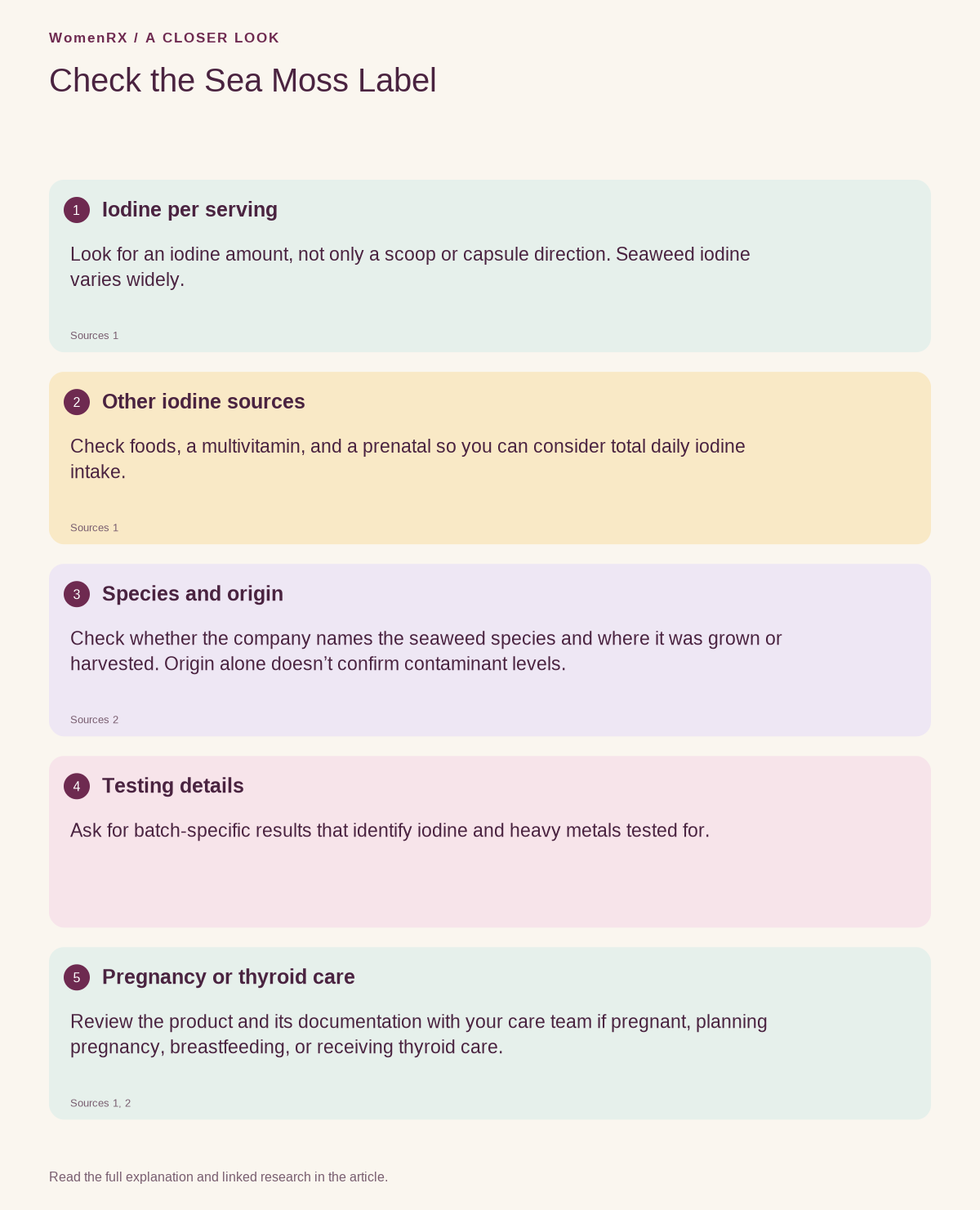
Check the Sea Moss Label
Iodine per serving: Look for an iodine amount, not only a scoop or capsule direction. Seaweed iodine varies widely.1
Other iodine sources: Check foods, a multivitamin, and a prenatal so you can consider total daily iodine intake.1
Species and origin: Check whether the company names the seaweed species and where it was grown or harvested. Origin alone doesn’t confirm contaminant levels.2
Testing details: Ask for batch-specific results that identify iodine and heavy metals tested for.
Pregnancy or thyroid care: Review the product and its documentation with your care team if pregnant, planning pregnancy, breastfeeding, or receiving thyroid care.12
Read the figure as text
Use these five checks to see what a serving tells you, and what still needs confirming.- Iodine per serving: Look for an iodine amount, not only a scoop or capsule direction. Seaweed iodine varies widely.1
- Other iodine sources: Check foods, a multivitamin, and a prenatal so you can consider total daily iodine intake.1
- Species and origin: Check whether the company names the seaweed species and where it was grown or harvested. Origin alone doesn’t confirm contaminant levels.2
- Testing details: Ask for batch-specific results that identify iodine and heavy metals tested for.
- Pregnancy or thyroid care: Review the product and its documentation with your care team if pregnant, planning pregnancy, breastfeeding, or receiving thyroid care.12
More questions, answered
Is the iodine RDA the amount of sea moss I should take?
No. The recommended daily intake applies to iodine from all sources combined, not to sea moss alone. The product’s iodine amount per serving would need to be known before you could assess its contribution. 1
Does every prenatal vitamin contain iodine?
No. Some prenatal supplements contain iodine and some do not, so check the specific label rather than assuming. 1
Sources you can check
- Iodine - Health Professional Fact SheetAccessed 2026-09-25Return to first citation
- Sea Moss2006Return to first citation