Sea Moss Supplements: What the Evidence Can Tell You
The lab study and iodine measurements discussed here don’t establish a timeline for benefits or prove the wellness claims often made about sea moss.
The gut and iodine studies do not establish how long sea moss supplements take to produce a benefit. One study tested Chondrus crispus in a lab model of gut bacteria, not in people, while iodine studies measured seaweed composition or intake rather than treatment effects. Iodine content can vary, so check whether your product states the amount. 23
If you started sea moss for digestion, energy, “detox,” or hormone balance, it’s reasonable to ask when you should notice a difference. The lab gut-fermentation experiment and iodine measurements discussed below don’t establish a dependable time to benefit or show that sea moss supplements deliver those outcomes in people.
Lab findings aren’t proof of a benefit in your body
A 2025 study tested red seaweeds, including Irish moss (Chondrus crispus), in an in vitro model of gut fermentation. It found changes in some gut bacteria during the lab experiment. That’s a clue for further research, not evidence that taking a sea moss supplement improves digestion or gut health in people. 2
Other studies measured seaweed iodine or assessed iodine intake. Those studies can help explain what may be in seaweed, but they don’t establish that a sea moss supplement treats thyroid problems, balances hormones, removes toxins, or improves energy. 34
So if you’re waiting for one of those effects, neither the lab experiment nor the iodine measurements establish a time to benefit. The more practical question is whether the product gives you a known amount of a nutrient you need.
Sea moss isn’t a dependable iodine dose
Iodine is needed to make thyroid hormones, but both too little and too much can be a problem. Seaweed iodine levels vary by species and sample. In an analysis of 30 red-seaweed samples, Irish moss had an average iodine concentration of 3.86 milligrams per kilogram of dry weight, with variation among samples. That measurement describes the seaweed analyzed, not the amount in every supplement or serving. 13
This matters because seeing “sea moss” on a label doesn’t tell you how much iodine you’ll get. If the amount of iodine isn’t stated, you can’t use that label to work out how the product fits with the rest of your diet or supplements. Check the specific product’s iodine disclosure and ingredient amounts; don’t assume all sea moss products have the same composition.
Iodine needs change during pregnancy and lactation
For adults, the recommended dietary allowance for iodine is 150 micrograms a day. It rises to 220 micrograms during pregnancy and 290 micrograms during lactation. These are total daily intake recommendations, not directions to take sea moss. 1
Pregnancy can make iodine intake more relevant, but an unverified sea moss product is not a precise way to meet a specific need. Some prenatal supplements contain iodine and some don’t, so check the label rather than relying on sea moss as a substitute. 1
A quick label check before you continue
Look for the named seaweed species, the amount of the ingredient per serving, and a stated iodine amount. Then compare the product’s actual claim with the evidence: a lab result about gut bacteria or a measurement of seaweed iodine doesn’t prove a human benefit. If a product doesn’t disclose iodine, you can’t know its iodine contribution from the label alone.
You don’t need a special “time to work” rule for a benefit that hasn’t been established. Decide whether the product has a clear, relevant purpose and enough composition information to make its iodine contribution understandable. If your goal is to address a thyroid concern or meet pregnancy-related iodine needs, sea moss marketing is not a substitute for figuring out the appropriate intake for you.
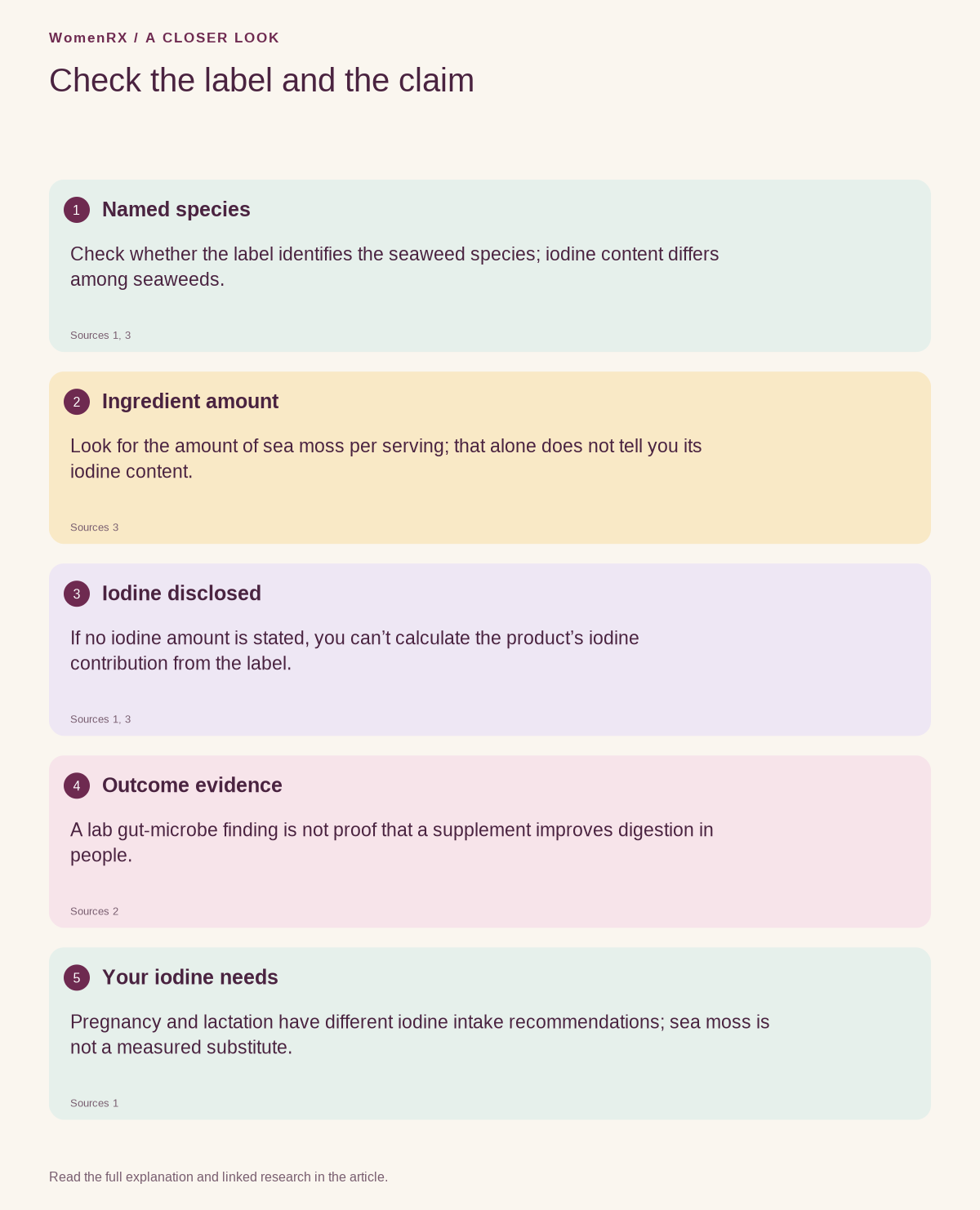
Check the label and the claim
Named species: Check whether the label identifies the seaweed species; iodine content differs among seaweeds.13
Ingredient amount: Look for the amount of sea moss per serving; that alone does not tell you its iodine content.3
Iodine disclosed: If no iodine amount is stated, you can’t calculate the product’s iodine contribution from the label.13
Outcome evidence: A lab gut-microbe finding is not proof that a supplement improves digestion in people.2
Your iodine needs: Pregnancy and lactation have different iodine intake recommendations; sea moss is not a measured substitute.1
Read the figure as text
Use these checks to compare a product’s stated composition with what the lab and iodine studies discussed here can establish.- Named species: Check whether the label identifies the seaweed species; iodine content differs among seaweeds.13
- Ingredient amount: Look for the amount of sea moss per serving; that alone does not tell you its iodine content.3
- Iodine disclosed: If no iodine amount is stated, you can’t calculate the product’s iodine contribution from the label.13
- Outcome evidence: A lab gut-microbe finding is not proof that a supplement improves digestion in people.2
- Your iodine needs: Pregnancy and lactation have different iodine intake recommendations; sea moss is not a measured substitute.1
More questions, answered
How long should I take sea moss before deciding if it works?
The gut and iodine studies don’t establish a time to benefit for sea moss supplements. The gut-related finding came from a lab fermentation model, not a supplement study in people; the iodine research measured seaweed composition or intake. 234
Can sea moss replace iodine in a prenatal supplement?
Don’t assume it can. Pregnancy iodine needs are higher, but seaweed iodine varies and a product only tells you its iodine contribution if that amount is disclosed. Check the prenatal label and the sea moss label rather than treating one as an automatic substitute for the other. 13
Sources you can check
- Iodine - Health Professional Fact SheetAccessed 2026-09-25Return to first citation
- Modulatory effects of red seaweeds (Palmaria palmata, Porphyra umbilicalis and Chondrus crispus) on the human gut microbiota via an in vitro model.López-Santamarina A, Cardelle-Cobas A, Mondragón Portocarrero ADC, Cepeda Sáez A, Miranda JM. · Food chemistry · 2025Return to first citation
- Risk assessment of iodine intake from the consumption of red seaweeds (Palmaria palmata and Chondrus crispus).Darias-Rosales J, Rubio C, Gutiérrez ÁJ, Paz S, Hardisson A. · Environmental science and pollution research international · 2020Return to first citation
- Iodine in Edible Seaweed, Its Absorption, Dietary Use, and Relation to Iodine Nutrition in Arctic People.Andersen S, Noahsen P, Rex KF, Florian-Sørensen HC, Mulvad G. · Journal of medicinal food · 2019Return to first citation