Sea Moss, Iodine, and Thyroid Questions
A sea moss label may not tell you how much iodine you’ll get, so check the amount and testing details before treating it as a thyroid or prenatal supplement.
Sea moss contains iodine, but its amount may not be stated on the product label. Iodine levels vary widely across seaweeds, so the ingredient name alone can’t tell you how much a serving provides. 1 If you have a thyroid condition or take thyroid medicine, show the exact label to your prescriber or pharmacist. During pregnancy, review supplements and iodine intake with your prenatal care provider. 2
Sea moss can sound like a simple way to get iodine. The catch is that knowing a product contains seaweed doesn’t tell you how much iodine a serving provides. If you’re managing a thyroid condition, taking thyroid medicine, or planning a pregnancy, that uncertainty matters more than the product’s general wellness claims.
Start with the iodine amount, not the promise
Iodine is needed to make thyroid hormones. For adults, the recommended dietary allowance is 150 micrograms a day; during pregnancy it’s 220 micrograms a day. Those figures describe recommended total daily intake, not a dose to take from sea moss. 1
Iodine levels vary widely among seaweeds. The NIH Office of Dietary Supplements reports a broad range across commercially available seaweeds, but that range is not a measurement of every sea moss product. A product that lists sea moss as an ingredient, without stating an iodine amount per serving, doesn’t give you a dependable way to estimate its iodine contribution. 1
Check the Supplement Facts panel for iodine per serving and the serving size. If iodine isn’t listed, don’t assume the product supplies a useful amount. Also look for other iodine sources in your routine, such as a multivitamin or prenatal supplement. Some, but not all, prenatal supplements contain iodine. 1
Check what the product is, and what testing shows
Look for the named seaweed species, not just “sea moss,” and read the full ingredient list for other seaweeds or added iodine. The review describing sea moss as Chondrus crispus also notes that it contains iodine and that seaweed can contain heavy metals from its growing environment. That does not establish the levels in any particular product. 3
If the label or manufacturer provides testing information, check whether it applies to the specific product batch and whether it reports iodine and heavy metals. A general statement that a product is “tested” doesn’t tell you what was tested or what the results were. If those details aren’t available, you can’t use the label to confirm the product’s iodine amount or contaminant levels. This is a practical information check, not a guarantee that a supplement is safe.
If you have a thyroid condition or take thyroid medicine
Don’t treat sea moss as a way to manage thyroid function. A review notes that medicinal value for sea moss has not been proven. 3
A practical next step is to bring the actual container or a clear photo of its Supplement Facts and ingredients to your prescriber or pharmacist. Ask whether the product’s listed iodine amount and other ingredients make sense for your thyroid condition and medication plan.
Pregnancy planning and pregnancy call for a total-intake check
Iodine needs rise during pregnancy, but sea moss isn’t a reliable way to meet them when its iodine amount is unknown. Check the iodine listed on any prenatal vitamin and include other supplements in the conversation. Some prenatal products contain iodine and some do not, so the product label matters. 1
If you’re trying to conceive or are pregnant, review sea moss and other supplements with your prenatal care provider before starting them. MedlinePlus advises checking with a provider before taking herbs or supplements during pregnancy, and not stopping or starting medicines without discussing the decision. 2
A quick label check
- Species: Is a seaweed species named, or does the label only say “sea moss”?
- Iodine: Is an amount listed per serving? If not, the iodine contribution is unknown from the label.
- Testing: Are results available for the specific product batch, including iodine and heavy metals?
- Your full routine: Does your prenatal or multivitamin already list iodine?
- Your care plan: Have you shown the product to the person managing your thyroid medicine or pregnancy care?
If key details are missing, you don’t have enough information to treat the product as a predictable iodine source. Choosing not to use it is a reasonable option; you can discuss other ways to meet your iodine needs with your care team.
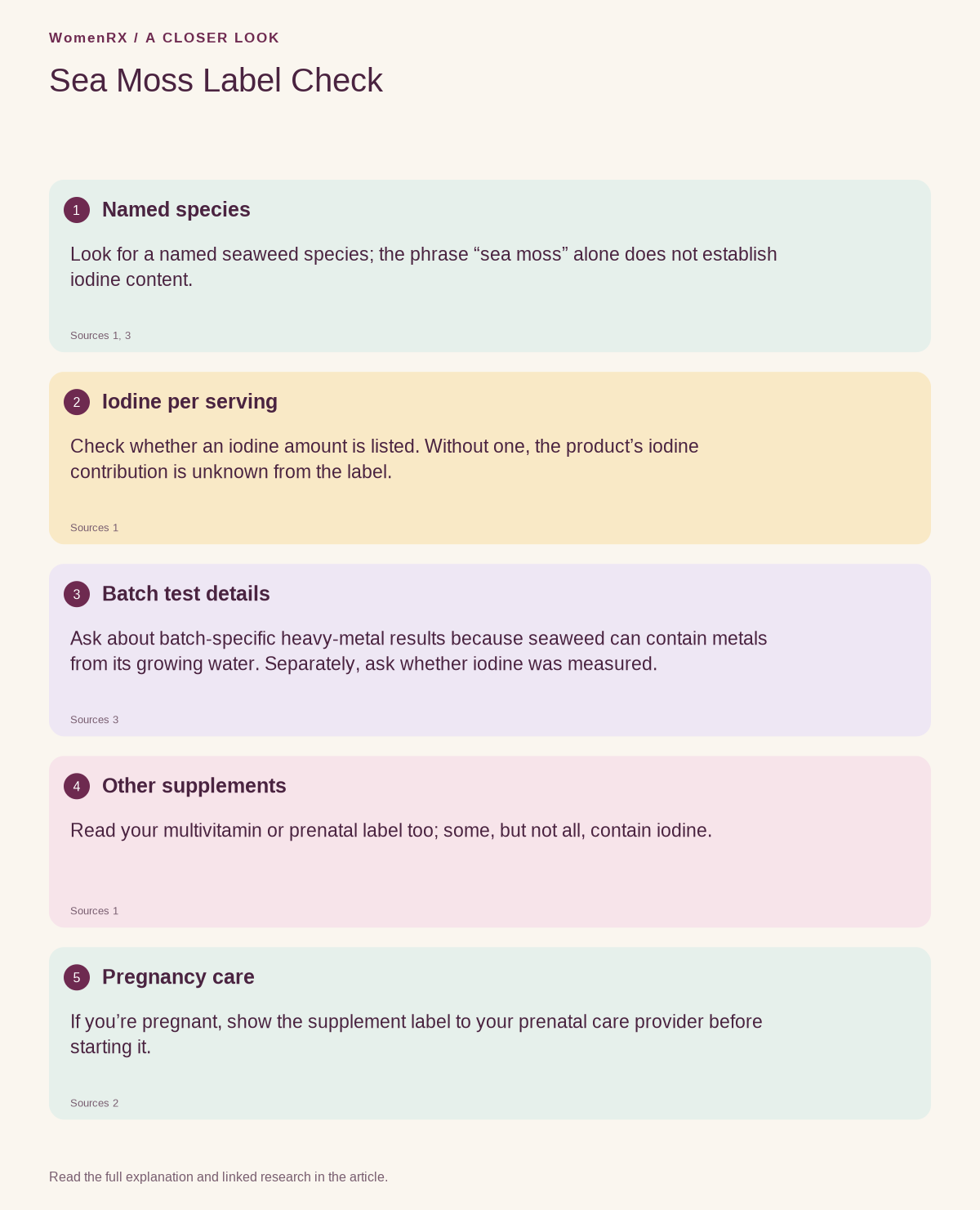
Sea Moss Label Check
Named species: Look for a named seaweed species; the phrase “sea moss” alone does not establish iodine content.13
Iodine per serving: Check whether an iodine amount is listed. Without one, the product’s iodine contribution is unknown from the label.1
Batch test details: Ask about batch-specific heavy-metal results because seaweed can contain metals from its growing water. Separately, ask whether iodine was measured.3
Other supplements: Read your multivitamin or prenatal label too; some, but not all, contain iodine.1
Pregnancy care: If you’re pregnant, show the supplement label to your prenatal care provider before starting it.2
Read the figure as text
Use these checks to distinguish a named ingredient from useful information about iodine, testing, and your own supplement routine.- Named species: Look for a named seaweed species; the phrase “sea moss” alone does not establish iodine content.13
- Iodine per serving: Check whether an iodine amount is listed. Without one, the product’s iodine contribution is unknown from the label.1
- Batch test details: Ask about batch-specific heavy-metal results because seaweed can contain metals from its growing water. Separately, ask whether iodine was measured.3
- Other supplements: Read your multivitamin or prenatal label too; some, but not all, contain iodine.1
- Pregnancy care: If you’re pregnant, show the supplement label to your prenatal care provider before starting it.2
More questions, answered
Does sea moss support thyroid function?
Iodine is needed to make thyroid hormones, but that doesn’t show that a sea moss product improves thyroid function. Its iodine amount may not be stated, iodine levels vary widely among seaweeds, and a review notes that medicinal value has not been proven. 1 3
Can I take sea moss with thyroid medicine?
If you’re considering sea moss while taking thyroid medicine, show the exact product label to your prescriber or pharmacist and ask how it fits your condition and medication plan.
Sources you can check
- Iodine - Health Professional Fact SheetAccessed 2026-09-25Return to first citation
- Pregnancy and Medicines | MedlinePlusAccessed 2026-09-25Return to first citation
- Sea Moss2006Return to first citation