Sea Moss After 40: Does Age Change the Case?
Turning 40 doesn’t create a sea moss need; the useful question is whether it addresses a specific nutritional need.
Age alone isn’t a reason to take sea moss. A small trial in healthy postmenopausal women tested a different seaweed and measured thyroid markers, not menopause symptoms. 1 Seaweeds can differ widely in iodine content, so a product’s name alone won’t tell you how much iodine you’d get. 3
A midlife claim isn’t the same as a midlife study
Sea moss is often marketed for broad benefits, including hormone balance and menopause support. But being over 40 doesn’t, by itself, establish a need for it. The postmenopausal trial most relevant to that claim tested Alaria esculenta, a different seaweed. It measured thyroid markers, not relief of menopause symptoms. 1
In that randomized crossover study, 25 healthy postmenopausal women took either placebo or 5 grams a day of Alaria, which supplied 475 micrograms of iodine, for seven weeks. Average TSH, a blood marker related to thyroid function, was higher during the seaweed period. That result doesn’t show whether sea moss helps or worsens menopause symptoms. It does show why a seaweed supplement’s iodine content matters when interpreting health claims. 1
The practical question is what the product contains
Your body needs iodine to make thyroid hormones. 2 Seaweed can provide iodine, but the amount isn’t interchangeable across species: a study measuring 11 seaweed species found a wide range of iodine concentrations. Those measurements don’t establish how much iodine is in a particular sea moss product. 3
If you’re considering sea moss specifically for iodine, look for an iodine amount stated on the product rather than relying on the words “sea moss.” When that amount isn’t stated, the name alone can’t tell you what the product contributes. 3
Iodine also comes from other parts of the diet. In a US observational study of adults, consumption of dairy products, eggs and breads, along with use of iodine-containing supplements, was associated with urinary iodine concentration. That study included men and women; it didn’t test sea moss or determine whether any one person needs more iodine. 2
Put the need before the claim
- You’re interested because you turned 40: Your age alone doesn’t identify a sea moss benefit or an iodine need.
- You want menopause relief or “hormone balance”: The postmenopausal trial tested another seaweed and thyroid markers, not those promised outcomes. 1
- You want a source of iodine: Check whether the product states an iodine amount. Measurements from one seaweed species can’t tell you the amount in another product. 3
- You think you may not get enough iodine: That’s a question about your overall intake, not a reason to assume sea moss is the answer. Foods and iodine-containing supplements were associated with iodine status in US adults, but those population findings can’t establish your individual need. 2
Sea moss doesn’t become necessary at a particular birthday. A more useful decision starts with the need you’re trying to meet, then asks whether the product provides a known amount of the nutrient in question.
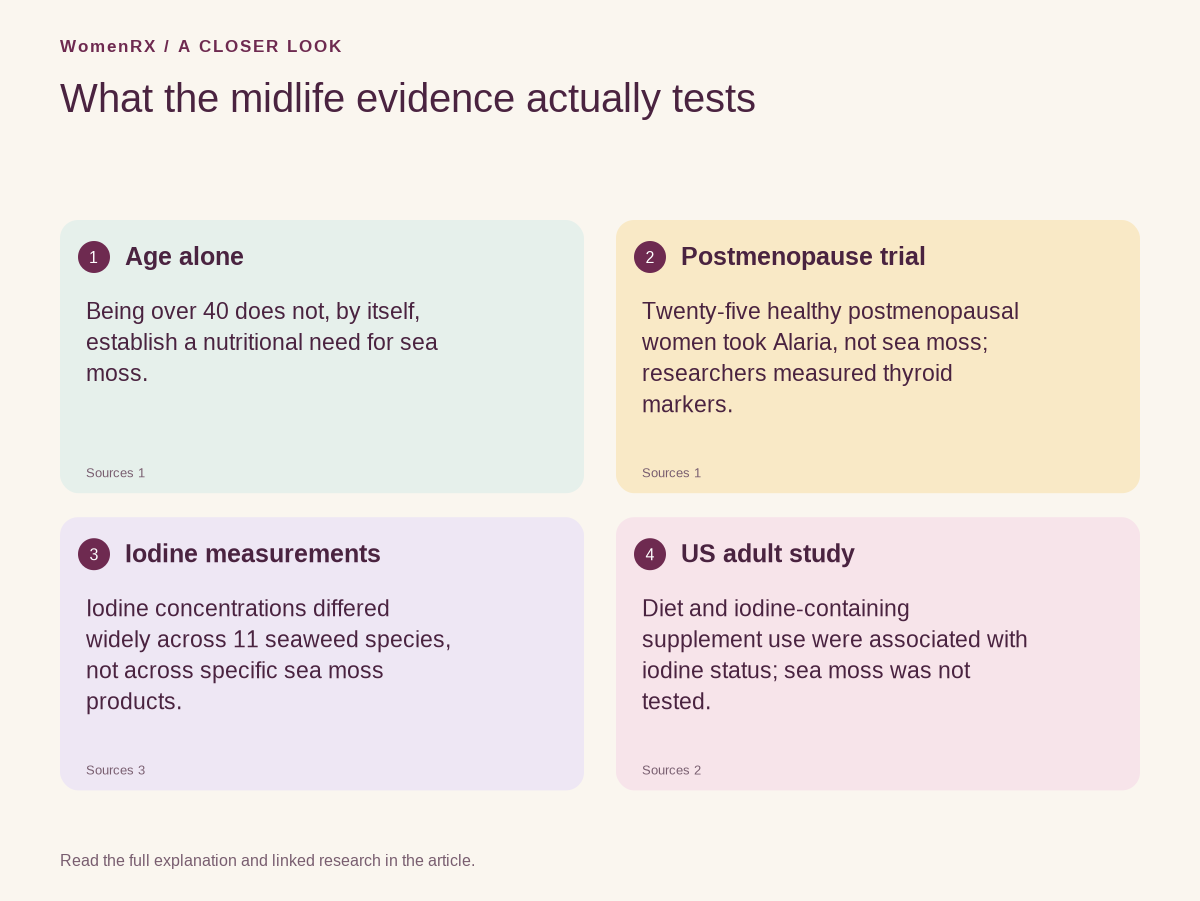
What the midlife evidence actually tests
Age alone: Being over 40 does not, by itself, establish a nutritional need for sea moss.1
Postmenopause trial: Twenty-five healthy postmenopausal women took Alaria, not sea moss; researchers measured thyroid markers.1
Iodine measurements: Iodine concentrations differed widely across 11 seaweed species, not across specific sea moss products.3
US adult study: Diet and iodine-containing supplement use were associated with iodine status; sea moss was not tested.2
Read the figure as text
Compare the population, product and outcome before applying a seaweed finding to sea moss.- Age alone: Being over 40 does not, by itself, establish a nutritional need for sea moss.1
- Postmenopause trial: Twenty-five healthy postmenopausal women took Alaria, not sea moss; researchers measured thyroid markers.1
- Iodine measurements: Iodine concentrations differed widely across 11 seaweed species, not across specific sea moss products.3
- US adult study: Diet and iodine-containing supplement use were associated with iodine status; sea moss was not tested.2
Sources you can check
- Seaweed and soy: companion foods in Asian cuisine and their effects on thyroid function in American women.Teas J, Braverman LE, Kurzer MS, Pino S, Hurley TG, Hebert JR. · Journal of medicinal food · 2007Return to first citation
- Food Group Intakes as Determinants of Iodine Status among US Adult Population.Lee KW, Shin D, Cho MS, Song WO. · Nutrients · 2016Return to first citation
- Perchlorate in seawater: bioconcentration of iodide and perchlorate by various seaweed species.Martinelango PK, Tian K, Dasgupta PK. · Analytica chimica acta · 2006Return to first citation