Sea Moss and Weight: What the Studies Can Tell You
Human studies offer some weight-related findings for selected seaweed preparations, but they don’t show that sea moss changes weight.
There’s no demonstrated weight benefit for sea moss in the human findings reported here. A review found favorable weight-related results for certain refined or extracted brown seaweed preparations, which can’t be assumed to apply to sea moss gel or capsules. Those studies also can’t tell you the iodine content or safety of a particular product. 2
A sea moss weight claim can sound more convincing when it’s backed by “seaweed research.” But seaweed is a broad category. To judge the claim, you need to know which preparation people took, what changed, and whether that result applies to the product in your hand.
The human results are about particular preparations
A systematic review and meta-analysis examined 11 intervention studies involving adults with overweight or obesity. Its pooled analysis found results favoring seaweed interventions for body mass index (BMI) and percentage of fat mass. The BMI finding was reported for refined or extracted brown seaweed, and the fat-mass finding for refined brown seaweed, in interventions lasting at least eight weeks. These are not results for sea moss gel or a sea moss capsule. 2
That distinction matters more than the word seaweed on a label. A finding for one type of processed seaweed ingredient doesn’t tell you that another species or preparation will have the same effect. The pooled results also aren’t a prediction of how many pounds an individual might lose. 2
BMI, body-fat percentage, and the number on a scale answer related but different questions. Body weight includes water, muscle, bone, and fat; BMI doesn’t distinguish among those tissues. If a product promises straightforward “weight loss,” a change in BMI or body-fat percentage in studies of other preparations is not enough to substantiate that promise. 12
The reported review findings don’t say whether outcomes differed for women or provide results by pregnancy, postpartum, perimenopausal, or postmenopausal status. They therefore can’t establish a women-specific sea moss effect. 2
Why the appetite and metabolism pitches get ahead of the research
Researchers have proposed several ways seaweed compounds might affect weight-related processes, including satiety, fat absorption, and fat-cell development. A proposed mechanism is a reason to investigate an ingredient, not proof that taking sea moss suppresses appetite or changes metabolism in people. 2
A separate review examined seaweed-derived polysaccharides in animal models of obesity. Its pooled food-intake analysis did not find a statistically significant difference between treated animals and controls. Animal experiments also can’t establish what happens to a person using a sea moss product. 3
Keep the iodine question separate
A weight study cannot tell you what’s in an individual jar or bottle. The human review reports outcomes across seaweed interventions; it does not provide the iodine amount or establish iodine-related safety for a particular sea moss product. That means a promising result for a studied preparation cannot serve as reassurance about a different product’s contents. 2
If you’re weighing a purchase, look for a clearly identified ingredient and product-specific iodine information rather than relying on a general seaweed claim. If that information isn’t given, the weight studies can’t fill it in. This is a limit on judging the product, not evidence that it is either safe or harmful.
For weight management, sea moss is hard to justify on the strength of these findings. The human results are worth distinguishing from marketing claims, but they don’t demonstrate that sea moss causes weight loss or gain. 2
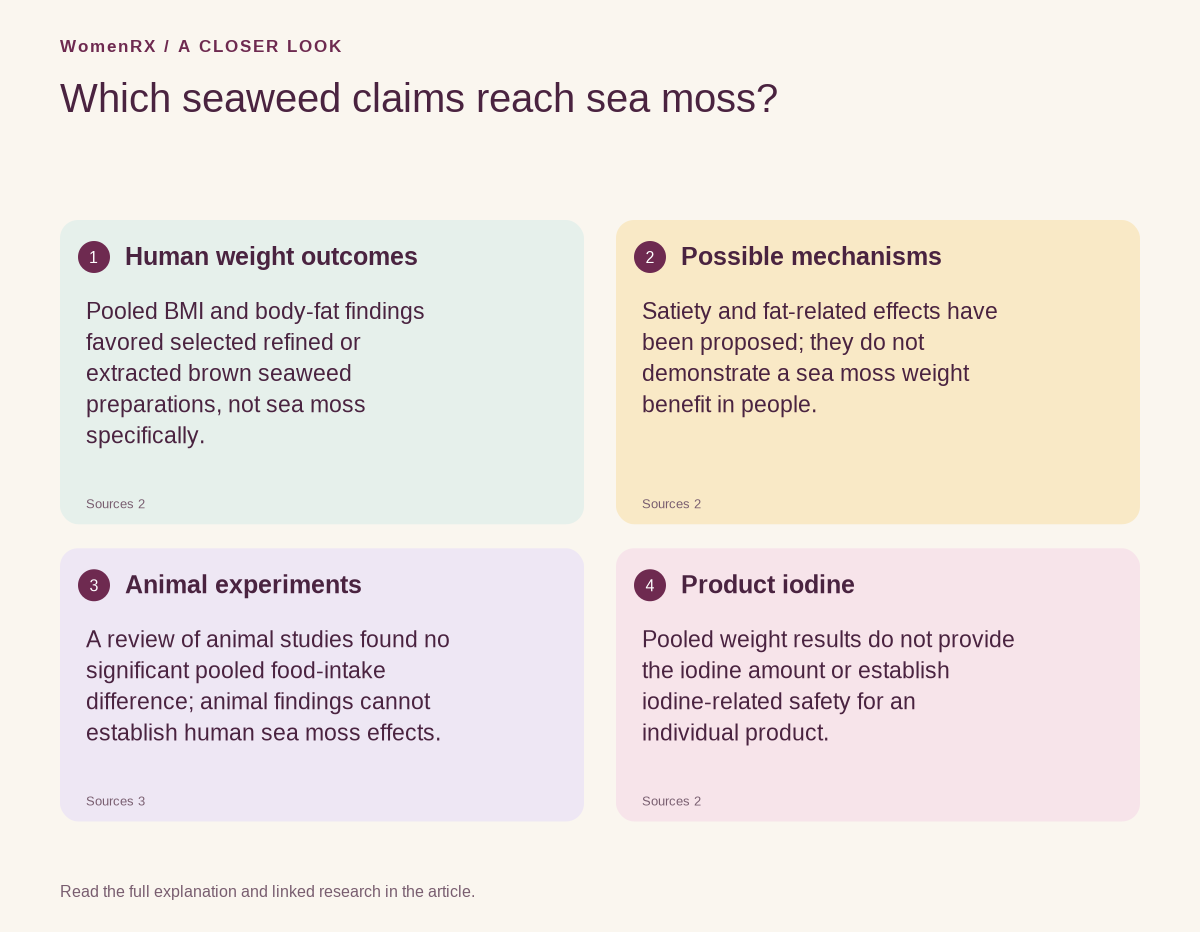
Which seaweed claims reach sea moss?
Human weight outcomes: Pooled BMI and body-fat findings favored selected refined or extracted brown seaweed preparations, not sea moss specifically.2
Possible mechanisms: Satiety and fat-related effects have been proposed; they do not demonstrate a sea moss weight benefit in people.2
Animal experiments: A review of animal studies found no significant pooled food-intake difference; animal findings cannot establish human sea moss effects.3
Product iodine: Pooled weight results do not provide the iodine amount or establish iodine-related safety for an individual product.2
Read the figure as text
This evidence map separates measured human outcomes from ideas and product questions that those outcomes cannot settle.- Human weight outcomes: Pooled BMI and body-fat findings favored selected refined or extracted brown seaweed preparations, not sea moss specifically.2
- Possible mechanisms: Satiety and fat-related effects have been proposed; they do not demonstrate a sea moss weight benefit in people.2
- Animal experiments: A review of animal studies found no significant pooled food-intake difference; animal findings cannot establish human sea moss effects.3
- Product iodine: Pooled weight results do not provide the iodine amount or establish iodine-related safety for an individual product.2
Sources you can check
- Body Weight: MedlinePlusAccessed 2026-09-25Return to first citation
- Effects of dietary seaweed on obesity-related metabolic status: a systematic review and meta-analysis of randomized controlled trials.Łagowska K, Jurgoński A, Mori M, Yamori Y, Murakami S, Ito T, Toda T, Pieczyńska-Zając JM, Bajerska J. · Nutrition reviews · 2025Return to first citation
- Anti-Obesity Effects of Sulphated Polysaccharides Derived from Marine Macro Algae or Seaweeds: A Systematic Review and Meta-Analysis.Magwaza SN, Chabalala VN, Hlongwane NP, Ismail H, Islam MS. · Marine drugs · 2024Return to first citation