What an Apple Gives You, and How to Eat It
A whole apple brings fiber to a snack, while its size and preparation shape the portion you eat and how filling it feels.
A medium raw Fuji apple with skin has about 4 grams of fiber, 29 grams of carbohydrate, and just 0.4 grams of protein. It’s a fruit, not a meaningful protein source. The whole apple may feel more filling than applesauce or juice, though you can choose the form that suits your meal and preferences. 62
Start with the apple you’re actually eating
For one medium raw Fuji apple with skin, USDA reference data estimate 121 calories, 29.2 grams of carbohydrate, 4 grams of fiber, 0.4 grams of protein, and 0.3 grams of fat. That apple weighs 192 grams. These are estimates for a defined variety and size, not numbers that fit every apple in the produce aisle. 6
Fiber is the standout in that profile. Dietary fiber is a carbohydrate found in plants; it helps digestion and can contribute to fullness. Apples also contain polyphenols, compounds that vary across apple varieties and parts of the fruit. Neither fact makes an apple a treatment for a health condition. 14
If you’ve heard apples described as a protein snack, the USDA number puts that in perspective: 0.4 grams in this medium Fuji. 6 You could pair the apple with yogurt or nut butter if you enjoy them. The apple can bring the fruit and fiber; it doesn’t have to do every job in the meal.
Size changes the portion more than a label does
“An apple” isn’t a fixed serving. If you want a smaller amount, cutting one to share or saving part for later is a straightforward choice. For scale, the same USDA Fuji reference lists 2.1 grams of fiber and 15.2 grams of carbohydrate per 100 grams of raw apple with skin, compared with 4 grams of fiber and 29.2 grams of carbohydrate in its 192-gram medium-apple portion. Those figures describe amounts of apple eaten, not a rule for how much you should eat. 6
Variety can matter too. Researchers measuring sugars in selected apple varieties found differences between them, and noted that ripeness and growing conditions complicate comparisons. That’s a reason not to treat the Fuji reference as an exact profile for every small, large, tart, or sweet apple. It isn’t a reason to hunt for a supposedly perfect variety. Choose one you like and consider its size when the portion matters to you. 56
Whole, sauced, or juiced: what changes?
Preparation affects more than convenience. In a study of 58 adults, researchers served matched-calorie portions of whole apple, applesauce, or apple juice before a meal. Participants reported the most fullness after the whole apple, followed by applesauce, then juice. The study tested a particular before-meal situation; it doesn’t tell you how hungry you’ll feel after every apple snack. 2
A separate crossover trial in 18 healthy adults compared equal-calorie portions of whole apple, apple purée, and juice. The whole apple left the stomach more slowly than the purée or juice and produced greater reported fullness and satiety than juice during the study period. Neither result establishes a special effect for women or for a particular life stage. 3
That makes the choice practical rather than moral. If you want fruit that takes time to eat and may feel more filling, reach for a whole apple or cut it into pieces. If you prefer a spoonable form, applesauce may fit a meal better. Juice offers a drink rather than the experience of eating a whole apple. Don’t transfer the 4-gram fiber figure for a medium raw Fuji with skin to a cup of sauce or a glass of juice: it isn’t a measured value for either product. 62
Keeping the skin is one way to eat the fruit represented by the USDA profile. Laboratory work has found differences in phenolic compounds between apple peel and flesh extracts, but it doesn’t show that eating the peel produces a particular health outcome. If you prefer your apple peeled, you can still enjoy it; just don’t use the with-skin nutrition figures as an exact match. 46
An apple can be a crisp snack, sliced into a meal, or cooked to suit your taste. Let the portion and preparation serve what you want from it: fruit and fiber from the measured whole-apple serving, more fullness from the whole form in the short-term studies, or simply a texture you enjoy. 623
Four ways to have an apple
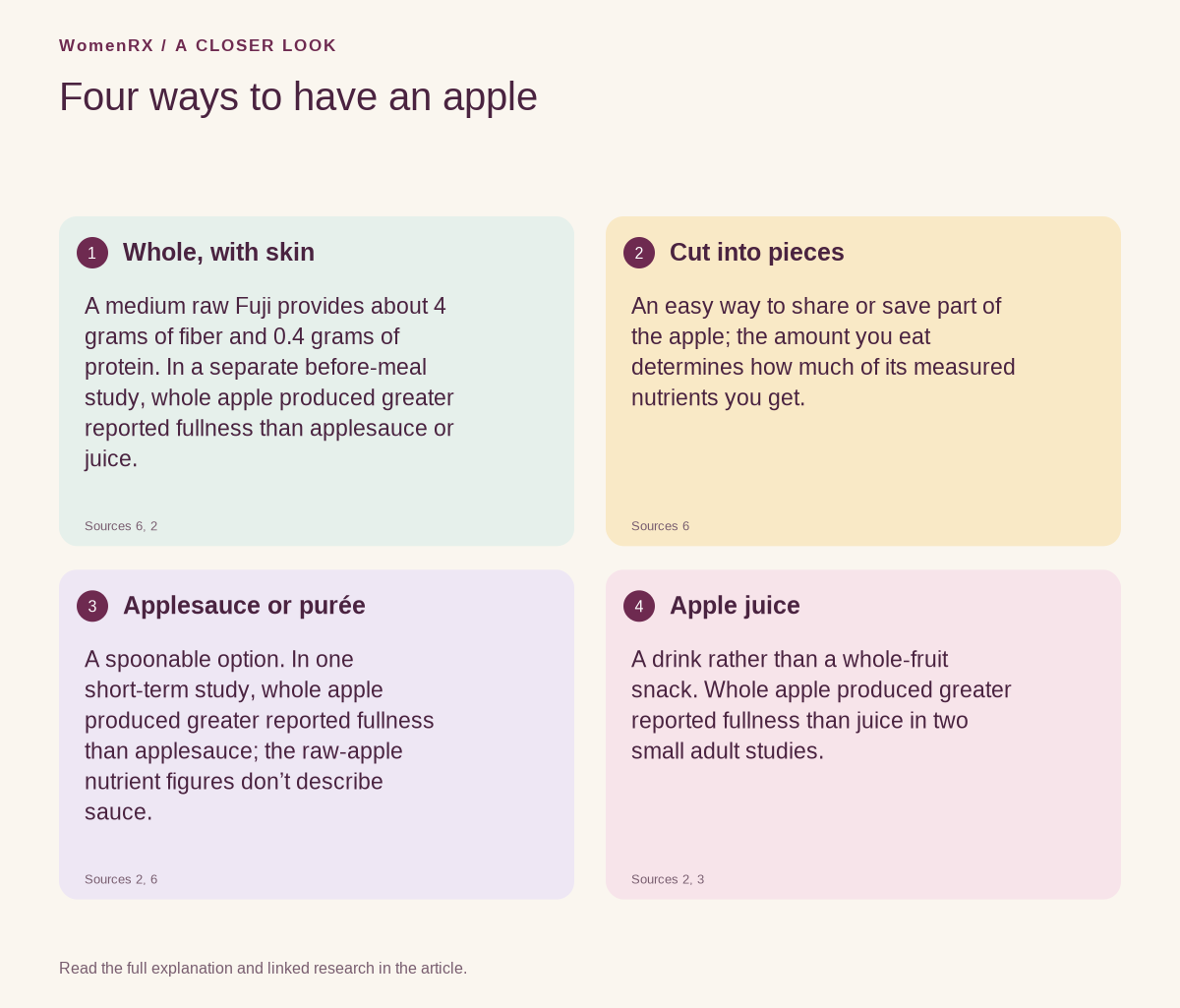
Whole, with skin: A medium raw Fuji provides about 4 grams of fiber and 0.4 grams of protein. In a separate before-meal study, whole apple produced greater reported fullness than applesauce or juice.62
Cut into pieces: An easy way to share or save part of the apple; the amount you eat determines how much of its measured nutrients you get.6
Applesauce or purée: A spoonable option. In one short-term study, whole apple produced greater reported fullness than applesauce; the raw-apple nutrient figures don’t describe sauce.26
Apple juice: A drink rather than a whole-fruit snack. Whole apple produced greater reported fullness than juice in two small adult studies.23
Read the figure as text
The same fruit can suit different meals, but the measured whole-apple nutrition figures and short-term fullness findings should not be applied to every form.- Whole, with skin: A medium raw Fuji provides about 4 grams of fiber and 0.4 grams of protein. In a separate before-meal study, whole apple produced greater reported fullness than applesauce or juice.62
- Cut into pieces: An easy way to share or save part of the apple; the amount you eat determines how much of its measured nutrients you get.6
- Applesauce or purée: A spoonable option. In one short-term study, whole apple produced greater reported fullness than applesauce; the raw-apple nutrient figures don’t describe sauce.26
- Apple juice: A drink rather than a whole-fruit snack. Whole apple produced greater reported fullness than juice in two small adult studies.23
Sources you can check
- Dietary Fiber: MedlinePlusAccessed 2026-09-25Return to first citation
- The effect of fruit in different forms on energy intake and satiety at a meal.Flood-Obbagy JE, Rolls BJ. · Appetite · 2009Return to first citation
- Processing Apples to Puree or Juice Speeds Gastric Emptying and Reduces Postprandial Intestinal Volumes and Satiety in Healthy Adults.Krishnasamy S, Lomer MCE, Marciani L, Hoad CL, Pritchard SE, Paul J, Gowland PA, Spiller RC. · The Journal of nutrition · 2020Return to first citation
- Structure-effect relationship of phenolic compounds on α-amylase inhibition studied by isothermal titration calorimetry.Xiong M, Plambeck J, Esatbeyoglu T, Buchweitz M. · Current research in food science · 2026Return to first citation
- Suitability of Selected Apple Varieties for People with Allergies and Diabetes.Aninowski M, Leszczyńska J, Bonikowski R, Ponder A, Hallmann E, Grzyb M, Szymczak K. · Nutrients · 2024Return to first citation
- USDA SR Legacy: Apples, raw, fuji, with skin (Includes foods for USDA's Food Distribution Program) (FDC 167793)Accessed 2026-09-25Return to first citation