Can Apples Help You Feel Fuller During Weight Loss?
A whole apple may satisfy you more than apple juice, but that short-term fullness effect isn’t proof that apples cause weight loss.
A whole apple can be a satisfying snack: in small, short-term experiments, people reported more fullness after eating whole apple than after drinking apple juice. That makes the fruit’s form relevant. But those studies measured fullness after eating, not lasting weight change, and they don’t show a special benefit for women. Apples can fit into a weight-loss eating pattern without being a weight-loss treatment. 34
The whole fruit may feel more satisfying
If you’re choosing between a whole apple and apple juice, the whole fruit has a plausible fullness advantage. In a randomized crossover study, 18 healthy adults consumed equal-calorie portions of whole apple, apple puree, and apple juice on separate occasions. They reported greater fullness and satiety after the whole apple than after the juice. The apple also left the stomach more slowly than either processed form during the study. 3
A separate randomized trial also found that participants felt more satiated 30 minutes after eating apple segments than after drinking apple juice. 4
These are useful findings about how food form can affect the experience of a snack. They don’t mean juice is inherently bad, or that an apple will keep you full for a particular length of time. The experiments looked at fullness after a single eating occasion, not whether eating apples regularly leads to lasting weight loss.
Why form and context matter
Whole fruit comes with fiber, and dietary fiber can add bulk and help you feel full. 2 That offers one reason a whole apple might feel different from juice, but the apple studies don’t isolate fiber as the sole cause. Eating and drinking are different experiences, too, and the whole-fruit comparison includes more than one difference in form.
For a practical choice, think about what you’ll actually eat and what will satisfy you. A whole apple can be a convenient snack on its own. If fruit alone doesn’t feel like enough, you could pair it with another food you enjoy, such as yogurt or nuts, or include it alongside a meal. That’s a way to shape a snack around your appetite, not a proven apple-based weight-loss formula.
Juice can still be part of your diet if you enjoy it. Just don’t assume a glass will have the same fullness effect as eating the fruit: the short-term comparisons found greater satiety after whole apple than after juice. 34
Fullness is not the same as weight loss
Feeling more satisfied after a snack could be useful if it helps you choose food that works for you. But an immediate fullness rating doesn’t tell us whether someone eats less later, maintains a change over time, or loses weight. The controlled apple experiments measured short-term responses, not long-term body-weight outcomes. 34
So the grounded answer is modest: apples may be a satisfying option, especially whole rather than juiced, but there’s no basis here to call them a fat-burning food or a weight-loss treatment. Weight management depends on a broader eating pattern and habits, not one fruit. 1
The short-term findings do not establish a women-specific fullness or weight-loss benefit. The studies report results for adult participants overall, without a women-only result. You don’t need a special apple strategy because you’re a woman; choose the form and snack context that feels satisfying to you.
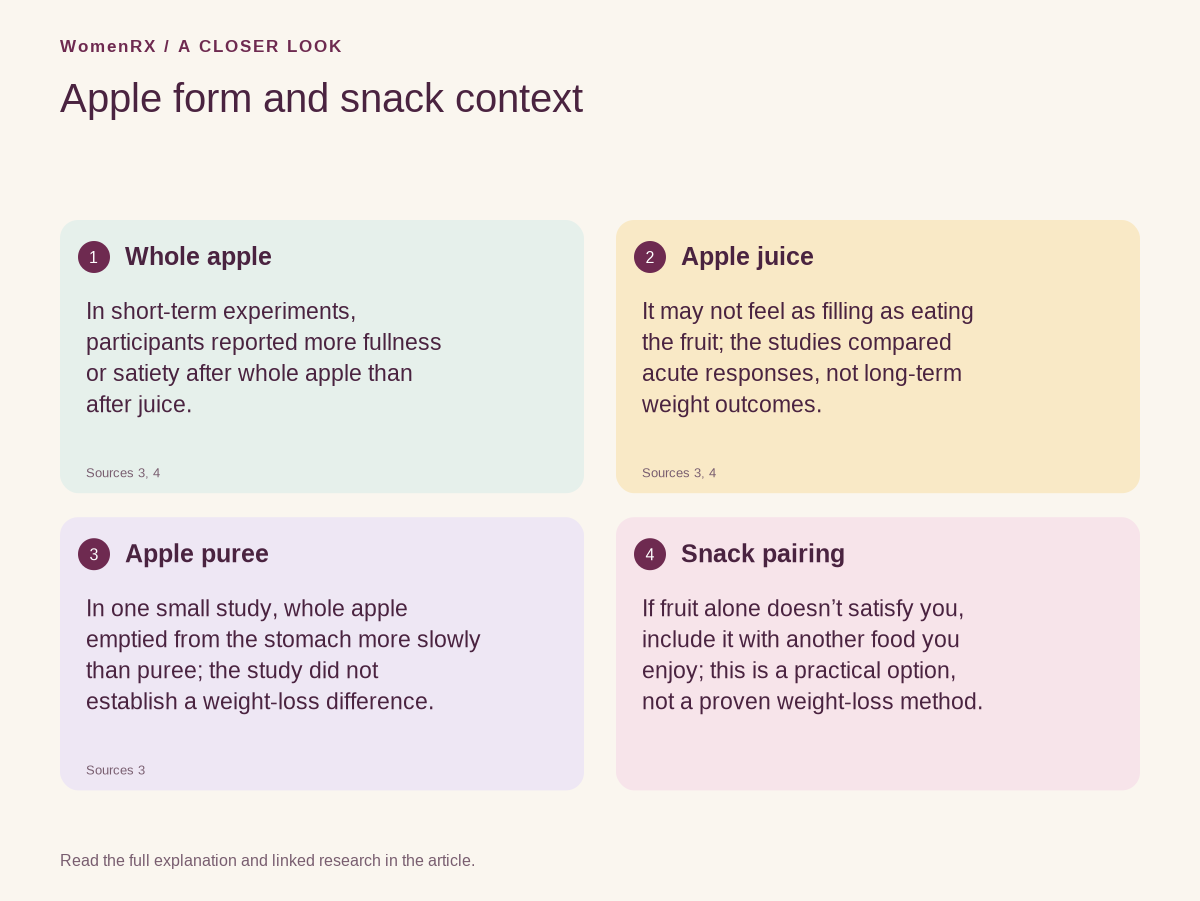
Apple form and snack context
Whole apple: In short-term experiments, participants reported more fullness or satiety after whole apple than after juice.34
Apple juice: It may not feel as filling as eating the fruit; the studies compared acute responses, not long-term weight outcomes.34
Apple puree: In one small study, whole apple emptied from the stomach more slowly than puree; the study did not establish a weight-loss difference.3
Snack pairing: If fruit alone doesn’t satisfy you, include it with another food you enjoy; this is a practical option, not a proven weight-loss method.
Read the figure as text
The comparison separates the short-term fullness evidence for different apple forms from practical snack choices that have not been tested as weight-loss treatments.- Whole apple: In short-term experiments, participants reported more fullness or satiety after whole apple than after juice.34
- Apple juice: It may not feel as filling as eating the fruit; the studies compared acute responses, not long-term weight outcomes.34
- Apple puree: In one small study, whole apple emptied from the stomach more slowly than puree; the study did not establish a weight-loss difference.3
- Snack pairing: If fruit alone doesn’t satisfy you, include it with another food you enjoy; this is a practical option, not a proven weight-loss method.
More questions, answered
Is apple juice just as filling as a whole apple?
Not in the short-term comparisons described here: participants reported more fullness or satiety after eating whole apple than after drinking apple juice. That doesn’t mean juice can’t fit into your diet, only that the two forms may not feel equally satisfying. 34
Do apples have a proven weight-loss effect for women?
The cited experiments measured fullness after eating, not lasting weight loss, and they don’t establish a women-specific weight-loss benefit. Apples can be part of a satisfying eating pattern, but a special effect for women hasn’t been established here. 34
Sources you can check
- Dietary Supplements for Weight Loss - Health Professional Fact SheetAccessed 2026-09-25Return to first citation
- Dietary Fiber: MedlinePlusAccessed 2026-09-25Return to first citation
- Processing Apples to Puree or Juice Speeds Gastric Emptying and Reduces Postprandial Intestinal Volumes and Satiety in Healthy Adults.Krishnasamy S, Lomer MCE, Marciani L, Hoad CL, Pritchard SE, Paul J, Gowland PA, Spiller RC. · The Journal of nutrition · 2020Return to first citation
- The effects of apples and apple juice on acute plasma uric acid concentration: a randomized controlled trial.White SJ, Carran EL, Reynolds AN, Haszard JJ, Venn BJ. · The American journal of clinical nutrition · 2018Return to first citation