Do Whole Oranges Support Weight Management?
A whole orange can be a useful snack choice, but the available orange trial did not demonstrate weight loss.
If you’re choosing between an orange and orange juice, the whole fruit is more likely to help you feel satisfied because it keeps its solid structure and fiber. Research on fruit overall suggests whole fruit can help limit long-term weight gain, but that doesn’t prove oranges cause weight loss. A small trial in adults with fatty liver found no change in body weight from daily oranges over four weeks. 2 3 4
The useful distinction is whole fruit versus juice
A whole orange can fit comfortably into a weight-management plan. It gives you a portion of fruit to eat, rather than a drink to sip, and it retains the fruit’s fiber. That makes it a reasonable snack if it replaces something you would otherwise eat. Adding it on top of your usual food is different: no single fruit automatically produces weight loss.
Much of the weight research is about fruit in general, not oranges specifically. A systematic review of adult studies found that whole-fruit intake was associated with a lower risk of long-term weight gain in middle-aged adults, and experimental studies suggested reduced overall energy intake could help explain the finding. The review also reported that fruit juice could have the opposite association over the long term. These results don’t show that an orange is a weight-loss treatment, and the review’s findings shouldn’t be read as proof that every glass of juice causes weight gain. 3
What changes when you drink the orange?
Juice can provide fruit nutrients, but it doesn’t have the same solid form as a whole orange. General food-form research offers a clue about why that may matter: in a meal experiment with 58 adults, eating a whole apple led to greater fullness and lower energy intake at the following meal than apple juice, including juice with added fiber. This was an apple study, not an orange study, so it supports a general comparison rather than a specific promise about oranges. 4
Juice isn’t automatically a poor choice. In a U.S. nutrition survey, adults who drank 100% fruit juice had higher energy intake and also higher diet-quality scores than nonconsumers. Because this was an observational study, it can’t tell us that juice caused either difference. If you enjoy juice, it can be part of your diet; it simply isn’t a like-for-like substitute for the intact fruit’s eating experience and fiber. 5
What orange-specific weight research tells us
One randomized trial tested daily whole oranges in 62 men and women with metabolic dysfunction-associated steatotic liver disease. Participants were assigned to oranges or non-citrus fruit for four weeks. The study reported no significant change in body weight, waist circumference, or body composition. Its main question was liver health, not weight loss, and the overall results don’t establish a different effect for women because sex-specific weight results weren’t reported. 2
So, the available trial did not demonstrate a special fat-burning or weight-loss effect from oranges. The study also doesn’t answer whether oranges help people lose weight over months or years.
A simple way to choose
- Choose a whole orange when you want a snack you can eat slowly and that includes the fruit’s fiber.
- Choose juice when that’s what you prefer, while remembering that a drink and a whole fruit may affect fullness differently. 4 5
- Think about what the orange replaces. A fruit snack in place of another snack may support your overall eating pattern; adding food without changing anything else doesn’t make the orange a weight-loss tool. Body weight reflects the overall pattern of food, activity, and other individual factors. 1
You don’t need to avoid oranges or rely on them for results. Pick the form you enjoy, and let the overall pattern do the work.
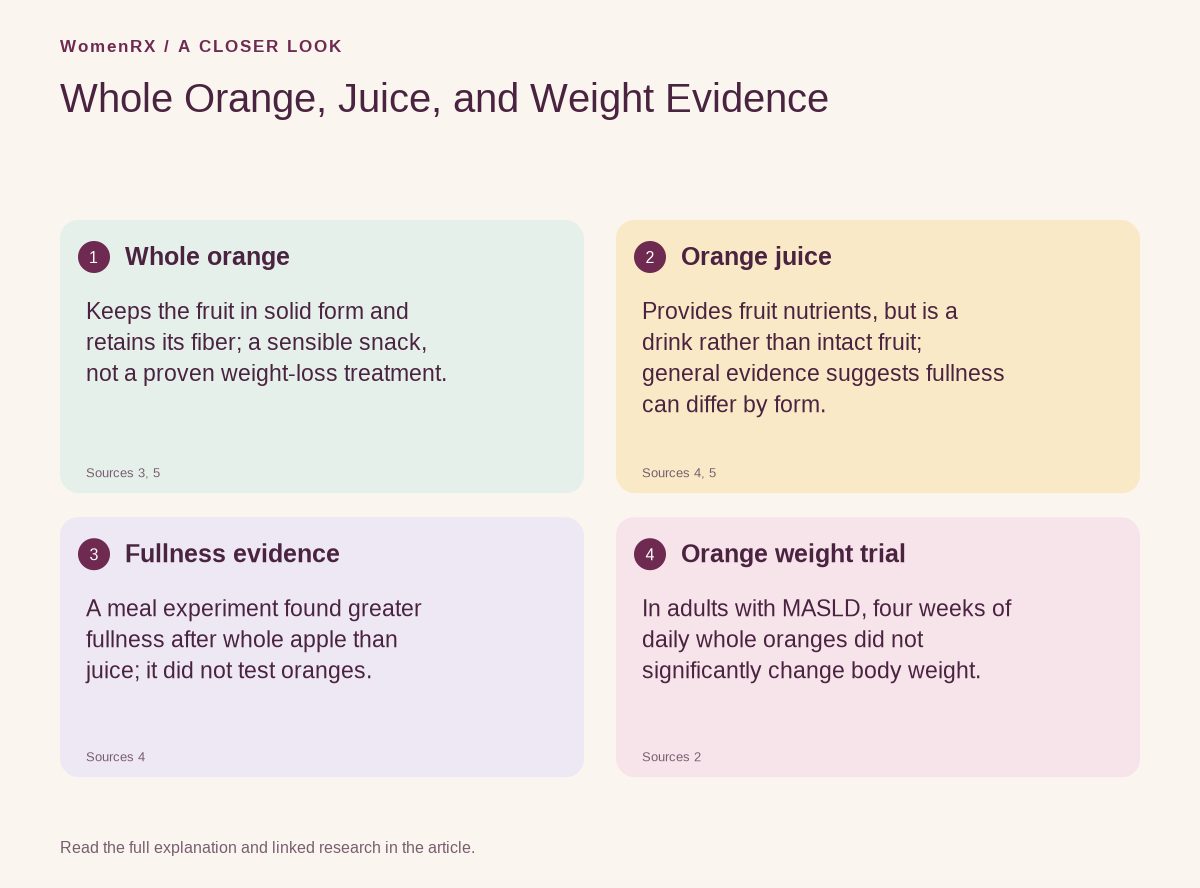
Whole Orange, Juice, and Weight Evidence
Whole orange: Keeps the fruit in solid form and retains its fiber; a sensible snack, not a proven weight-loss treatment.35
Orange juice: Provides fruit nutrients, but is a drink rather than intact fruit; general evidence suggests fullness can differ by form.45
Fullness evidence: A meal experiment found greater fullness after whole apple than juice; it did not test oranges.4
Orange weight trial: In adults with MASLD, four weeks of daily whole oranges did not significantly change body weight.2
Read the figure as text
Compare the food form with what the research can actually say about fullness and body weight.- Whole orange: Keeps the fruit in solid form and retains its fiber; a sensible snack, not a proven weight-loss treatment.35
- Orange juice: Provides fruit nutrients, but is a drink rather than intact fruit; general evidence suggests fullness can differ by form.45
- Fullness evidence: A meal experiment found greater fullness after whole apple than juice; it did not test oranges.4
- Orange weight trial: In adults with MASLD, four weeks of daily whole oranges did not significantly change body weight.2
More questions, answered
Are oranges better than orange juice for fullness?
The available meal experiment compared apples, not oranges, and found greater fullness after whole apple than after juice. That makes whole fruit a reasonable choice when fullness is your priority, but it doesn’t prove the same effect size for oranges. 4
Do oranges have a special weight-loss benefit for women?
The orange trial included both men and women, but it did not report a separate weight result for women. That doesn’t establish a unique effect based on sex. 2
Sources you can check
- Obesity: MedlinePlusAccessed 2026-09-25Return to first citation
- Daily Orange Consumption Reduces Hepatic Steatosis Prevalence in Patients with Metabolic Dysfunction-Associated Steatotic Liver Disease: Exploratory Outcomes of a Randomized Clinical Trial.Notarnicola M, Tutino V, De Nunzio V, Cisternino AM, Cofano M, Donghia R, Giannuzzi V, Zappimbulso M, Milella RA, Giannelli G, Fontana L. · Nutrients · 2024Return to first citation
- Fruit consumption and adiposity status in adults: A systematic review of current evidence.Hebden L, O'Leary F, Rangan A, Singgih Lie E, Hirani V, Allman-Farinelli M. · Critical reviews in food science and nutrition · 2017Return to first citation
- The effect of fruit in different forms on energy intake and satiety at a meal.Flood-Obbagy JE, Rolls BJ. · Appetite · 2009Return to first citation
- Diet quality is positively associated with 100% fruit juice consumption in children and adults in the United States: NHANES 2003-2006.O'Neil CE, Nicklas TA, Zanovec M, Fulgoni VL. · Nutrition journal · 2011Return to first citation