Period-Like Symptoms Without Bleeding: What Might Be Happening?
Familiar cramps or mood changes can happen before a period, but if bleeding is late, pregnancy is one possibility to check.
A “phantom period” isn’t a diagnosis. Cramps can start before bleeding, and pelvic pain can also come from the bowel, bladder, or reproductive organs.12 If your period is late and pregnancy is possible, take a pregnancy test rather than relying on symptoms to tell you.68 Severe or worsening pelvic pain needs urgent attention.1
First, check whether your period is actually late
A cramp on the day you expect your period can feel like a period that forgot to arrive. Pain or discomfort can begin just before bleeding starts, and menstrual cramps may spread into the back or thighs.2 If bleeding begins and the pain follows your familiar pattern, that’s different from having cramps while a period remains absent.
Mood changes can make the experience feel even more like your usual lead-up to a period. Premenstrual symptoms can include mood changes, bloating, breast tenderness, and cramping, and they typically ease after bleeding starts.67 But neither a familiar mood change nor a cramp can confirm PMS, pregnancy, or the reason bleeding hasn’t started. “Phantom period” is an informal description, not a diagnosis. The useful questions are: Is bleeding due yet? Is it late? And do these symptoms keep appearing around the same point in your cycle, or do they happen at unrelated times?
If bleeding stays absent, check for pregnancy
If your period is late and pregnancy is possible, take a pregnancy test. Pregnancy is a common reason for a missed period, and guidance on evaluating absent periods puts ruling it out first, even when a previously regular period is only about a week late.68 Cramps or mood changes can’t answer that question on their own. If a urine test is negative but bleeding remains absent or you have concerning symptoms, seek medical assessment; a negative urine result does not rule out pregnancy in every clinical situation.8
Pregnancy is not the only possible reason periods may remain absent. Other causes include medication effects and conditions involving the ovaries, hypothalamus, pituitary, or other hormone-producing glands.5 Symptoms near an expected bleeding date cannot distinguish among these possibilities.
One missed period isn’t the same as a diagnosis of amenorrhea. For someone whose periods were previously regular, going three months without menstruation meets a commonly used threshold for evaluating secondary amenorrhea. For someone whose periods were previously irregular, the threshold is six months. Those are evaluation thresholds, not a reason to wait if you have concerning pain or might be pregnant.8
Cycle length can also change across life stages. Longer gaps between periods commonly occur around the first menstrual years and during perimenopause. That can make an expected bleeding date less predictable, but it doesn’t mean period-like symptoms prove perimenopause or rule out pregnancy.5
When cramps may not be about your period
Pelvic pain can feel crampy even when it isn’t menstrual pain. Constipation or irritable bowel syndrome, a bladder or sexually transmitted infection, and conditions affecting reproductive organs, such as an ovarian cyst or endometriosis, are among the possibilities. Where pain happens and what comes with it can offer clues, but similar symptoms can have different causes.1
For example, pain that appears when you pee or have a bowel movement deserves attention even if it happens near the date you expected a period. Pain that keeps returning outside your usual premenstrual window is also worth discussing rather than repeatedly assuming it’s about to become a period.12 These patterns are clues to share, not a way to diagnose yourself. A mood change without bleeding is likewise worth noting in context: does it recur near an expected period, or appear at other times too? The pattern may help you describe what’s happening, but it won’t identify the cause on its own.
Know when not to wait for bleeding
Get urgent medical care if pelvic pain is severe, getting worse, or comes with faintness or shoulder-tip pain.1 Sharp pain on one side with nausea and vomiting can occur with ovarian torsion, an emergency, though symptoms alone can’t tell you whether that’s the cause.4 If pregnancy is possible and you have pelvic pain, seek prompt medical assessment rather than waiting to see whether a period starts. Ectopic pregnancy is another potentially serious cause of pelvic pain.13
Seek prompt medical advice for pelvic pain with painful or frequent urination. Arrange a medical appointment for pain during sex, pain when having a bowel movement, or bleeding between periods. These symptoms deserve attention even if they happen near an expected period.12 You don’t need to reach an amenorrhea threshold before raising a new or troubling symptom.28
If symptoms are mild and familiar, jot down when they started, when bleeding was expected or last occurred, and whether bleeding eventually starts. Note whether pain is centered or on one side, any bowel or urinary changes, and whether mood changes recur at a similar point in the cycle. That short record makes it easier to describe what’s different from your usual pattern if you need care.167
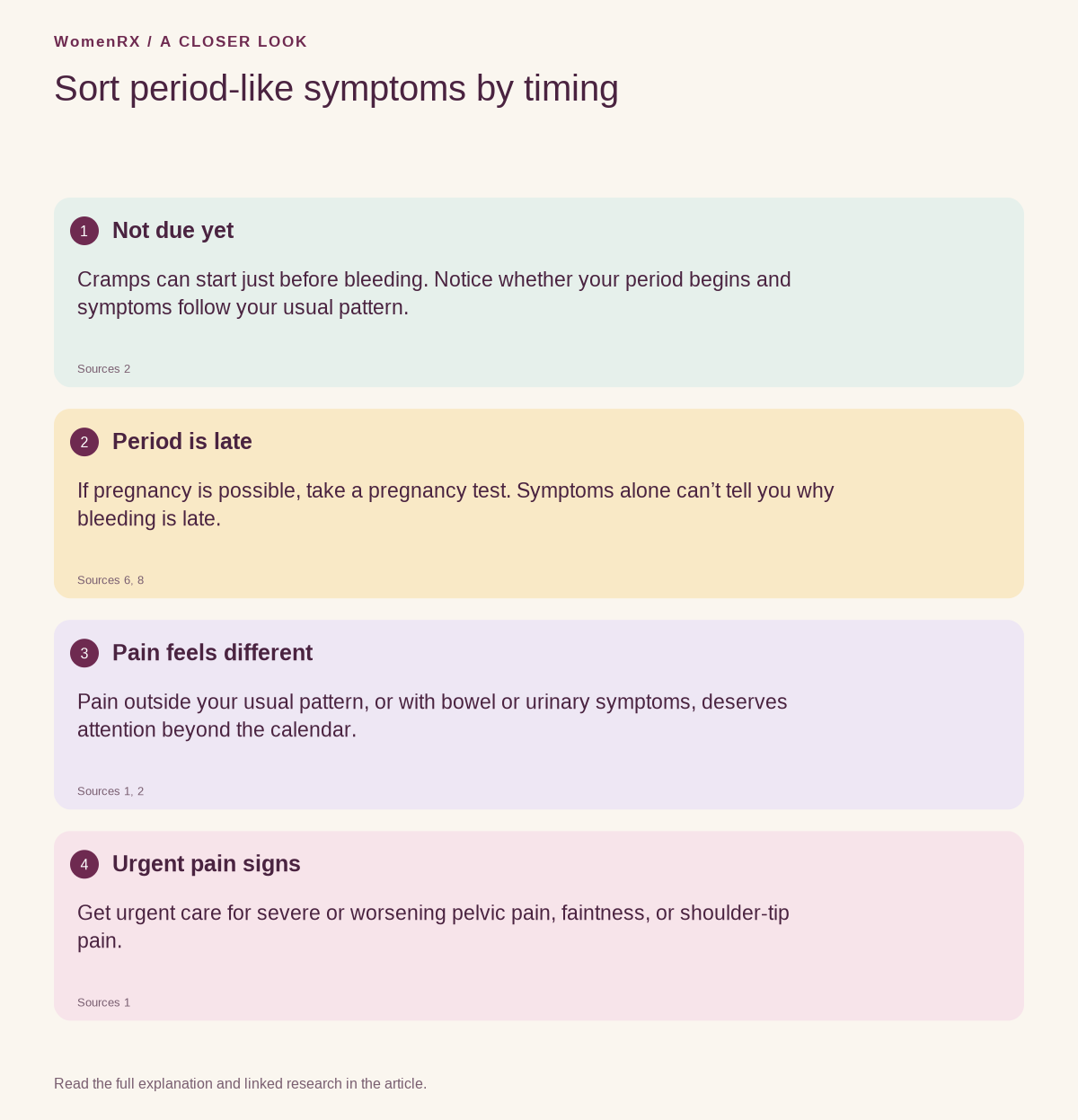
Sort period-like symptoms by timing
Not due yet: Cramps can start just before bleeding. Notice whether your period begins and symptoms follow your usual pattern.2
Period is late: If pregnancy is possible, take a pregnancy test. Symptoms alone can’t tell you why bleeding is late.68
Pain feels different: Pain outside your usual pattern, or with bowel or urinary symptoms, deserves attention beyond the calendar.12
Urgent pain signs: Get urgent care for severe or worsening pelvic pain, faintness, or shoulder-tip pain.1
Read the figure as text
Start with your expected bleeding date, then check for symptoms that change the next step.- Not due yet: Cramps can start just before bleeding. Notice whether your period begins and symptoms follow your usual pattern.2
- Period is late: If pregnancy is possible, take a pregnancy test. Symptoms alone can’t tell you why bleeding is late.68
- Pain feels different: Pain outside your usual pattern, or with bowel or urinary symptoms, deserves attention beyond the calendar.12
- Urgent pain signs: Get urgent care for severe or worsening pelvic pain, faintness, or shoulder-tip pain.1
Sources you can check
- Pelvic pain - NHSAccessed 2026-09-25Return to first citation
- Period pain - NHSAccessed 2026-09-25Return to first citation
- ESR Essentials: Gynaecological causes of acute pelvic pain in women: a primer for emergent evaluation-practice recommendations by the European Society of Emergency Radiology.Dick EA, Blanco A, De La Hoz Polo M, Basilico R. · European radiology · 2025Return to first citation
- Management of adnexal torsion: A 5-year experience from a tertiary center.Guclu M, Keles E, Baglar I, Ozturk A, Mat E. · Northern clinics of Istanbul · 2025Return to first citation
- AmenorrheaNawaz G, Rogol AD, Jenkins SM. · 2024Return to first citation
- Period problems - NHSAccessed 2026-09-25Return to first citation
- PMS (premenstrual syndrome) - NHSAccessed 2026-09-25Return to first citation
- Current evaluation of amenorrhea: a committee opinion (2024) | American Society for Reproductive Medicine | ASRMAccessed 2026-09-25Return to first citation