Bleeding or Swollen Gums: When to Get Help
Bleeding gums deserve a dental check, while severe swelling, loose teeth, or signs of a spreading infection call for faster help.
Book a dental visit if your gums bleed when you brush, floss, or eat, or if they’re painful or swollen. Ask for an urgent dental appointment if swelling is severe, a tooth becomes loose, or you suspect an abscess. If a dental problem comes with trouble breathing or swallowing, or difficulty opening your mouth, get emergency care. Menopause may be part of your health history, but it doesn’t explain away gum symptoms.452
What bleeding gums can mean
If you see blood on your toothbrush or floss, make a dental appointment rather than assuming you brushed too hard or that menopause is the cause. Bleeding, redness, swelling, and soreness are common signs of gum disease. Plaque that builds up on teeth can irritate the gums, but a dentist needs to examine your mouth to work out what’s happening.4
Mention changes you’ve noticed even if they don’t hurt. Gum disease can be associated with bad breath, a bad taste, gums that seem to be shrinking, and teeth that become loose. Bleeding when you eat something firm, such as an apple, also counts as a symptom worth reporting.4
When to seek help sooner
Ask for an urgent dental appointment if your gums are very sore and swollen, a tooth is becoming loose, or you have an ulcer, red patch, or lump in your mouth along with gum problems. Intense tooth or gum pain, a swollen face or jaw, a bad taste, or difficulty chewing can be signs of a dental abscess. An abscess needs urgent dental treatment and won’t clear up on its own.45
Get emergency medical help if a dental problem comes with difficulty breathing, speaking, or swallowing; substantial swelling inside your mouth; difficulty opening your mouth; or swelling or pain around an eye or a sudden change in vision. These are different from the usual question of whether to book a dental check.5
A dentist is the starting point for gum symptoms because they can examine both your teeth and gums. If gum disease is found, care depends on how severe it is, from cleaning advice and professional cleaning to treatment beneath the gumline for more serious disease. A painful or swollen area isn’t something to diagnose from its appearance alone.45
What menopause does, and doesn’t, tell you
You may notice mouth changes around perimenopause or menopause; sensitive teeth and painful gums are among the mouth problems reported during this time.3 A review comparing premenopausal and postmenopausal women found a tendency toward worse periodontal measurements after menopause. But most included studies were observational, results differed, and factors such as age, diabetes, smoking, and oral hygiene weren’t consistently accounted for. That means the findings don’t establish that menopause caused an individual woman’s gum problem.2
It’s useful to mention where you are in the menopause transition, especially if you’ve noticed other mouth changes. It’s more useful still to have the gums assessed rather than treating menopause as the diagnosis. For example, bleeding around several teeth and intense pain with swelling near one tooth are different descriptions for a dentist to investigate.245
A few details to bring to the dental visit
You don’t need a perfect symptom diary. Be ready to point out where your gums bleed or hurt, when you first noticed it, and whether you’ve seen swelling, recession, a bad taste, or a loose tooth. Tell the dentist if you’ve changed how you brush or clean between your teeth. Swelling, recession, a bad taste, and loose teeth are symptoms worth assessing, while cleaning habits matter because plaque buildup can irritate gums.4
Also share relevant health context, including diabetes or smoking.2 Bring an up-to-date list of medicines. If your mouth feels dry, mention that too. Those details give the dental team a fuller picture; none proves that menopause or a medicine is causing the gum change.
While arranging care, keep up the basics: brush twice a day with fluoride toothpaste and clean between your teeth daily. These habits help remove plaque, but they don’t replace an examination when your gums are bleeding, painful, swollen, or changing.14
What to tell your dentist
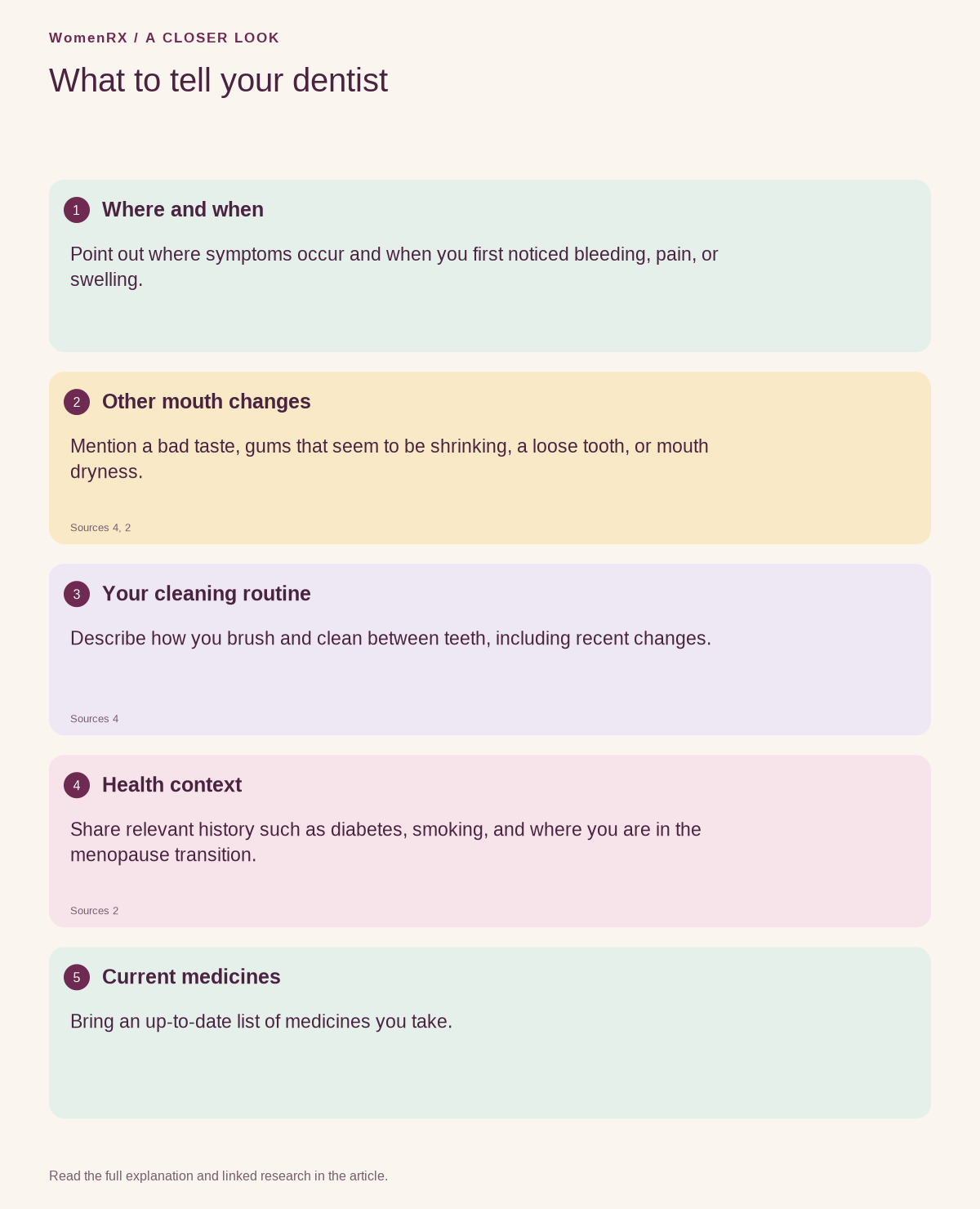
Where and when: Point out where symptoms occur and when you first noticed bleeding, pain, or swelling.
Other mouth changes: Mention a bad taste, gums that seem to be shrinking, a loose tooth, or mouth dryness.42
Your cleaning routine: Describe how you brush and clean between teeth, including recent changes.4
Health context: Share relevant history such as diabetes, smoking, and where you are in the menopause transition.2
Current medicines: Bring an up-to-date list of medicines you take.
Read the figure as text
Use these prompts to describe the gum problem and the context around it. They aren’t a diagnostic score.- Where and when: Point out where symptoms occur and when you first noticed bleeding, pain, or swelling.
- Other mouth changes: Mention a bad taste, gums that seem to be shrinking, a loose tooth, or mouth dryness.42
- Your cleaning routine: Describe how you brush and clean between teeth, including recent changes.4
- Health context: Share relevant history such as diabetes, smoking, and where you are in the menopause transition.2
- Current medicines: Bring an up-to-date list of medicines you take.
More questions, answered
Should I wait to see if bleeding gums stop?
Bleeding when you brush, floss, or eat is a reason to book a dental visit, even if you don’t have pain. A dentist can check whether gum disease or another dental problem needs attention.4
Should I see a dentist or a clinician about menopause?
Start with a dentist for the gum problem. If you also want to discuss broader perimenopause or menopause symptoms and care options, raise those separately with a medical clinician. Menopause alone can’t identify the cause of bleeding or swollen gums.432
Sources you can check
- Dental Health: MedlinePlusAccessed 2026-09-25Return to first citation
- Impact of menopause on clinical periodontal outcomes: a systematic review.Martín FC, Rus MJ, de la Cruz Gándara Alvarez A, Simon-Soro A, Cantiga-Silva C. · Clinical oral investigations · 2026Return to first citation
- Symptoms of menopause and perimenopause - NHSAccessed 2026-09-25Return to first citation
- Gum disease - NHSAccessed 2026-09-25Return to first citation
- Dental abscess - NHSAccessed 2026-09-25Return to first citation