Bleeding Gums in Your 40s: Look Beyond Hormones
Bleeding or tender gums can start during a time of hormonal change, but their timing doesn’t reveal the cause.
Bleeding or tender gums in your 40s aren’t enough to identify perimenopause as the cause. Plaque-related gum disease is a common possibility, and a dentist can check for it. Arrange a dental visit for gums that bleed, hurt, or swell. Seek earlier dental attention if swelling is severe, a tooth becomes loose, or you have signs of an abscess. 67
Timing is a clue, not an explanation
Maybe your gums started bleeding around the same time your periods became less predictable. It makes sense to wonder whether the changes are connected. Perimenopause is the transition when periods become irregular; menopause is defined by 12 months without a period when you’re not using hormonal contraception. Being in your 40s alone doesn’t establish that you’re in perimenopause. 5
There is a reason to keep hormones in the conversation, but not to stop there. A systematic review of nine observational studies found a tendency toward deeper gum pockets and more loss of the tissue attachment around teeth in postmenopausal women compared with premenopausal women. Results varied between studies, and bleeding measures were inconsistent. Those comparisons can’t show that perimenopause caused your bleeding gums. 1
What bleeding and tenderness can tell you
Gum disease can make gums red, swollen, sore, and likely to bleed during brushing, cleaning between teeth, or eating something firm. Plaque builds up on teeth and irritates the gums when it isn’t removed regularly. That gives a dentist a practical place to look, whether or not your periods are changing. 6
Bleeding is one measure of gum health, but it isn’t the same measure as pocket depth or attachment loss around teeth. The menopause studies assessed these separately. So where and when you see blood is useful to describe, but it doesn’t, by itself, settle whether deeper periodontal changes are present. 1
Brushing removes plaque from tooth surfaces, but the spaces between teeth are harder to reach and can develop gingivitis. If you notice blood or tenderness around certain teeth, that location is worth showing a dentist. It’s a clue about where to look, not proof that plaque, or hormones, caused it. 3
When to book, and when to be seen sooner
Arrange a dental visit if your gums bleed when you brush or eat firm food, or if they’re painful and swollen. A dentist can examine your teeth and gums and decide whether cleaning advice, professional cleaning, or further periodontal care is needed. You don’t need to wait to see whether the symptoms follow a menstrual pattern. 6
Ask for an earlier dental assessment if your gums become very sore and swollen, a tooth becomes loose, or you notice an ulcer, red patch, or lump in your mouth. Intense tooth or gum pain with facial or jaw swelling, a bad taste, or fever could signal a dental abscess, which needs urgent dental treatment. If swelling makes it hard to breathe or swallow, seek emergency medical care. 67
Cleaning between teeth: a choice, not a test
You don’t have to buy a powered tool to take bleeding seriously. In a review of randomized trials involving people with gingivitis, adding a liquid-based powered interdental cleaner to brushing reduced bleeding between teeth compared with brushing alone. When powered interdental tools were compared with brushing plus flossing, bleeding outcomes were comparable. The review did not establish that one tool is the right fit for every mouth. 3
Regular brushing and cleaning between your teeth help remove the plaque that irritates gums. If cleaning between your teeth is difficult, ask your dental team what fits the spaces you have. That question is more useful than treating a new device as a way to diagnose, or rule out, gum disease. 63
Other factors belong in the picture
Smoking is another reason not to assume a gum problem is hormonal. It’s an established periodontal risk factor, although bleeding by itself won’t tell you how smoking has affected your gums. The smoking-cessation research includes men and women; a result specifically for women in their 40s was not reported. 2
Mention your medication history at the dental visit, including any recent changes, rather than assuming the timing points to hormones. If you use hormone therapy, that context is especially relevant to interpreting the menopause research: hormone therapy use was one of the differences between studies that made their results harder to compare. This research does not establish that a particular medication caused your bleeding. 1
The pattern matters beyond your mouth, too. If you also notice unexplained bruising or bleeding elsewhere, tell a medical clinician as well as your dentist. Problems with platelets or clotting factors are among the possible reasons bleeding may not stop normally; gum bleeding alone cannot establish one. 4
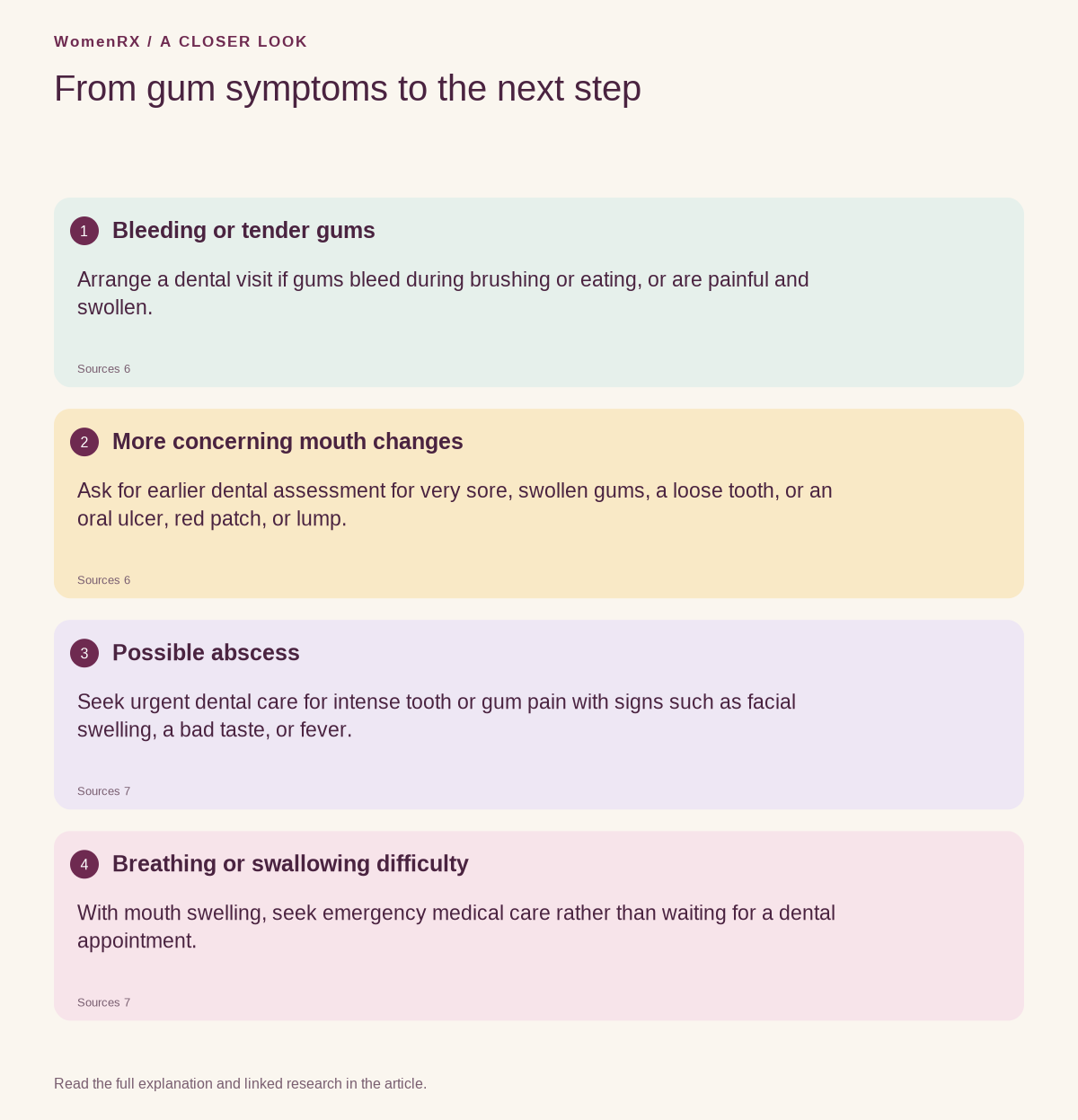
From gum symptoms to the next step
Bleeding or tender gums: Arrange a dental visit if gums bleed during brushing or eating, or are painful and swollen.6
More concerning mouth changes: Ask for earlier dental assessment for very sore, swollen gums, a loose tooth, or an oral ulcer, red patch, or lump.6
Possible abscess: Seek urgent dental care for intense tooth or gum pain with signs such as facial swelling, a bad taste, or fever.7
Breathing or swallowing difficulty: With mouth swelling, seek emergency medical care rather than waiting for a dental appointment.7
Read the figure as text
Use the symptoms you notice to decide whether to arrange a dental visit, ask to be seen sooner, or seek emergency care.- Bleeding or tender gums: Arrange a dental visit if gums bleed during brushing or eating, or are painful and swollen.6
- More concerning mouth changes: Ask for earlier dental assessment for very sore, swollen gums, a loose tooth, or an oral ulcer, red patch, or lump.6
- Possible abscess: Seek urgent dental care for intense tooth or gum pain with signs such as facial swelling, a bad taste, or fever.7
- Breathing or swallowing difficulty: With mouth swelling, seek emergency medical care rather than waiting for a dental appointment.7
More questions, answered
Does bleeding when I clean between my teeth mean I should stop?
Bleeding alone doesn’t establish what’s happening beneath the gumline. Cleaning between teeth helps remove plaque, but a tool that’s difficult to use may not fit your teeth well. Ask your dental team to check the bleeding area and help you choose a workable approach. 631
Sources you can check
- Impact of menopause on clinical periodontal outcomes: a systematic review.Martín FC, Rus MJ, de la Cruz Gándara Alvarez A, Simon-Soro A, Cantiga-Silva C. · Clinical oral investigations · 2026Return to first citation
- Association between smoking cessation and periodontitis progression: a systematic review and meta-analysis of prospective observational studies.Xie Y, Ma Y, Geng Z, Zhao H, Li X, Wang L, Yan P, Jiang X, Zhang M. · Frontiers in oral health · 2026Return to first citation
- Efficacy of power-driven interdental cleaning tools: A systematic review and meta-analysis.Edlund P, Bertl K, Pandis N, Stavropoulos A. · Clinical and experimental dental research · 2023Return to first citation
- Hemorrhage | Bleeding | MedlinePlusAccessed 2026-09-25Return to first citation
- What are menopause and perimenopause? - NHSAccessed 2026-09-25Return to first citation
- Gum disease - NHSAccessed 2026-09-25Return to first citation
- Dental abscess - NHSAccessed 2026-09-25Return to first citation