Menopause, Hormones, and Gum Problems: What’s the Link?
Hormonal shifts may change how gum tissue responds to irritation, but bleeding or sore gums still deserve a dental explanation.
Hormones can influence gum inflammation, and menopause is also associated in research with oral dryness and periodontal changes. But a symptom like bleeding doesn’t show whether you have gum disease or whether hormones caused it. A dental exam can look for plaque-related inflammation and assess the tissues around your teeth; dry mouth is a separate symptom worth mentioning too. 4 6
Hormones can affect the response, not explain every symptom
Gum tissue doesn’t respond to inflammation in isolation. A 2025 narrative review describes how sex hormones may alter the way periodontal tissue responds to local factors, especially plaque biofilm. That offers a plausible link between hormonal changes and gum symptoms, but it doesn’t mean hormones alone cause gum disease. 4
This distinction matters if you notice bleeding, soreness, or other changes around menopause. A symptom is not a diagnosis: gum inflammation, damage to the supporting tissues around teeth, and dry mouth are different issues. Hormonal context can be part of the picture without being the whole explanation.
Menopause research points to possible changes, with limits
A 2026 scoping review describes menopause as a period when lower sex hormone levels may be associated with dry mouth, changes in salivary flora, and bone loss that could contribute to worsening periodontal disease. Those are related but distinct outcomes: feeling dry is not the same as having periodontitis, and a review’s summary does not show that every woman will experience these changes. 6
Some individual studies have compared periodontal findings before and after menopause. One cross-sectional study assessed 60 women aged 40 to 60 and reported higher average plaque, gum inflammation, calculus, pocket-depth, and attachment-loss scores in its postmenopausal group than in its premenopausal group. Because the study was small and observed the groups at one point in time, it can show a difference between those participants, not that menopause caused it or what any one woman’s risk will be. 5
A separate controlled clinical trial abstract described 210 menopausal women who already had periodontal disturbances. It reported improvements in some measures among women receiving hormone therapy, but found no significant result for gum recession. Since the participants already had problems and the report does not establish a general preventive effect, it isn’t a basis for using hormone therapy to prevent gum disease. 3
Taken together, the evidence supports a possible hormonal influence on gum tissue, not a rule that menopause inevitably causes periodontal disease. The studies also do not make bleeding, soreness, dry mouth, and diagnosed periodontal damage interchangeable outcomes.
What a dental assessment can clarify
A dentist can examine the gums and the tissues that support the teeth, including measures such as pocket depth and attachment loss used in periodontal research. They can also assess signs of plaque and calculus, which matter because plaque biofilm is a key local factor in the hormonal-response explanation. 4 5
When you make an appointment for persistent gum changes, describe what you’re noticing and when it began. Mention dry mouth separately, and include menopause or other hormonal changes and medicines you take; medications can also be associated with changes inside the mouth. 2 This gives the dental team context without assuming the cause in advance.
Regular dental care is part of looking after your teeth and gums. 1 If you have a symptom, an examination is more useful than trying to decide from the symptom alone whether it is hormonal or periodontal. Your next step is a dental assessment that distinguishes gum inflammation or tissue changes from dryness and other oral concerns.
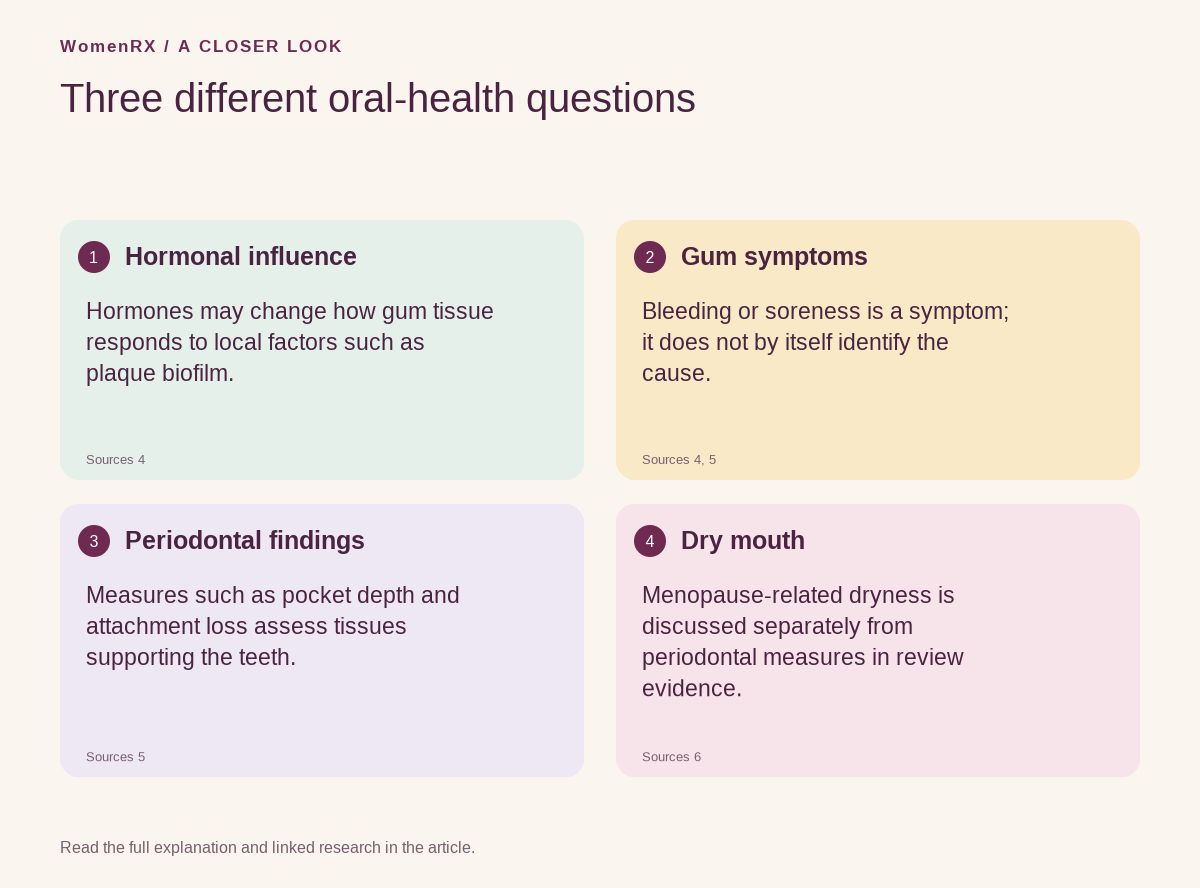
Three different oral-health questions
Hormonal influence: Hormones may change how gum tissue responds to local factors such as plaque biofilm.4
Gum symptoms: Bleeding or soreness is a symptom; it does not by itself identify the cause.45
Periodontal findings: Measures such as pocket depth and attachment loss assess tissues supporting the teeth.5
Dry mouth: Menopause-related dryness is discussed separately from periodontal measures in review evidence.6
Read the figure as text
Gum symptoms, periodontal findings, and dry mouth can overlap, but they describe different things and need different assessment.- Hormonal influence: Hormones may change how gum tissue responds to local factors such as plaque biofilm.4
- Gum symptoms: Bleeding or soreness is a symptom; it does not by itself identify the cause.45
- Periodontal findings: Measures such as pocket depth and attachment loss assess tissues supporting the teeth.5
- Dry mouth: Menopause-related dryness is discussed separately from periodontal measures in review evidence.6
More questions, answered
Is dry mouth the same as gum disease?
No. Dry mouth is an oral symptom, while periodontal disease involves the tissues supporting the teeth. Menopause-related dry mouth is discussed in a scoping review, but dryness alone does not establish periodontal disease. 6
Sources you can check
- Dental Health: MedlinePlusAccessed 2026-09-25Return to first citation
- Health Effects of Oral Contraceptives on Periodontal Disease and Gingivitis: A Cross-Sectional Questionnaire-Based Study Among Saudi Women in Jeddah.AlGhamdi SA, Altowairqi K, Altowairqi YG, Alkharobi H, Alfayez E, Mansouri R, Aljahdali B, Badahdah A, Alqarni NM, Qumusan GS, Alrafiah A. · Clinical, cosmetic and investigational dentistry · 2023Return to first citation
- Periodontal aspects in menopausal women undergoing hormone replacement therapy.López-Marcos JF, García-Valle S, García-Iglesias AA. · Medicina oral, patologia oral y cirugia bucal · 2005Return to first citation
- The Impact of Female Hormones on the Periodontium-A Narrative Review.Reeves J. · International journal of dental hygiene · 2025Return to first citation
- Assessment of Periodontal Status in Pre- and Postmenopausal Women with Chronic Periodontitis: A Cross-Sectional Study.Agrawal R, Ahmed H, Soorgani N, Naik L, Reddy S, Medabalmi M. · Journal of pharmacy & bioallied sciences · 2021Return to first citation
- Impact of female hormonal changes throughout life on oral health: A scoping review.Lopes Cardoso I, Fryde M, Guimarães MI, Leal F. · Journal of dental sciences · 2026Return to first citation