Gum Problems Around Menopause: Where Supplements Fit
Bleeding or receding gums deserve a dental assessment; supplements cannot replace periodontal care.
If your gums bleed, feel sore, or seem to be receding, arrange a dental assessment rather than trying a supplement first. An exam can establish whether you need periodontal care, including treatment to remove deposits beneath the gumline. Vitamin D may offer a small additional benefit during treatment for some people with low levels, but the findings are mixed and aren’t specific to menopause. 643
Gum changes may catch your attention during perimenopause or after menopause. The timing is worth mentioning to your dentist, but it doesn’t tell you what’s causing the bleeding or recession. If your gums bleed, feel sore, or look as though they’re receding, arrange a dental assessment. The useful first question is whether you have gum inflammation or damage to the tissues supporting your teeth. 6
Why a vitamin cannot replace periodontal care
Periodontitis involves an inflammatory response to microbes around the teeth. It can begin with gum inflammation and progress to loss of supporting tissue. A dentist can assess what’s happening around your teeth and whether you need treatment beneath the gumline. Depending on the findings, periodontal care can include instruction on cleaning your teeth and gums, professional removal of plaque and hardened deposits, and other treatment. A supplement cannot do that cleaning. 64
That distinction is especially useful if you’re deciding whether to wait and try an oral-health supplement. For example, blood when you brush or a gumline that looks lower than it used to cannot tell you how much support the teeth have lost. Tell the dental team what has changed, where you’ve noticed it, and whether you’re already taking supplements. The exam, not the timing of menopause, can establish what care your gums need. 6
What vitamin D research actually shows
Vitamin D helps your body absorb calcium and supports normal bone health. That makes it reasonable to ask about during midlife, but a benefit for bones doesn’t automatically mean a supplement treats gum disease. 2
Researchers have tested vitamin D alongside nonsurgical periodontal treatment, often called scaling and root planing. A 2026 systematic review found four eligible trials. Its authors reported little added clinical benefit in people whose vitamin D levels were already sufficient and more promising results in people with low levels, while calling for larger, longer trials. 3
The findings aren’t uniform. A 2023 meta-analysis found a small improvement in a measure of how firmly teeth are supported when vitamin D was added to scaling and root planing, but no meaningful additional improvement in pocket depth, gum inflammation, or bleeding measures. An earlier review found too few intervention studies to draw a conclusion about supplementation after periodontal treatment. Taken together, these results make vitamin D a possible adjunct in selected people, not a stand-alone treatment or a dependable way to stop bleeding gums. The studies do not establish a particular benefit for women around menopause. 463
If you have a reason to suspect low vitamin D, such as a condition that limits nutrient absorption, ask your usual care clinician whether assessing your vitamin D status makes sense. A blood test can measure it, but routine testing isn’t recommended for every healthy adult. Correcting a deficiency is a separate decision from treating the cause of gum symptoms. Taking more vitamin D than you need can be harmful, especially if you’re combining products that contain it. 12
What about vitamin C or calcium?
Vitamin C has a different evidence picture. A review of six trials found some improvement in bleeding measures for gingivitis, but vitamin C added to nonsurgical treatment did not produce a clinically significant improvement in pocket depth after three months for people with periodontitis. The reviewers could not recommend it to improve the main outcomes of initial periodontal treatment. Less bleeding, in other words, would not prove that deeper disease has been treated. 5
Calcium belongs in a conversation about meeting your nutritional needs and maintaining bone health, particularly after menopause. Vitamin D helps the body absorb it. But bone-health evidence is not evidence that a calcium supplement repairs receding gums or replaces periodontal care. Before adding calcium and vitamin D together, consider what you already get from food and other supplements: excess vitamin D can cause harm, and a large trial in postmenopausal women found more kidney stones in the group assigned calcium plus vitamin D than in the placebo group. 2
What a dental review can clarify
For a dental review, bring a list of the changes you’ve noticed and supplements you take. Ask what the exam shows about inflammation, pockets, and support around your teeth; whether deposits need professional removal; and which areas need more attention when you clean your teeth and gums. 64 If you’re considering a supplement, ask a more precise question: ‘Do I have a reason to suspect a nutrient deficiency, and would addressing it change my care?’ That keeps nutrition in its proper place, supporting your overall health without delaying treatment your gums may need. 635
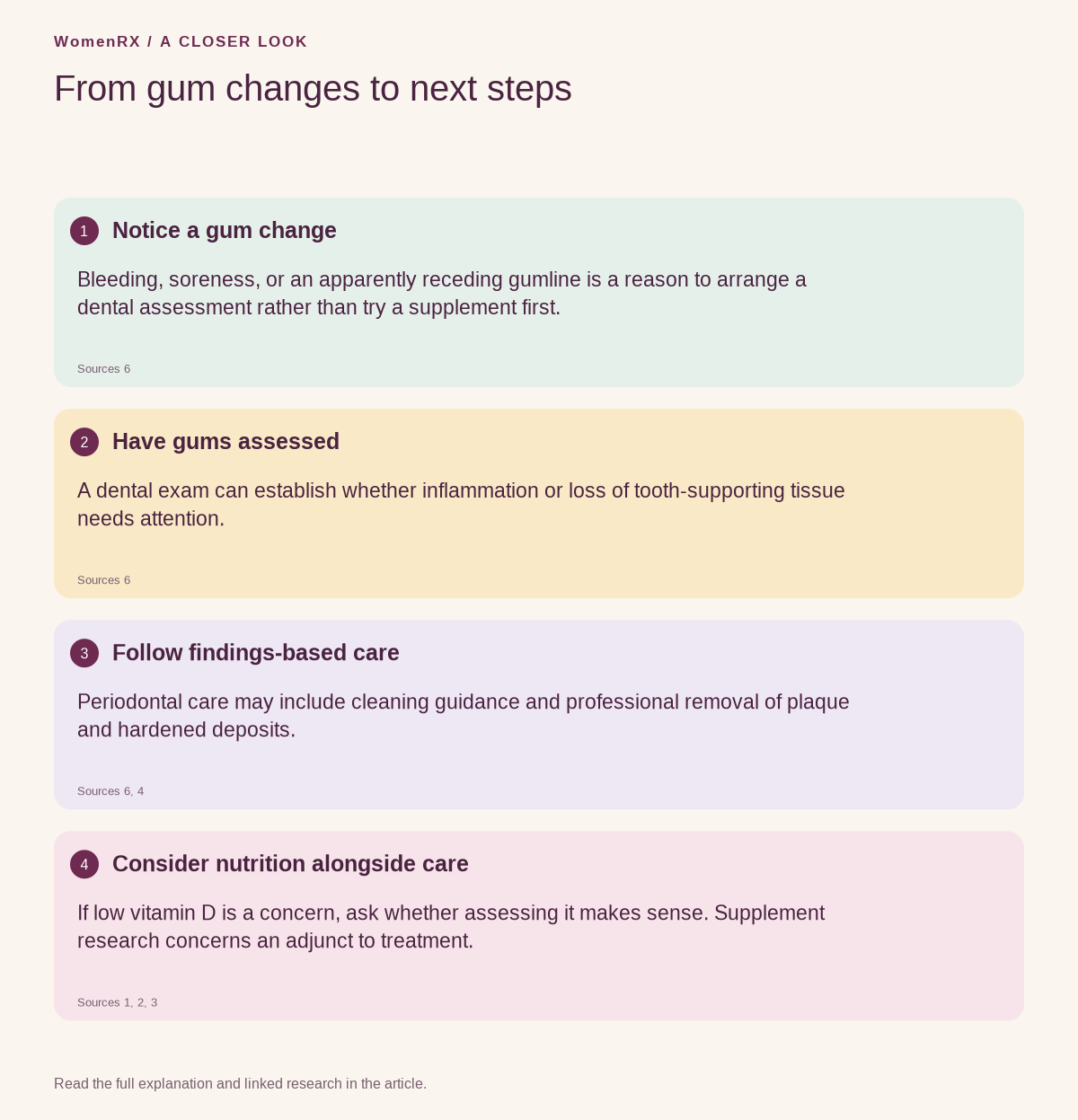
From gum changes to next steps
Notice a gum change: Bleeding, soreness, or an apparently receding gumline is a reason to arrange a dental assessment rather than try a supplement first.6
Have gums assessed: A dental exam can establish whether inflammation or loss of tooth-supporting tissue needs attention.6
Follow findings-based care: Periodontal care may include cleaning guidance and professional removal of plaque and hardened deposits.64
Consider nutrition alongside care: If low vitamin D is a concern, ask whether assessing it makes sense. Supplement research concerns an adjunct to treatment.123
Read the figure as text
Start with an assessment of the gum change; consider nutrition alongside any care the exam shows you need.- Notice a gum change: Bleeding, soreness, or an apparently receding gumline is a reason to arrange a dental assessment rather than try a supplement first.6
- Have gums assessed: A dental exam can establish whether inflammation or loss of tooth-supporting tissue needs attention.6
- Follow findings-based care: Periodontal care may include cleaning guidance and professional removal of plaque and hardened deposits.64
- Consider nutrition alongside care: If low vitamin D is a concern, ask whether assessing it makes sense. Supplement research concerns an adjunct to treatment.123
More questions, answered
Does menopause itself mean I need vitamin D for my gums?
No. The periodontal supplement reviews do not establish that menopause causes gum disease or that vitamin D works differently for women in perimenopause or postmenopause. Vitamin D needs and possible deficiency are worth considering on their own merits, not as a substitute for finding out why your gums have changed. 342
Sources you can check
- Vitamin D Deficiency: MedlinePlusAccessed 2026-09-25Return to first citation
- Vitamin D - Health Professional Fact SheetAccessed 2026-09-25Return to first citation
- The Effectiveness of Vitamin D Supplementation in Association with Non-Surgical Periodontal Therapy: A Systematic Review.Pesce P, Bagnasco F, de Angelis N, Isola G, Portaccio C, Migliorati M, Menini M. · Dentistry journal · 2026Return to first citation
- Association of vitamin D in individuals with periodontitis: an updated systematic review and meta-analysis.Liang F, Zhou Y, Zhang Z, Zhang Z, Shen J. · BMC oral health · 2023Return to first citation
- Efficacy of vitamin C supplementation as an adjunct in the non-surgical management of periodontitis: a systematic review.Fageeh HN, Fageeh HI, Prabhu A, Bhandi S, Khan S, Patil S. · Systematic reviews · 2021Return to first citation
- Vitamin D and Periodontitis: A Systematic Review and Meta-Analysis.Machado V, Lobo S, Proença L, Mendes JJ, Botelho J. · Nutrients · 2020Return to first citation