Can CBT-I Help With Sleep Problems Around Menopause?
CBT-I improved insomnia in a trial of women with frequent hot flashes, even though it didn’t reduce how often the flashes occurred.
Yes, CBT-I may help if trouble falling or staying asleep has become an ongoing problem during perimenopause or after menopause. In a randomized trial of 106 women with insomnia symptoms and frequent hot flashes, telephone CBT-I improved insomnia more than menopause education. It did not reduce hot-flash frequency, and it doesn’t replace looking into other reasons for disrupted sleep. 15
First, identify what’s keeping you awake
Trouble falling asleep, waking repeatedly, or waking without feeling refreshed can all be part of insomnia, particularly when the nights leave you tired, irritable, or struggling to concentrate during the day. 12
During perimenopause or after menopause, insomnia symptoms and hot flashes can occur together. That was true of the women in the menopause-specific CBT-I trial, but the trial didn’t establish that hot flashes caused each woman’s sleep problem. Stress, medicines, medical conditions, caffeine or alcohol, and other sleep disorders can also contribute to insomnia. 15
That distinction helps you choose a treatment target. CBT-I works on the insomnia problem. If hot flashes are bothersome, or another condition may be affecting sleep, those concerns deserve attention in their own right. 135
What happens in CBT-I?
CBT-I stands for cognitive behavioral therapy for insomnia. It’s more structured than a list of sleep tips: the menopause trial used six telephone sessions over eight weeks, with weekly electronic sleep diaries and work between sessions. The reported components were sleep restriction, stimulus control, sleep-hygiene education, cognitive restructuring, and behavioral homework. 5
In plain language, those components address different parts of an insomnia pattern. Sleep restriction concerns the amount of time set aside for sleep, while stimulus control concerns the habits and cues linking bed with sleep or wakefulness. Sleep-hygiene education covers everyday sleep habits. Cognitive restructuring addresses thoughts about sleep, and homework means putting the work into practice between sessions. These are descriptions of the components, not a schedule to try on your own; the trial report does not specify exactly how each was delivered. 25
If you’re comparing programmes, ask whether they offer those insomnia-focused elements or mainly provide general sleep-habit advice. Also ask who guides the programme and how you can raise questions as you go. Those are practical questions for understanding an offer of care, not a validated way to rate providers.
What improved in women around menopause?
The randomized trial included 106 perimenopausal or postmenopausal women, ages 40 to 65, with moderate insomnia symptoms and at least two hot flashes a day. Half were assigned to telephone CBT-I and half to telephone menopause education. After eight weeks, average insomnia-severity scores had fallen 9.9 points in the CBT-I group and 4.7 points in the education group, a 5.2-point greater reduction with CBT-I. The difference between groups was still present at 24 weeks. These were changes in symptom scores, not a promise that every participant slept well afterward. 5
Hot-flash frequency did not differ between the groups. Women receiving CBT-I did report a greater reduction in how much hot flashes interfered with their lives. In other words, feeling less disrupted by flashes isn’t the same as having fewer of them. 5
Menopause guidance also recommends cognitive behavioral therapy among nonhormonal options for vasomotor symptoms, the category that includes hot flashes. That broader recommendation shouldn’t be confused with a finding that the insomnia-focused CBT-I programme stopped hot flashes. Hormone therapy is identified separately in menopause guidance as the most effective treatment for vasomotor symptoms; whether it fits a particular woman is a separate treatment discussion. 345
Finding care that fits your sleep problem
You can tell a primary care clinician or menopause clinician what a difficult night looks like, what happens the following day, and whether hot flashes are part of the picture. Ask whether CBT-I fits the insomnia symptoms and where you can find someone who provides it. A review of your sleep and medical history can help identify problems that need another kind of care; an evaluation for a different sleep disorder may sometimes be appropriate. 12
When you contact a clinician or programme, try asking: “Do you provide CBT-I specifically?” “Which behavioral and thought-focused components are included?” and “Who can I talk to if the plan isn’t working for me?” If hot flashes or another health issue seem central to your nights, ask how those will be considered alongside insomnia.
The direct menopause-specific evidence here comes from one telephone programme at one site. CBT can also be offered online for insomnia, but the telephone trial doesn’t show that every app or self-guided course will produce the same result. 25
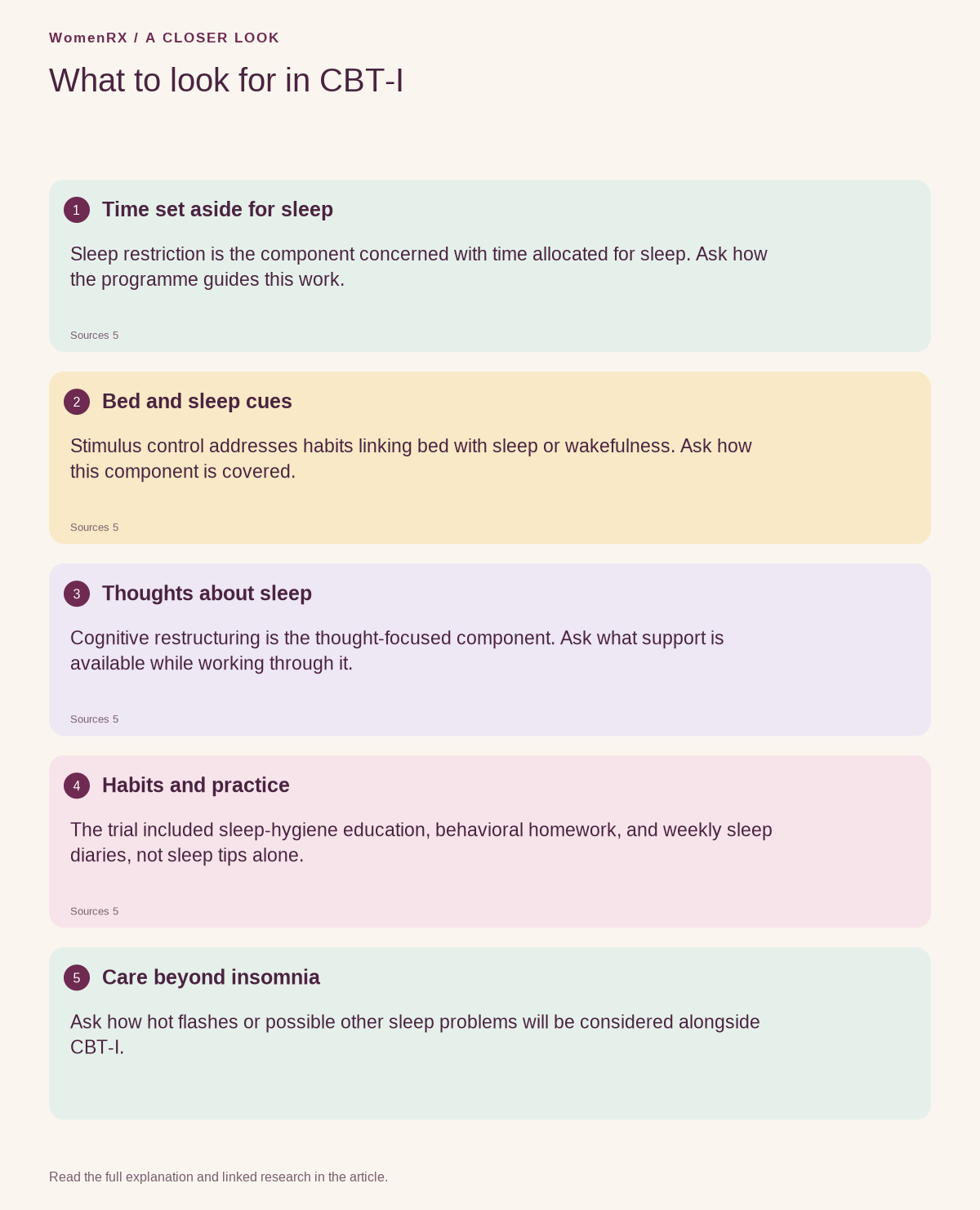
What to look for in CBT-I
Time set aside for sleep: Sleep restriction is the component concerned with time allocated for sleep. Ask how the programme guides this work.5
Bed and sleep cues: Stimulus control addresses habits linking bed with sleep or wakefulness. Ask how this component is covered.5
Thoughts about sleep: Cognitive restructuring is the thought-focused component. Ask what support is available while working through it.5
Habits and practice: The trial included sleep-hygiene education, behavioral homework, and weekly sleep diaries, not sleep tips alone.5
Care beyond insomnia: Ask how hot flashes or possible other sleep problems will be considered alongside CBT-I.
Read the figure as text
The trial combined several kinds of insomnia-focused work. Use these distinctions to ask what a clinician or programme actually offers.- Time set aside for sleep: Sleep restriction is the component concerned with time allocated for sleep. Ask how the programme guides this work.5
- Bed and sleep cues: Stimulus control addresses habits linking bed with sleep or wakefulness. Ask how this component is covered.5
- Thoughts about sleep: Cognitive restructuring is the thought-focused component. Ask what support is available while working through it.5
- Habits and practice: The trial included sleep-hygiene education, behavioral homework, and weekly sleep diaries, not sleep tips alone.5
- Care beyond insomnia: Ask how hot flashes or possible other sleep problems will be considered alongside CBT-I.
More questions, answered
Is CBT-I just better sleep habits?
No. Sleep-hygiene education was one part of the menopause trial’s CBT-I programme. It also included behavioral components, work on thoughts about sleep, and homework between sessions. 5
Sources you can check
- Insomnia | MedlinePlusAccessed 2026-09-25Return to first citation
- Insomnia - NHSAccessed 2026-09-25Return to first citation
- The 2022 hormone therapy position statement of The North American Menopause Society.“The 2022 Hormone Therapy Position Statement of The North American Menopause Society” Advisory Panel. · Menopause (New York, N.Y.) · 2022Return to first citation
- The 2023 nonhormone therapy position statement of The North American Menopause Society.Menopause (New York, N.Y.) · 2023Return to first citation
- Telephone-Based Cognitive Behavioral Therapy for Insomnia in Perimenopausal and Postmenopausal Women With Vasomotor Symptoms: A MsFLASH Randomized Clinical Trial.McCurry SM, Guthrie KA, Morin CM, Woods NF, Landis CA, Ensrud KE, Larson JC, Joffe H, Cohen LS, Hunt JR, Newton KM, Otte JL, Reed SD, Sternfeld B, Tinker LF, LaCroix AZ. · JAMA internal medicine · 2016Return to first citation