Sleep Problems During Menopause: What May Be Disrupting Yours?
Night sweats are one possible culprit, but ongoing insomnia can also persist without hot flashes or reflect another sleep or health issue.
Menopause-related hot flashes and night sweats can interrupt sleep, but insomnia also occurs in perimenopause and after menopause without those symptoms. Notice whether you wake during a heat episode, lie awake even when comfortable, or have clues such as snoring and interrupted breathing. The pattern can help point toward the next step: addressing hot flashes, treating insomnia, or checking for another cause. 1 3 6
Start with the pattern, not the label
Insomnia means difficulty falling asleep, staying asleep, or waking too early, often with tiredness or poor concentration the next day. A rough night now and then is different from a persistent pattern that affects how you feel and function. 2 3
During perimenopause, sleep may be interrupted by hot flashes or night sweats; this can continue after menopause, too. But chronic insomnia has also been studied in peri- and postmenopausal women with or without vasomotor symptoms. So a menopause transition can be part of the picture without being the whole explanation. 1 6
A useful first distinction is whether the awakening seems tied to a hot flash or happens independently. If you wake feeling suddenly hot and sweaty, then settle again once it passes, vasomotor symptoms may be contributing. If you lie awake for long stretches even on nights without that pattern, insomnia itself or another factor may deserve attention. These clues are not a diagnosis; more than one cause can overlap.
Check for other sleep and health factors
Sleep apnea can cause snoring or interrupted breathing during sleep and may look like repeated awakenings or unrefreshing sleep. Pain, some medicines, caffeine, tobacco, alcohol, stress, and anxiety can also contribute to insomnia. A new or changed medicine may be worth including in the picture, but don’t stop a prescribed medicine on your own. 2 3
Mood and sleep can affect each other: insomnia can go along with anxiety or depression, and those concerns may also be part of what is keeping you awake. Not every sleep change in midlife should be attributed to hormones. 2
Track just enough to spot a useful clue
For a week or two, jot down when you went to bed, roughly when you fell asleep, how often you woke, and how you felt the next day. Add whether you noticed a hot flash or soaking sweat, snoring or breathing interruptions reported by someone else, pain or mood changes, alcohol or caffeine, naps, and any medicine changes. This isn’t a diagnostic test. It’s a compact way to see whether awakenings follow a pattern and to give a clinician a clearer sleep history. 2
If your sheets or clothes are repeatedly soaked even when the room is cool, don’t assume menopause is the only possible explanation. Night sweats can have several causes. Get medical advice if they regularly wake you or worry you, especially if they come with fever, cough, diarrhea, or unexplained weight loss. 1
Match the next step to the likely cause
If hot flashes are repeatedly waking you, the useful conversation is about treating bothersome vasomotor symptoms. Hormone therapy is the most effective treatment for those symptoms, but whether it suits you depends on individual benefits and risks. That doesn’t make hormone therapy an automatic treatment for insomnia by itself. Nonhormonal options for vasomotor symptoms also exist, including cognitive behavioral therapy and certain prescription treatments; the right choice depends on your circumstances and preferences. 4 5
If the main problem is persistent insomnia, cognitive behavioral therapy for insomnia (CBT-I) is a distinct approach that targets sleep-related thoughts and behaviors. A 2026 systematic review and meta-analysis of randomized trials in peri- and postmenopausal women found nonpharmacological treatments improved sleep-quality and insomnia measures, while the review authors described CBT-I among the more robust options. The studies did not find improvement in total sleep time, so feeling or rating sleep better does not necessarily mean sleeping longer. 6
A few sleep habits may help, especially for short-term trouble: keep a regular sleep schedule, go to bed when sleepy, make the room dark and quiet, and exercise during the day. If sleep remains difficult for months, daytime tiredness is affecting your life, or you suspect a breathing problem or medicine effect, bring that pattern to a clinician rather than treating every awakening as a menopause symptom. 2 3
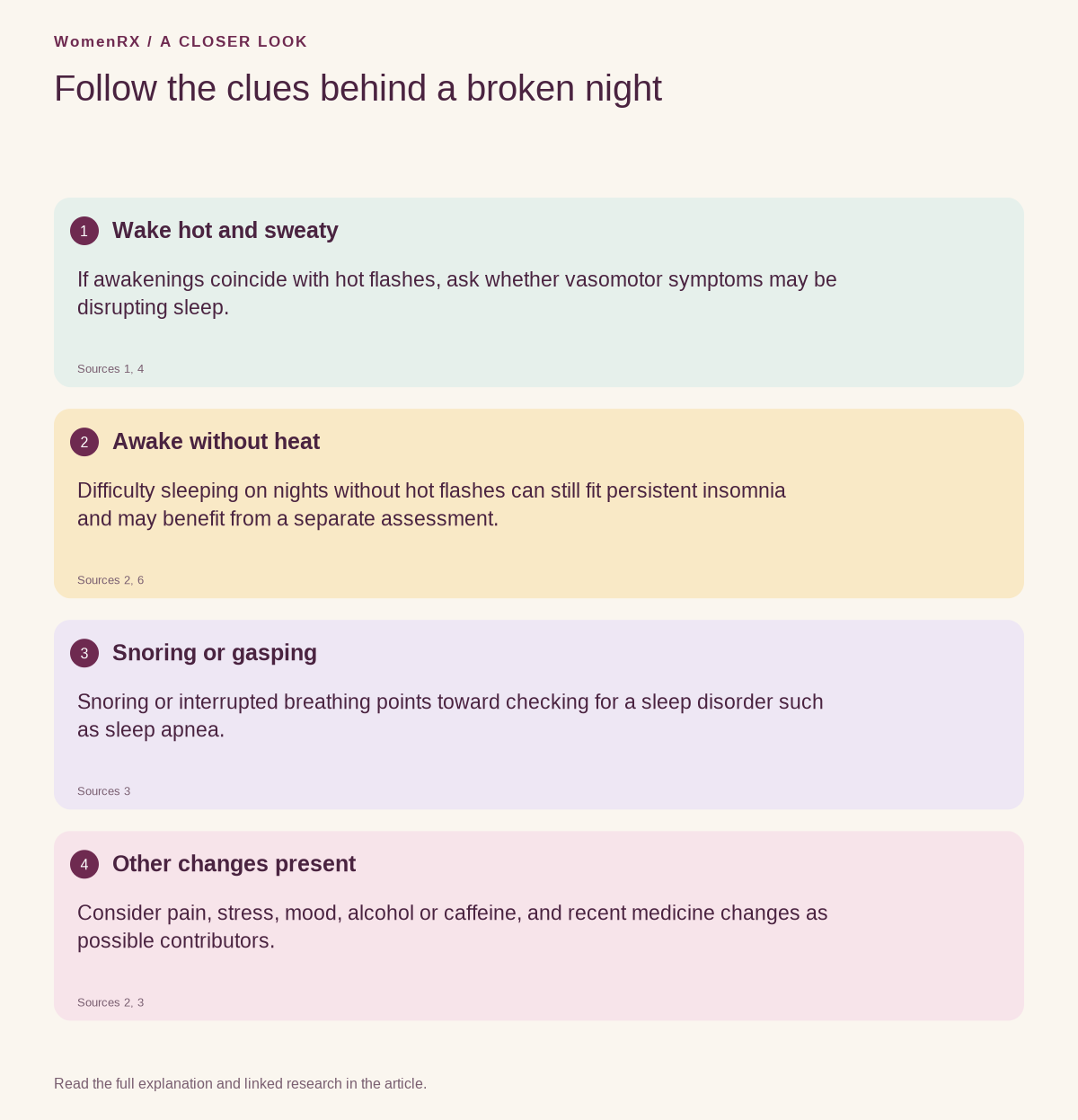
Follow the clues behind a broken night
Wake hot and sweaty: If awakenings coincide with hot flashes, ask whether vasomotor symptoms may be disrupting sleep.14
Awake without heat: Difficulty sleeping on nights without hot flashes can still fit persistent insomnia and may benefit from a separate assessment.26
Snoring or gasping: Snoring or interrupted breathing points toward checking for a sleep disorder such as sleep apnea.3
Other changes present: Consider pain, stress, mood, alcohol or caffeine, and recent medicine changes as possible contributors.23
Read the figure as text
Use the pattern of waking as a starting point, not a diagnosis: hot flashes, persistent insomnia, breathing symptoms, and other factors can overlap.- Wake hot and sweaty: If awakenings coincide with hot flashes, ask whether vasomotor symptoms may be disrupting sleep.14
- Awake without heat: Difficulty sleeping on nights without hot flashes can still fit persistent insomnia and may benefit from a separate assessment.26
- Snoring or gasping: Snoring or interrupted breathing points toward checking for a sleep disorder such as sleep apnea.3
- Other changes present: Consider pain, stress, mood, alcohol or caffeine, and recent medicine changes as possible contributors.23
More questions, answered
Can insomnia happen without night sweats?
Yes. Chronic insomnia has been studied in perimenopausal and postmenopausal women both with and without vasomotor symptoms, so the absence of night sweats doesn’t rule out insomnia or another cause of poor sleep. 6
When should repeated night sweats be checked?
Seek medical advice if soaking night sweats regularly wake you or concern you. Fever, cough, diarrhea, or unexplained weight loss alongside them are additional reasons to get checked. 1
Sources you can check
- Night sweats - NHSAccessed 2026-09-25Return to first citation
- Insomnia | MedlinePlusAccessed 2026-09-25Return to first citation
- Insomnia - NHSAccessed 2026-09-25Return to first citation
- The 2022 hormone therapy position statement of The North American Menopause Society.“The 2022 Hormone Therapy Position Statement of The North American Menopause Society” Advisory Panel. · Menopause (New York, N.Y.) · 2022Return to first citation
- The 2023 nonhormone therapy position statement of The North American Menopause Society.Menopause (New York, N.Y.) · 2023Return to first citation
- Pharmacological and non-pharmacological treatments for chronic insomnia in perimenopausal and postmenopausal women: a systematic review and meta-analysis.Bruyneel M, Rozenberg S, Sanida C, Demaeyer N, Castermans E, Bruyneel AV. · Sleep medicine · 2026Return to first citation