Are Hormones Linked to Tinnitus During Menopause?
Tinnitus can overlap with the menopause transition, but that timing alone doesn’t show that hormone changes caused it.
Research offers a possible connection, not proof that perimenopause or menopause causes tinnitus. A review describes tinnitus among vestibular symptoms reported across reproductive stages, but its abstract doesn’t establish a menopause-specific effect. A small study in younger women taking hormonal contraceptives also can’t answer what happens during menopause. Hearing changes, medicines, and other ear-related causes deserve consideration too. 3 4 1
If ringing, buzzing, or another sound in your ears changes around perimenopause or menopause, the timing can feel like a clue. It may be worth mentioning, but timing by itself can’t tell you whether hormones are the cause. The research suggests a possible relationship between estrogen and some ear or balance symptoms, yet it doesn’t establish that menopause causes tinnitus in an individual woman. 3
What the research does, and doesn’t, show
A review of estrogen and neurotological symptoms describes tinnitus among symptoms reported across reproductive stages. But the abstract doesn’t give a clear menopause-specific comparison or show that changing estrogen levels caused tinnitus. A broad review that includes a symptom isn’t the same as a study demonstrating that menopause triggers that symptom. 3
Another small study looked at 60 women ages 14 to 35: 30 used combined hormonal contraceptives and 30 had never used them. The researchers reported tinnitus among findings in the contraceptive group. These participants were not in the menopause transition, and the study’s design cannot establish that hormones caused the finding. It therefore offers little direct evidence about tinnitus during perimenopause or after menopause. 4
Taken together, these studies leave a distinction worth keeping in mind: hormones might be relevant to inner-ear or balance symptoms, but that possibility doesn’t identify the cause of a particular person’s tinnitus. This research doesn’t provide a reliable way to predict who will develop tinnitus during menopause or whether hormone therapy would improve it. 3 4
Don’t let timing crowd out other explanations
Tinnitus is hearing a sound that doesn’t come from an outside source. It can sound like ringing, roaring, clicking, hissing, or buzzing, and may be in one ear or both. Hearing loss is a common association, and some medicines can also contribute. 1 2
That gives you more than one reasonable avenue to consider. For example, if tinnitus started after a medication change, the timing is worth raising with the prescriber. If you’ve noticed difficulty hearing, an ear and hearing assessment may help identify a relevant issue. Earwax or an ear infection can also be checked for during an evaluation. 2
A useful way to think about the timeline is to note when the sound began or changed, whether it’s in one or both ears, and whether it followed a medication change, loud-noise exposure, or change in hearing. These details can help describe the pattern; they don’t prove what caused it. Don’t assume that a menopause-related explanation rules out other causes.
When to seek care
Arrange an evaluation if tinnitus is persistent, getting worse, or interfering with sleep or concentration. Seek urgent care for tinnitus that beats in time with your pulse. Tinnitus with sudden hearing loss, weakness in the face, or a spinning sensation needs immediate attention. 2
If the sound is affecting your sleep or making you anxious, that impact also deserves attention, even while the cause is being assessed. When no treatable cause is found, support may focus on reducing distress and helping you cope with the sound. 1 2
The practical takeaway: a change around menopause is a real observation, not a diagnosis. Keep the hormonal link as one possibility, while checking for hearing, medication, and ear-related explanations that can be evaluated.
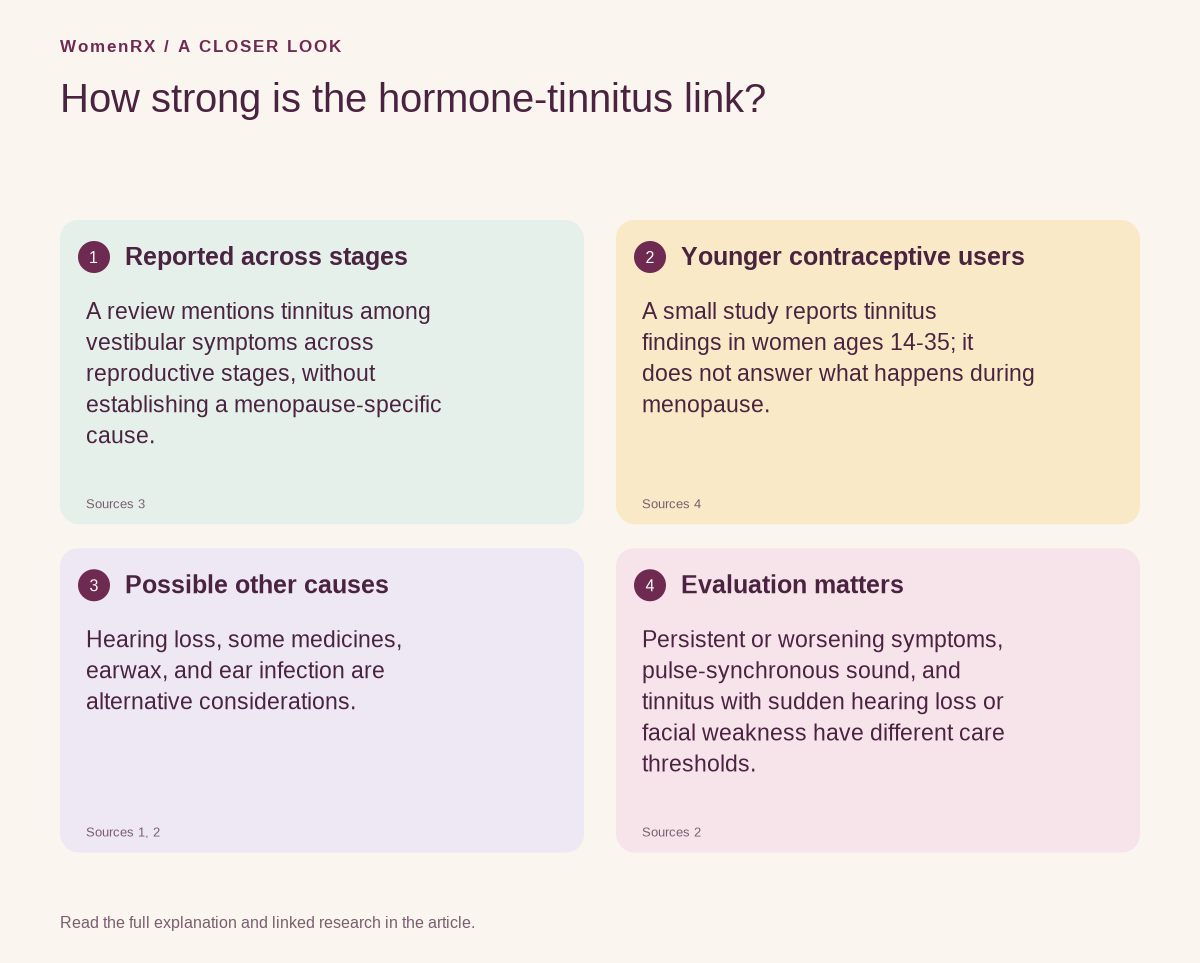
How strong is the hormone-tinnitus link?
Reported across stages: A review mentions tinnitus among vestibular symptoms across reproductive stages, without establishing a menopause-specific cause.3
Younger contraceptive users: A small study reports tinnitus findings in women ages 14-35; it does not answer what happens during menopause.4
Possible other causes: Hearing loss, some medicines, earwax, and ear infection are alternative considerations.12
Evaluation matters: Persistent or worsening symptoms, pulse-synchronous sound, and tinnitus with sudden hearing loss or facial weakness have different care thresholds.2
Read the figure as text
The evidence points to a question worth keeping open, not a proven menopause-related cause. These distinctions show what each kind of finding can tell you.- Reported across stages: A review mentions tinnitus among vestibular symptoms across reproductive stages, without establishing a menopause-specific cause.3
- Younger contraceptive users: A small study reports tinnitus findings in women ages 14-35; it does not answer what happens during menopause.4
- Possible other causes: Hearing loss, some medicines, earwax, and ear infection are alternative considerations.12
- Evaluation matters: Persistent or worsening symptoms, pulse-synchronous sound, and tinnitus with sudden hearing loss or facial weakness have different care thresholds.2
More questions, answered
Does tinnitus mean my estrogen is low?
No. Tinnitus alone can’t show that your estrogen is low or establish a hormone cause. The research summarized here doesn’t provide a menopause-specific test or pattern that would make that conclusion. 3
Should I try hormone therapy for tinnitus?
This evidence doesn’t establish hormone therapy as a treatment for tinnitus. A possible association between estrogen and ear or balance symptoms is not proof that hormone therapy will improve tinnitus. 3
Sources you can check
- Tinnitus | Tinnitus Treatment | MedlinePlusAccessed 2026-09-25Return to first citation
- Tinnitus - NHSAccessed 2026-09-25Return to first citation
- [Estrogen and neurotological diders in womenSexual hormones and neurotological disorders in women].Castillo-Bustamante M, Del Cid Chua C, Vázquez M, Bello Dotel L, Baez Recalde M. · Revista de la Facultad de Ciencias Medicas (Cordoba, Argentina) · 2020Return to first citation
- Audiometric and vestibular evaluation in women using the hormonal contraceptive method.Mitre EI, Figueira AS, Rocha AB, Alves SM. · Brazilian journal of otorhinolaryngology · 2006Return to first citation