Tinnitus During Perimenopause: What Else to Check
Ringing can begin during perimenopause, but the timing alone can’t tell you whether hormones, hearing changes, or an ear problem are involved.
Perimenopause may overlap with tinnitus, but research hasn’t shown that the transition causes it. A small study of women with menopausal symptoms found no clear difference in follicle-stimulating hormone (FSH) levels between those with and without tinnitus. An ear exam and hearing check can look for other explanations. Seek urgent assessment for a sound that beats with your pulse, and immediate care if tinnitus comes with sudden hearing loss. 4 1 2
Why the timing doesn’t settle the cause
Tinnitus is hearing a sound without an outside source. It might be ringing, buzzing, hissing, clicking, or roaring, in one ear or both. If it begins while your periods and other symptoms are changing, it makes sense to wonder about perimenopause. That timing is worth mentioning when you get it checked, but it doesn’t identify the cause. 1
The direct menopause research is limited. In one clinic study of 59 women with menopausal symptoms, 22 reported tinnitus. Researchers excluded two whose tinnitus had an identified thyroid-related cause. Among the smaller groups with complete information, FSH levels and most menopause-related factors did not differ significantly between women with and without tinnitus; headache history did differ. Because this was a small clinic comparison, it can neither establish a hormonal cause nor rule one out. 4
A study of women seen at a specialist clinic for recurrent dizziness offers another clue, but not an answer about tinnitus in perimenopause generally. Tinnitus was common in that selected group, which also reported migraine-related and vasomotor symptoms. These overlapping experiences don’t show which one caused another. If your tinnitus comes with repeated dizziness or headaches, describe the combination rather than assuming it’s a menopause symptom. 3
What an ear and hearing assessment can find
Hearing loss, loud-noise exposure, and certain medicines are recognized contributors to tinnitus. An ear exam may also find something treatable, such as wax buildup or an infection, and a hearing check can identify a change you might not have noticed clearly yourself. 1 2
Think about what changed around the time the sound began. For example, does conversation sound muffled, does one ear seem different from the other, or did the ringing start after a loud event or a medicine change? Those details give an examiner more to work with than the date your periods became irregular. Bring the names of medicines you take to the assessment. 1 2
If hearing loss is present, hearing aids may be considered as part of tinnitus care. When no treatable cause is found, there are still ways to reduce how much the sound disrupts daily life. Sound therapy and cognitive behavioral therapy are options aimed at tinnitus-related distress, although a 2026 guideline for adults in Korea notes that much of the treatment evidence it reviewed was low or very low certainty. 2 6
Which changes should move assessment sooner?
Arrange a medical or hearing assessment if tinnitus is regular or constant, is getting worse, or is affecting sleep, concentration, or mood. Say if it’s only on one side or your hearing differs between ears. An adult tinnitus guideline recommends imaging as part of the evaluation when hearing loss is asymmetric; that’s a decision for the assessing clinician, not a test everyone with ringing needs. 2 6
A sound that beats in time with your pulse needs urgent assessment. This is a different pattern from a steady ring or hiss, and it may need further investigation. A rhythmic whoosh that doesn’t clearly match your pulse is also worth describing accurately rather than labeling it yourself. 2 7
Get immediate medical care if tinnitus appears with sudden hearing loss, facial weakness, or a spinning sensation, or if it follows a head injury. Don’t wait to find out whether it settles as perimenopause symptoms change. 2
Does hormone therapy change the picture?
One report compared perimenopausal women with chronic tinnitus who did or didn’t receive menopausal hormone therapy. It described changes in tinnitus-handicap and sleep scores after treatment among women with more severe menopause symptoms, but treatment was not described as randomly assigned. That finding cannot show that hormone therapy caused the improvement or establish it as a tinnitus treatment. 5
Menopausal hormone therapy has established uses for symptoms such as bothersome hot flashes; tinnitus is a separate question. If you’re considering it for menopause symptoms, discuss those symptoms on their own terms while still having new or changing tinnitus assessed. 8 2
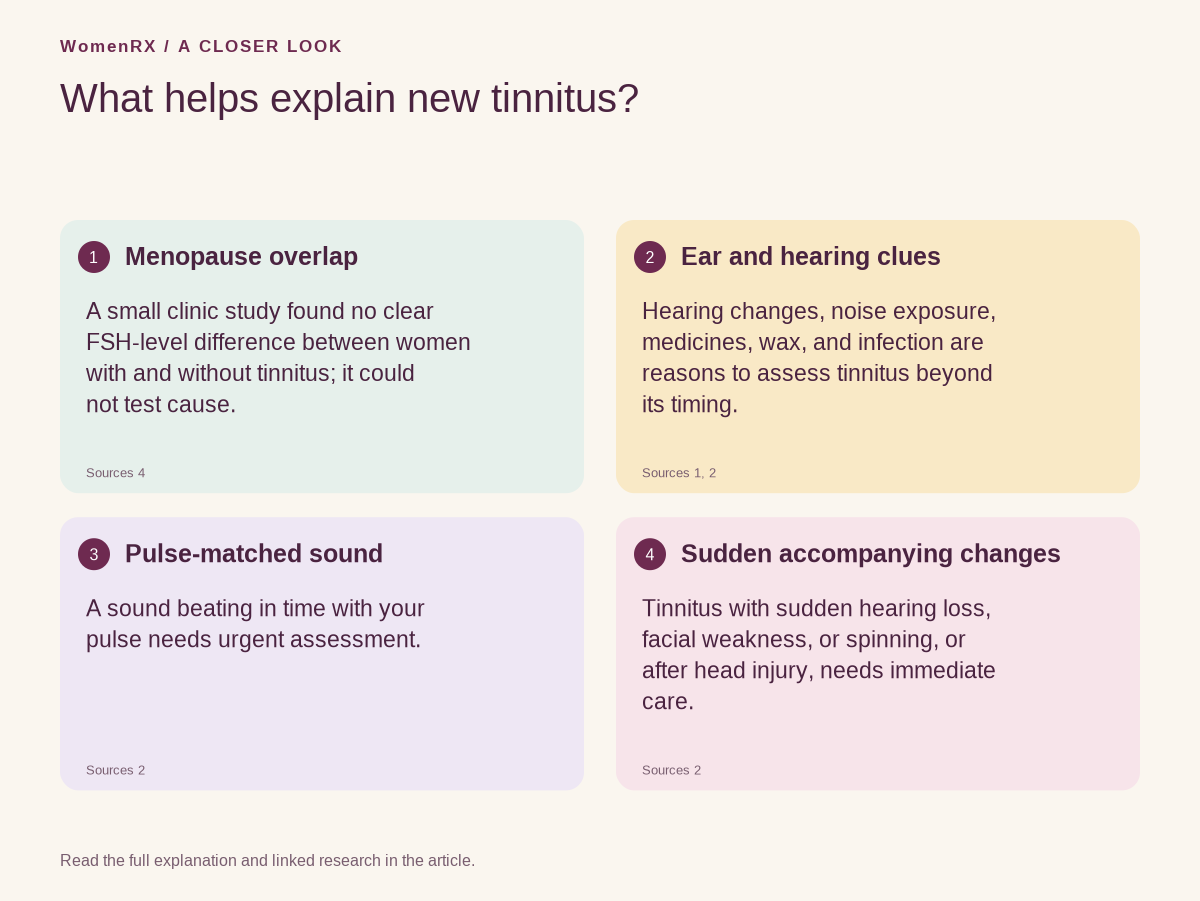
What helps explain new tinnitus?
Menopause overlap: A small clinic study found no clear FSH-level difference between women with and without tinnitus; it could not test cause.4
Ear and hearing clues: Hearing changes, noise exposure, medicines, wax, and infection are reasons to assess tinnitus beyond its timing.12
Pulse-matched sound: A sound beating in time with your pulse needs urgent assessment.2
Sudden accompanying changes: Tinnitus with sudden hearing loss, facial weakness, or spinning, or after head injury, needs immediate care.2
Read the figure as text
A menopause overlap is possible, but the sound pattern and accompanying hearing changes do more to guide the next step.- Menopause overlap: A small clinic study found no clear FSH-level difference between women with and without tinnitus; it could not test cause.4
- Ear and hearing clues: Hearing changes, noise exposure, medicines, wax, and infection are reasons to assess tinnitus beyond its timing.12
- Pulse-matched sound: A sound beating in time with your pulse needs urgent assessment.2
- Sudden accompanying changes: Tinnitus with sudden hearing loss, facial weakness, or spinning, or after head injury, needs immediate care.2
Sources you can check
- Tinnitus | Tinnitus Treatment | MedlinePlusAccessed 2026-09-25Return to first citation
- Tinnitus - NHSAccessed 2026-09-25Return to first citation
- Clinical Features of Midlife Women With Isolated Episodic Vestibular Syndrome and Their Relationship With Migraine and Menopause Transition.Mangia LRL, Bittar RSM. · Otology & neurotology : official publication of the American Otological Society, American Neurotology Society [and] European Academy of Otology and Neurotology · 2026Return to first citation
- [Preliminary analysis of risk factors of tinnitus related to female menopause].Ma X, Lu YQ, Zhao YX, Yu LS, Bai WP, Lai RC, E LJ. · Zhonghua er bi yan hou tou jing wai ke za zhi = Chinese journal of otorhinolaryngology head and neck surgery · 2024Return to first citation
- [Hormone replacement therapy in perimenopausal women with chronic tinnitus].Liu P, Wei R, Zhu Z, Li H, Guo L, Miao Y, Chen X. · Lin chuang er bi yan hou tou jing wai ke za zhi = Journal of clinical otorhinolaryngology head and neck surgery · 2021Return to first citation
- Clinical Practice Guideline for the Diagnosis and Management of Tinnitus in Korea.Park E, Lee HY, Kim HJ, Lee JM, An YH, Cho AR, Han W, Chung JH, Han JS, Jung DJ, Lee KY. · Clinical and experimental otorhinolaryngology · 2026Return to first citation
- Assessment and management of pulsatile tinnitus.Hyder Y, Irving R, Ramalingam S, Wakerley BR. · Practical neurology · 2026Return to first citation
- The 2022 hormone therapy position statement of The North American Menopause Society.“The 2022 Hormone Therapy Position Statement of The North American Menopause Society” Advisory Panel. · Menopause (New York, N.Y.) · 2022Return to first citation