Metallic Taste During Perimenopause: What Else Could Explain It?
A metallic taste that appears while your periods are changing may have a separate, checkable cause.
A metallic taste during perimenopause doesn’t, by itself, tell you that hormones are responsible. Medicines, gum disease, colds or sinus problems, indigestion, and changes in smell are possible explanations. Start by comparing when the taste began with medicine changes, mouth symptoms, and recent illness. If it doesn’t go away or you can’t find an obvious cause, arrange a medical review. 1
It’s natural to connect a new symptom with other changes happening at the same time. But the timing of a metallic taste can’t establish a hormonal cause. A more useful first question is whether anything else changed when the taste began. 1
A taste change can also have more than one possible clue. For example, a new medicine and a dry-feeling mouth might happen around the same time, without proving which one is responsible. Treat these clues as a way to decide what to check, not as a diagnosis.
First, compare the taste with medicine changes
Did it start after you began or changed a medicine? Certain medicines can cause a metallic taste. Metronidazole and zopiclone are examples, not a complete list. If the timing fits, ask your pharmacist or prescriber about the specific medicine rather than stopping a prescribed treatment yourself. 1
Include medicines you take for menopause symptoms in that review. For example, clonidine can cause dry mouth. Dry mouth can accompany altered taste, although that doesn’t mean clonidine caused a metallic flavor in your case. 2 3
When you discuss a possible medicine effect, it may help to note when you started or changed the medicine and when the taste appeared. That timeline gives the pharmacist or prescriber something specific to assess. It still can’t prove the medicine caused the change, and it isn’t a reason to stop a prescribed treatment on your own. 1
Then check your mouth, not just your taste buds
Gum disease is another possible cause of metallic taste. Dryness is a different clue worth noticing: reduced saliva or a dry-feeling mouth can occur alongside difficulty tasting, and medicines and dehydration are among its possible causes. If your gums are bothering you or your mouth stays dry, a dental check can help assess those oral-health concerns. 1 3 4
A dry mouth isn’t proof of why a taste seems metallic. It does, however, give you something more specific to describe than “food tastes strange.” Notice whether the dryness is persistent or comes with difficulty speaking, chewing, swallowing, or tasting. These symptoms can accompany dry mouth, but they don’t identify its cause by themselves. 3 4
Look beyond your mouth if those clues don’t fit
Colds, sinus infections, other airway problems, and indigestion are listed causes of metallic taste. A changed sense of smell is another possible explanation for a metallic taste, so notice whether smells seem different too. These are separate clues; having a cold doesn’t automatically explain a smell change. Pregnancy is also a possible cause if it applies to you. 1
If the taste began during an illness, notice whether it settles as the illness clears. If a changed sense of smell is part of the picture, mention that too: smell changes can affect how taste is experienced. If neither illness nor smell changes fit, that doesn’t rule out other causes. 1
When to get it checked
A metallic taste that doesn’t go away, or that has no obvious cause, is a reason to arrange a medical review. If there’s a clear mouth concern, such as gum symptoms or persistent dryness, a dental check can address that part of the picture. 1 3
The practical takeaway is to check the timing, not to assume the explanation: what changed with medicines, your mouth, your sense of smell, or your health around the time the taste started? Perimenopause may be happening at the same time, but the taste alone can’t show that hormones are the cause.
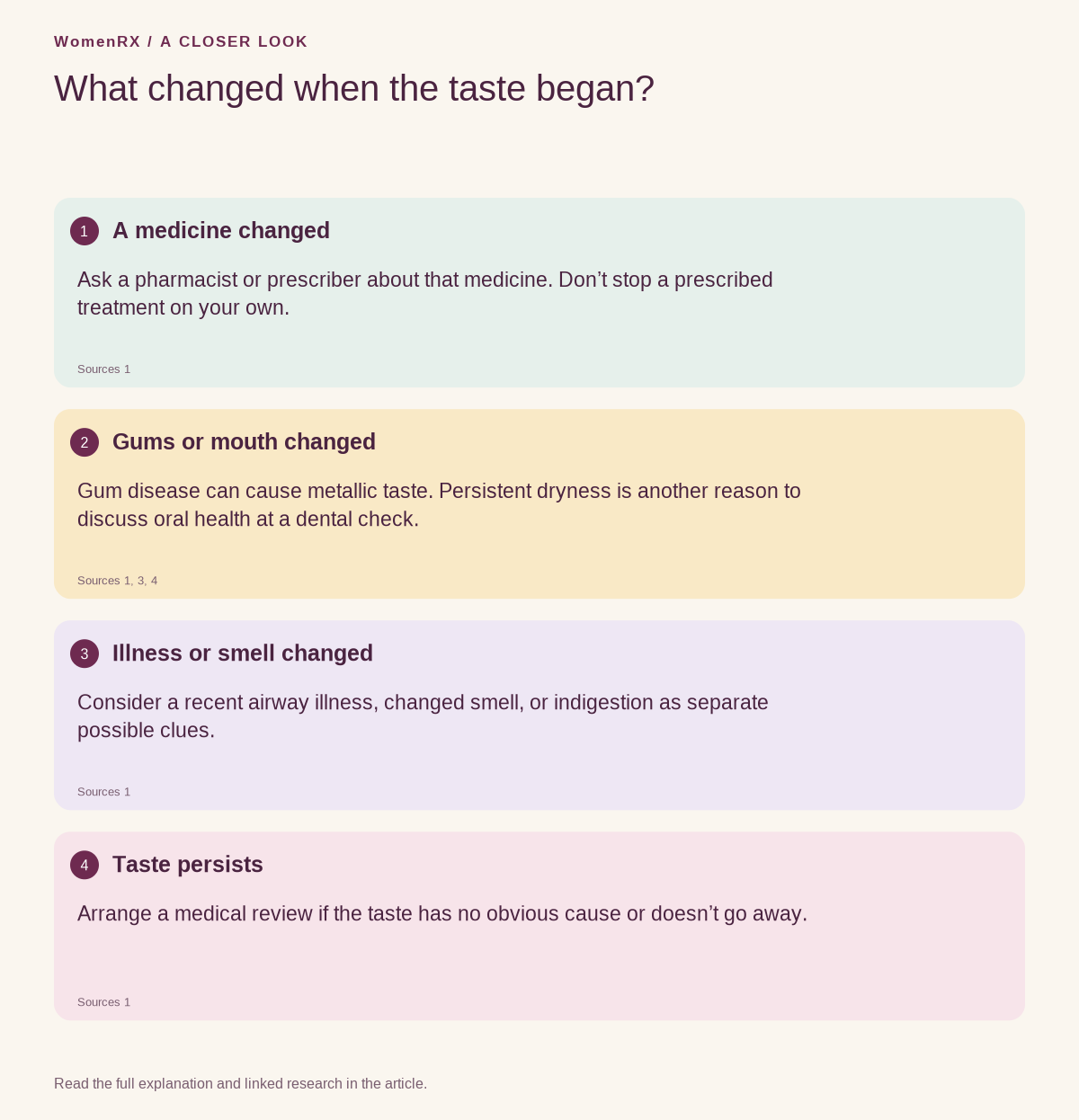
What changed when the taste began?
A medicine changed: Ask a pharmacist or prescriber about that medicine. Don’t stop a prescribed treatment on your own.1
Gums or mouth changed: Gum disease can cause metallic taste. Persistent dryness is another reason to discuss oral health at a dental check.134
Illness or smell changed: Consider a recent airway illness, changed smell, or indigestion as separate possible clues.1
Taste persists: Arrange a medical review if the taste has no obvious cause or doesn’t go away.1
Read the figure as text
Follow the clue that best matches your situation. These steps help organize what to check; they don’t diagnose the cause.- A medicine changed: Ask a pharmacist or prescriber about that medicine. Don’t stop a prescribed treatment on your own.1
- Gums or mouth changed: Gum disease can cause metallic taste. Persistent dryness is another reason to discuss oral health at a dental check.134
- Illness or smell changed: Consider a recent airway illness, changed smell, or indigestion as separate possible clues.1
- Taste persists: Arrange a medical review if the taste has no obvious cause or doesn’t go away.1
Sources you can check
- Metallic taste - NHSAccessed 2026-09-25Return to first citation
- Other medicines for menopause symptoms - NHSAccessed 2026-09-25Return to first citation
- [Xerostomia and dysphagia].Takahashi K. · Clinical calcium · 2012Return to first citation
- [Dry mouth--oral care for patients with oligoliasia and xerostomia].Rath C, Imfeld T. · Therapeutische Umschau. Revue therapeutique · 2008Return to first citation