Diarrhea During Perimenopause: What Else Could Be Going On?
Cycle timing may be worth noting, but the duration of diarrhea and any other symptoms matter more when deciding what to do next.
Diarrhea during perimenopause isn’t, by itself, evidence that hormonal changes caused it. A brief episode may follow an infection, while recurring symptoms can be related to diet, medicines, or a bowel condition. Replace lost fluids. Contact a healthcare professional if you have signs of dehydration, diarrhea lasts more than two days, or you notice concerning symptoms. 1 2 3
Notice the timing, but look beyond your cycle
If loose stools seem to arrive around a period, write down when they happen. That pattern is worth noticing, but it doesn’t tell you the cause. Diarrhea has many possible explanations, and the questions that help sort them out are more specific: Did it start suddenly? Has it happened before? Is there abdominal pain? Did a food, medicine, or other change come before it? 1 2
A short bout often goes away on its own. Acute diarrhea is frequently associated with a short-lived infection; diet and medicines are also useful clues, particularly when symptoms keep returning. Past digestive surgery can matter too. 1 2 You don’t need to choose between noting a cycle pattern and considering these other possibilities.
What the pattern can tell you
For recurring episodes, keep a short record of the date, number of loose stools, how long the episode lasts, and any abdominal pain. Add the timing of periods, meals, and medicines so you can compare possible patterns rather than relying on memory. This isn’t a test for a hormonal cause or a reason to stop a prescribed medicine on your own. Diet and medication history can help direct an evaluation. 2
Pay particular attention to pain. Irritable bowel syndrome (IBS) can involve abdominal pain around bowel movements along with a change in stool form or frequency. Frequent loose stools without significant abdominal pain can point toward a different pattern called functional diarrhea. Neither pattern should be assumed from a log alone, especially when symptoms are new or changing. 2 3
When to get checked
Don’t wait for a two-day cutoff if you have signs of dehydration. Diarrhea causes fluid loss, so replacing fluids and electrolytes matters even during a brief episode. MedlinePlus advises adults to contact a healthcare professional for signs of dehydration or diarrhea lasting more than two days. 1
Also get symptoms assessed if you notice blood in your stool, unexplained weight loss, or diarrhea that wakes you at night. These features can change what evaluation is needed, particularly when diarrhea is ongoing or recurring. 2 3
Diarrhea that lasts at least four weeks, whether continuous or coming and going, meets a commonly used definition of chronic diarrhea. Possible causes include IBS, functional diarrhea, celiac disease, and conditions affecting the colon. A clinician may use your history to decide whether blood or stool tests, or other evaluation, would be useful; not everyone needs every test. 1 2 3
The practical distinction is this: cycle timing belongs in the picture, but it shouldn’t explain away persistent diarrhea or a symptom that calls for attention sooner.
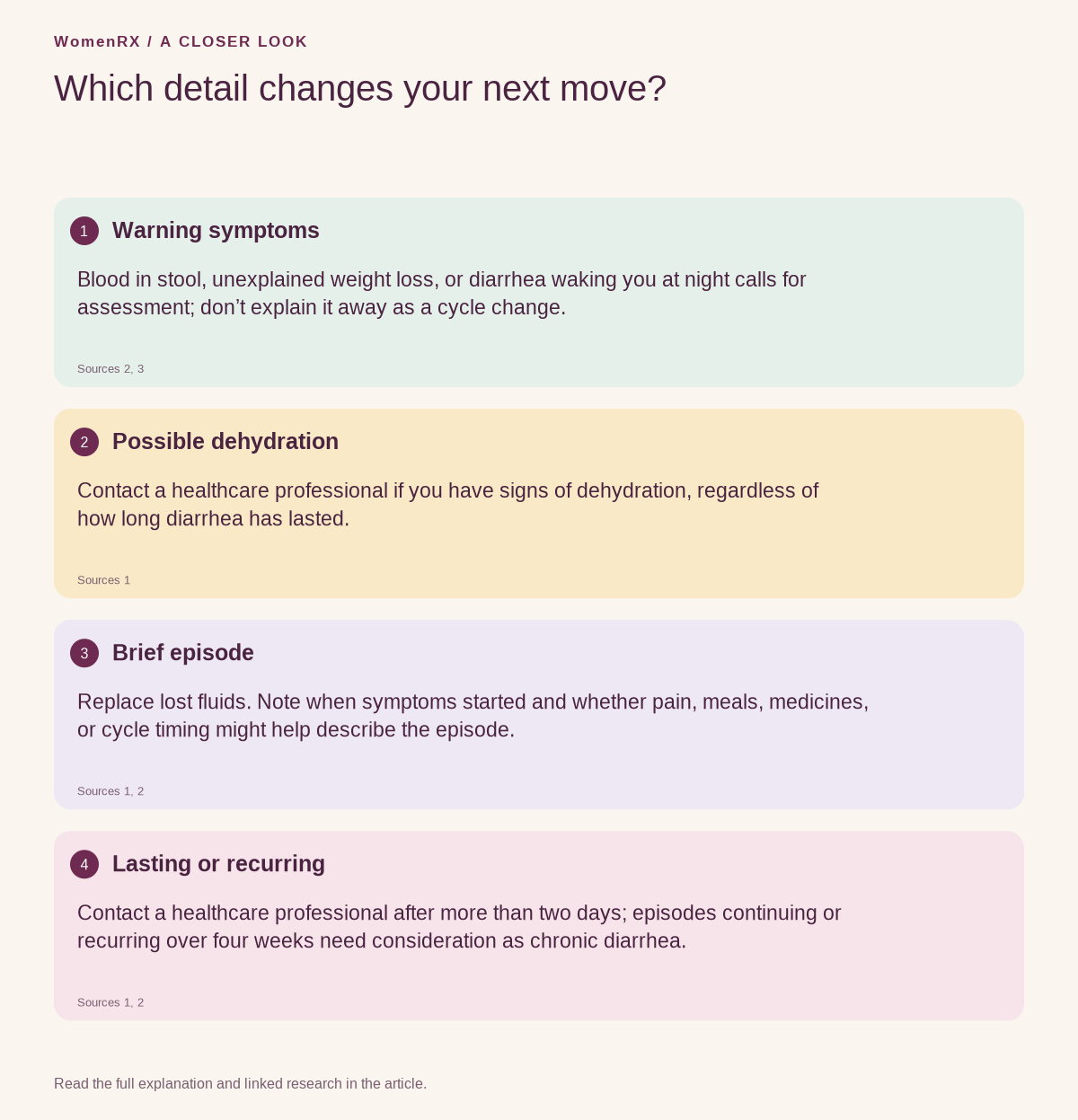
Which detail changes your next move?
Warning symptoms: Blood in stool, unexplained weight loss, or diarrhea waking you at night calls for assessment; don’t explain it away as a cycle change.23
Possible dehydration: Contact a healthcare professional if you have signs of dehydration, regardless of how long diarrhea has lasted.1
Brief episode: Replace lost fluids. Note when symptoms started and whether pain, meals, medicines, or cycle timing might help describe the episode.12
Lasting or recurring: Contact a healthcare professional after more than two days; episodes continuing or recurring over four weeks need consideration as chronic diarrhea.12
Read the figure as text
These are separate paths to consider, not steps to work through in order.- Warning symptoms: Blood in stool, unexplained weight loss, or diarrhea waking you at night calls for assessment; don’t explain it away as a cycle change.23
- Possible dehydration: Contact a healthcare professional if you have signs of dehydration, regardless of how long diarrhea has lasted.1
- Brief episode: Replace lost fluids. Note when symptoms started and whether pain, meals, medicines, or cycle timing might help describe the episode.12
- Lasting or recurring: Contact a healthcare professional after more than two days; episodes continuing or recurring over four weeks need consideration as chronic diarrhea.12
Sources you can check
- Diarrhea | MedlinePlusAccessed 2026-09-25Return to first citation
- Chronic Diarrhea: Diagnosis and Management.Schiller LR, Pardi DS, Sellin JH. · Clinical gastroenterology and hepatology : the official clinical practice journal of the American Gastroenterological Association · 2017Return to first citation
- Chronic, Noninfectious Diarrhea: A Review.Singh P, Lee A, Sheth NM, Chey WD. · JAMA · 2026Return to first citation