Tinnitus During Perimenopause: What to Check and What Helps
Tinnitus can appear during the menopause transition, but timing alone can’t show that hormones caused it.
A general medical reference lists hormonal changes in women among possible tinnitus causes, but that doesn’t establish that perimenopause causes ringing or other phantom sounds. Hearing loss, noise exposure, some medicines, and other ear or health conditions are also possible contributors. A first assessment can include an ear exam and hearing test; new one-sided or pulse-like tinnitus may need a more targeted evaluation. 1 4
A possible connection isn’t a proven cause
Tinnitus means hearing a sound, such as ringing, buzzing, hissing, or clicking, when there’s no matching sound outside your body. It can happen in one ear or both, and it can come and go. The sound is real as an experience, even when an outside source can’t be found. 1 2
It’s reasonable to notice tinnitus beginning around the same time as cycle changes, hot flashes, or sleep disruption. A general medical reference does include hormonal changes in women among possible causes of tinnitus. But that broad statement doesn’t establish that perimenopause causes tinnitus, explain a specific hormone mechanism, or show that hormone treatment would help. The timing may be a clue to mention, not proof of cause. 1
Other recognized possibilities include hearing loss, loud-noise exposure, some medicines, and thyroid problems. Tinnitus is also often linked to hearing loss; an ear infection or earwax buildup can sometimes be found on examination. 1 2
Start with ears and hearing, not a scan
For new tinnitus, an initial evaluation can include questions about when it began, whether it’s in one or both ears, and whether it pulses in time with your heartbeat. Looking in the ear and checking hearing help identify issues such as wax or hearing loss. Imaging is not automatic: the type of sound, ear-exam findings, and hearing results help guide whether it’s useful and which kind to consider. 2 4
A useful route is to start with a primary care clinician, who can examine your ears and arrange or refer for a hearing test. An audiologist can assess hearing; an ear, nose, and throat specialist may be involved when findings call for more evaluation. If tinnitus is pulse-like or hearing is uneven between ears, mention that clearly. Pulsatile tinnitus can affect the imaging decision, and tinnitus with asymmetric hearing loss is also a reason imaging may be considered. 3 4 5
Tinnitus in one ear isn’t automatically a sign of a serious problem, and it doesn’t mean you necessarily need a scan. Still, one-sided tinnitus, pulsatile tinnitus, or tinnitus alongside asymmetric hearing loss is worth describing specifically during assessment, because those features may call for a different workup than nonpulsatile sound in both ears. 3 4 5
When symptoms need urgent attention
Seek urgent medical assessment if tinnitus comes with sudden hearing loss, facial weakness, or a spinning sensation, or if it starts after a head injury. These combinations warrant more than routine follow-up. 2
What may help while you’re figuring it out
If a hearing test finds hearing loss, hearing aids may help with hearing and can be part of tinnitus care. If the cause isn’t treatable or remains unclear, support can focus on reducing how much the sound disrupts sleep, concentration, or daily life. Cognitive behavioral therapy and sound-based approaches are among options discussed in tinnitus guidance, though the certainty of much tinnitus-treatment evidence is low or very low. 2 3
At home, soft background sound may make tinnitus less noticeable than complete silence. If sleep is affected, a steady bedtime routine may help; notice whether stress or loud sound seems to make the tinnitus more intrusive. These are coping measures, not proof that stress or menopause caused the sound. 2
If tinnitus began during perimenopause, tell the person assessing it about the timing and any hearing changes, noise exposure, or new medicines. The aim is to check plausible ear and hearing causes and decide whether further evaluation is warranted, rather than assuming a hormonal explanation.
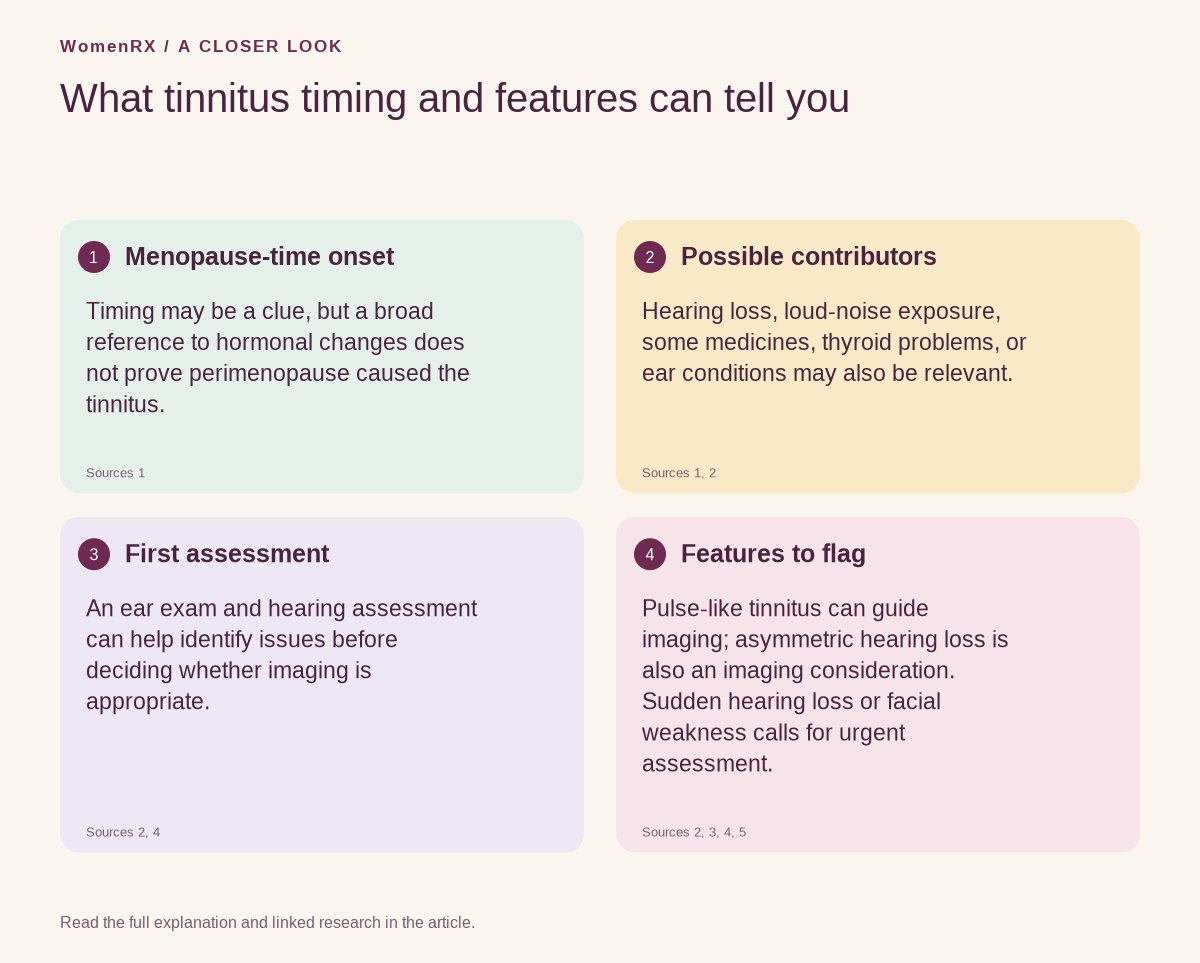
What tinnitus timing and features can tell you
Menopause-time onset: Timing may be a clue, but a broad reference to hormonal changes does not prove perimenopause caused the tinnitus.1
Possible contributors: Hearing loss, loud-noise exposure, some medicines, thyroid problems, or ear conditions may also be relevant.12
First assessment: An ear exam and hearing assessment can help identify issues before deciding whether imaging is appropriate.24
Features to flag: Pulse-like tinnitus can guide imaging; asymmetric hearing loss is also an imaging consideration. Sudden hearing loss or facial weakness calls for urgent assessment.2345
Read the figure as text
A menopause-time onset can be worth mentioning, but the sound pattern and hearing findings help determine what to assess next.- Menopause-time onset: Timing may be a clue, but a broad reference to hormonal changes does not prove perimenopause caused the tinnitus.1
- Possible contributors: Hearing loss, loud-noise exposure, some medicines, thyroid problems, or ear conditions may also be relevant.12
- First assessment: An ear exam and hearing assessment can help identify issues before deciding whether imaging is appropriate.24
- Features to flag: Pulse-like tinnitus can guide imaging; asymmetric hearing loss is also an imaging consideration. Sudden hearing loss or facial weakness calls for urgent assessment.2345
More questions, answered
Does tinnitus during perimenopause mean my estrogen is low?
No. Tinnitus starting during the menopause transition doesn’t identify a hormone level or prove that hormone changes caused it. A general reference lists hormonal changes in women among possible causes, but that does not establish a perimenopause-specific link. 1
Will hormone therapy treat tinnitus?
A menopause-time onset alone doesn’t show that hormone therapy will help tinnitus; an ear and hearing assessment can check other possible contributors. 1 4
Sources you can check
- Tinnitus | Tinnitus Treatment | MedlinePlusAccessed 2026-09-25Return to first citation
- Tinnitus - NHSAccessed 2026-09-25Return to first citation
- Clinical Practice Guideline for the Diagnosis and Management of Tinnitus in Korea.Park E, Lee HY, Kim HJ, Lee JM, An YH, Cho AR, Han W, Chung JH, Han JS, Jung DJ, Lee KY. · Clinical and experimental otorhinolaryngology · 2026Return to first citation
- ACR Appropriateness Criteria® Tinnitus: 2023 Update.Expert Panel on Neurological Imaging, Jain V, Policeni B, Juliano AF, Adunka O, Agarwal M, Dubey P, Friedman ER, Gule-Monroe MK, Hagiwara M, Hunt CH, Lo BM, Oh ES, Rath TJ, Roberts... · Journal of the American College of Radiology : JACR · 2023Return to first citation
- ACR Appropriateness Criteria® Tinnitus.Expert Panel on Neurologic Imaging:, Kessler MM, Moussa M, Bykowski J, Kirsch CFE, Aulino JM, Berger KL, Choudhri AF, Fife TD, Germano IM, Kendi AT, Kim JH, Luttrull MD, Nunez D, S... · Journal of the American College of Radiology : JACR · 2017Return to first citation