Sleep problems while taking progesterone: side effect, timing, or another cause?
A change in sleep after starting progesterone is worth noticing, but research doesn’t establish that progesterone reliably causes insomnia or improves sleep for everyone.
Studies of micronized progesterone have found mixed sleep results, and some trials also used estrogen, so they can’t show what progesterone alone did. Menopause symptoms such as night sweats can also interrupt sleep. If sleep changed after a treatment start or change, note the pattern, product, and prescribed timing alongside other changes, then discuss the pattern before altering treatment. 1 2 4

What the sleep research can, and can’t, tell you
Feeling sleepy and having trouble sleeping may seem like opposite effects. But research averages don’t predict how one person will respond, and the studies here don’t establish how often progesterone itself causes insomnia or explain why an individual’s sleep changes.
The evidence is specifically about micronized progesterone, not every product described as progesterone or every progestogen. A systematic review of nine randomized trials included 388 participants; eight trials enrolled postmenopausal women. In pooled results from four trials, micronized progesterone favored a shorter time to fall asleep, but the analysis didn’t find a clear benefit for total sleep time or sleep efficiency. Self-reported sleep improved in most trials. The results varied, and some trials also gave participants estradiol, which makes progesterone’s independent effect hard to separate. 2
There’s also a small randomized trial in 189 perimenopausal women that found participants taking oral micronized progesterone reported better sleep quality. Its main measure of hot flashes and night sweats did not differ significantly between treatment and placebo at the third month. That result is a reason not to assume progesterone invariably worsens sleep, but it doesn’t establish how an individual’s insomnia began. 3
Broader findings on menopause hormone therapy need similar care. A review of 15 studies found a small improvement in self-reported sleep compared with placebo, but no improvement in sleep measures recorded in a sleep laboratory. Because the review covered different hormone regimens, including combinations, it can’t tell you what progesterone by itself did. 4
Menopause-related sleep disruption can look similar
During perimenopause, changing ovarian hormone levels can occur alongside irregular periods, hot flashes, night sweats, and difficulty falling asleep or getting back to sleep after waking. If you wake during a sweat or hot flash, that may point to a different sleep pattern than lying awake without one. It doesn’t, by itself, identify the cause of the insomnia. 1
Cycle changes may also make the timing harder to interpret: sleep changes and treatment changes can happen during the same broader stretch of perimenopause. So a close timing match is useful information, not proof that progesterone caused the problem. The studies summarized here don’t establish how often a sleep change in someone taking progesterone is due to the treatment rather than another factor.
Make a short timeline that separates the clues
For a few weeks, or until you have a clear pattern to describe, keep a simple record. You don’t need to score your sleep. Note:
- Before a treatment change: What was your usual sleep like? Were night sweats, hot flashes, or cycle changes already occurring?
- Treatment details: When did the treatment start or change? What product are you taking, and when do you take it as prescribed?
- The sleep change: Is the main problem falling asleep, waking during the night, waking with a hot flash or sweat, or feeling unusually sleepy during the day?
- Other changes around then: Note changes in your menstrual cycle, other medicines, or health. Recording them doesn’t mean any one caused the sleep change; it helps keep the sequence clear.
Comparing the pattern before and after a treatment change can help you describe what happened. A connection that repeats or begins soon after a change is worth raising, but timing alone can’t prove cause. The product matters too: research findings for micronized progesterone shouldn’t automatically be applied to a different formulation or a combination regimen. 2 4
Discuss the pattern before changing treatment
Bring the timeline and ask whether your specific product and regimen could be contributing, how that possibility fits with the reason you’re taking it, and what other explanations make sense given your symptoms. Menopause hormone therapy decisions are individualized, with benefits and risks reevaluated over time. 5
You don’t have to decide from the timeline alone whether progesterone is responsible. Its most useful role is to make the change, its timing, and the other sleep clues easier to discuss.
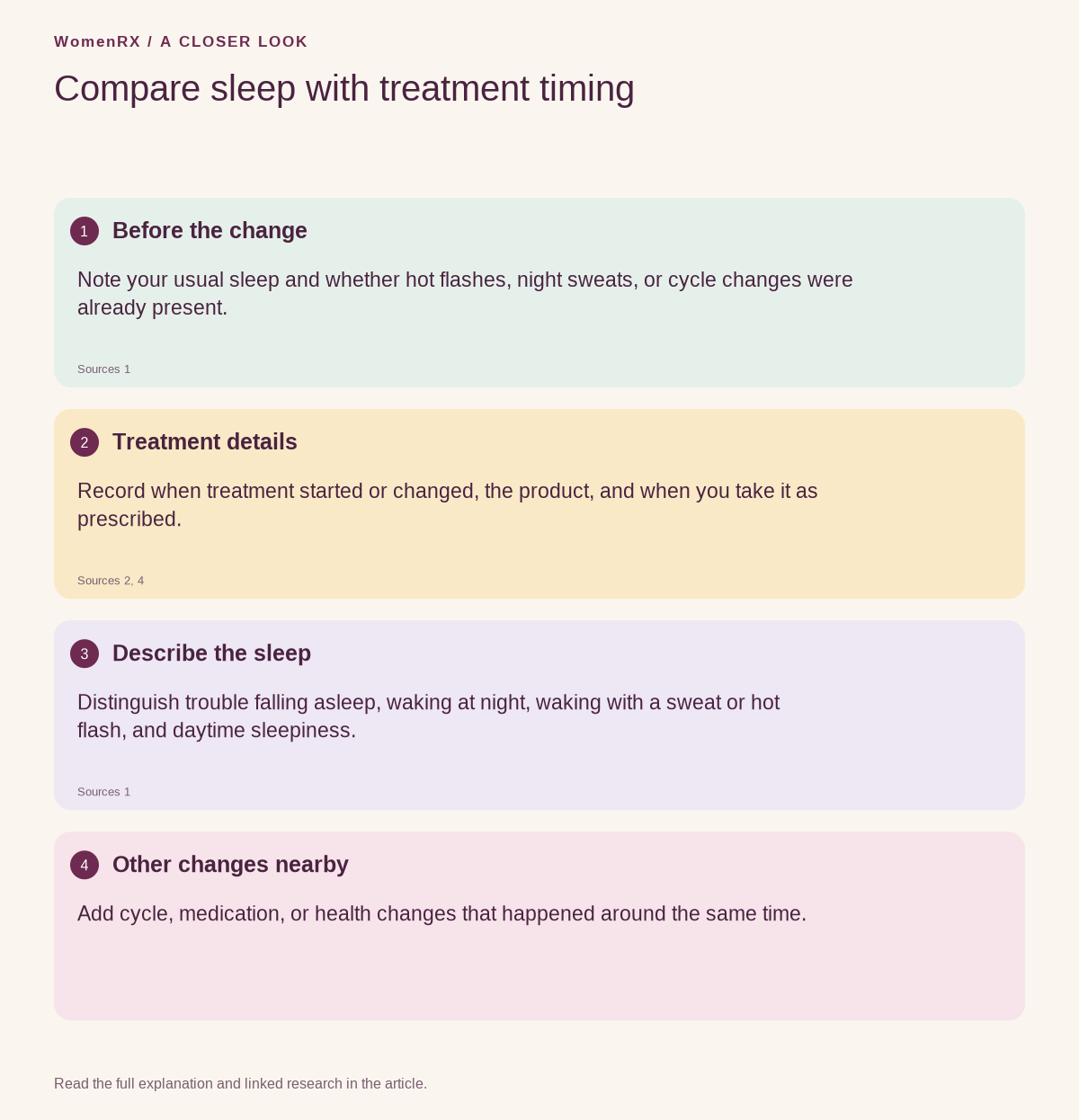
Compare sleep with treatment timing
Before the change: Note your usual sleep and whether hot flashes, night sweats, or cycle changes were already present.1
Treatment details: Record when treatment started or changed, the product, and when you take it as prescribed.24
Describe the sleep: Distinguish trouble falling asleep, waking at night, waking with a sweat or hot flash, and daytime sleepiness.1
Other changes nearby: Add cycle, medication, or health changes that happened around the same time.
Read the figure as text
Arrange sleep, treatment, and other changes in sequence. A match can help describe the pattern, but it cannot establish what caused it.- Before the change: Note your usual sleep and whether hot flashes, night sweats, or cycle changes were already present.1
- Treatment details: Record when treatment started or changed, the product, and when you take it as prescribed.24
- Describe the sleep: Distinguish trouble falling asleep, waking at night, waking with a sweat or hot flash, and daytime sleepiness.1
- Other changes nearby: Add cycle, medication, or health changes that happened around the same time.
Sources you can check
- Menopause | Menopause Symptoms | MedlinePlusAccessed 2026-09-25Return to first citation
- Efficacy of Micronized Progesterone for Sleep: A Systematic Review and Meta-analysis of Randomized Controlled Trial Data.Nolan BJ, Liang B, Cheung AS. · The Journal of clinical endocrinology and metabolism · 2021Return to first citation
- Oral micronized progesterone for perimenopausal night sweats and hot flushes a Phase III Canada-wide randomized placebo-controlled 4 month trial.Prior JC, Cameron A, Fung M, Hitchcock CL, Janssen P, Lee T, Singer J. · Scientific reports · 2023Return to first citation
- Different regimens of menopausal hormone therapy for improving sleep quality: a systematic review and meta-analysis.Pan Z, Wen S, Qiao X, Yang M, Shen X, Xu L. · Menopause (New York, N.Y.) · 2022Return to first citation
- The 2022 hormone therapy position statement of The North American Menopause Society.“The 2022 Hormone Therapy Position Statement of The North American Menopause Society” Advisory Panel. · Menopause (New York, N.Y.) · 2022Return to first citation