Can Progesterone Affect Dreams or Sleep?
Progesterone is linked with sleep in research, but vivid dreams after starting it don’t prove it’s the cause.
Progesterone may affect sleep, but research on sleep quality and awakenings doesn’t establish that taking it causes vivid dreams. Sleep findings vary, and menopause-related symptoms can also disrupt sleep. If you noticed a change after starting progesterone, note when it began, which product you take, and whether you’re waking more often. That pattern is worth discussing with your prescriber. 2 3
Separate the dreams from the rest of your night
If your dreams became unusually vivid after you started progesterone, the timing is worth paying attention to. It isn’t, by itself, proof that progesterone caused them. Reviews of progesterone and sleep discuss outcomes such as sleep quality, duration, awakenings, and REM sleep. They don’t establish an effect on dream content. 2 3
Try describing two things separately: what you remember dreaming and what happened to your sleep. For example, you might recall more dreams while otherwise sleeping as usual. Or you might be waking repeatedly and noticing dreams when you wake. That distinction gives your prescriber a clearer question to help answer.
What progesterone research can tell you
Reviews generally describe progesterone and its metabolites as having sleep-promoting effects, and they report improved sleep with hormone therapy during the menopause transition. That doesn’t mean progesterone alone will improve everyone’s sleep. The perimenopause research reviewed includes reports of fewer sleep complaints and less waking after sleep onset, as well as contrary findings of more awakenings or arousals and less slow-wave sleep. 2 3
A known effect of a particular product can also be different from a dream effect. The US prescribing information for Prometrium oral micronized progesterone capsules, for example, says they may cause temporary drowsiness and dizziness. It does not establish that the capsules cause vivid dreams, and its product-specific information shouldn’t be applied to every progesterone formulation or route. 1
Why menopause may complicate the picture
During perimenopause, sleep can change for several reasons at once. Hot flashes or night sweats may wake you; insomnia, sleep-related breathing disorders, movement disorders, mood symptoms, and changes in sleep timing may also play a part. None should automatically be blamed on hormones or treatment just because it appeared around the same time. 2
The pattern matters. Waking hot or sweaty points to a different nighttime experience than feeling drowsy after taking a capsule, for example. If you’re waking more often, that’s useful to mention even if vivid dreams are what first caught your attention.
Bring a pattern, not a guess
A short note can help you and your prescriber sort out what changed. Record when the dreams began relative to starting or changing progesterone. Include the exact product name, prescribed dose, how you take it, and when you take it. Then note whether your sleep duration, nighttime waking, night sweats, or daytime alertness changed too.
Add other changes that happened around the same time, such as a different medicine or supplement, a shift in your schedule, or new mood or menopause symptoms. These are possibilities to consider, not a list of proven causes of your dreams. Bring the medication label if you can, and ask whether the timing fits a treatment effect or whether another sleep issue deserves attention. Check with your prescriber before changing a prescribed hormone.
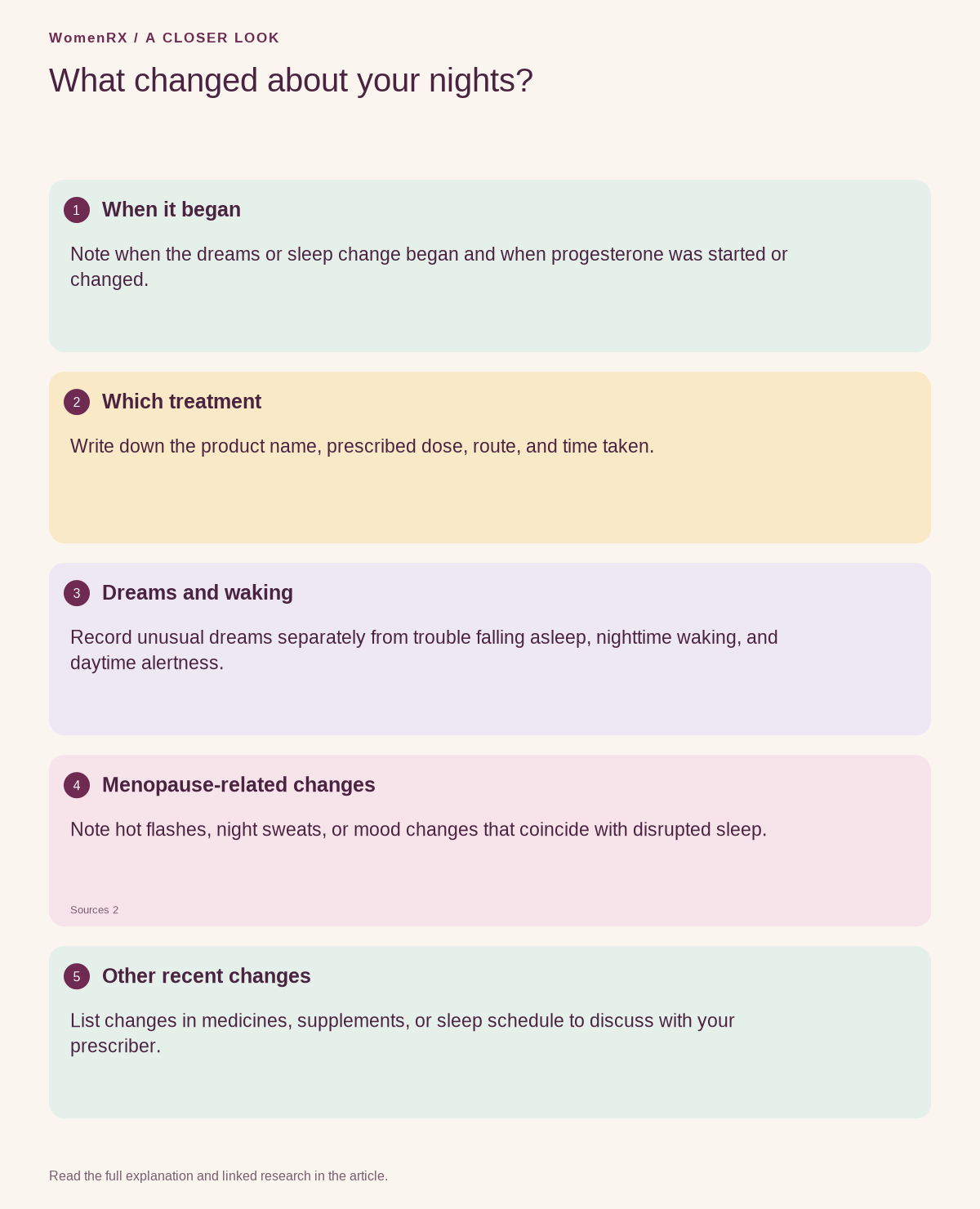
What changed about your nights?
When it began: Note when the dreams or sleep change began and when progesterone was started or changed.
Which treatment: Write down the product name, prescribed dose, route, and time taken.
Dreams and waking: Record unusual dreams separately from trouble falling asleep, nighttime waking, and daytime alertness.
Menopause-related changes: Note hot flashes, night sweats, or mood changes that coincide with disrupted sleep.2
Other recent changes: List changes in medicines, supplements, or sleep schedule to discuss with your prescriber.
Read the figure as text
Use these prompts to describe the pattern. They aren’t a test for whether progesterone caused it.- When it began: Note when the dreams or sleep change began and when progesterone was started or changed.
- Which treatment: Write down the product name, prescribed dose, route, and time taken.
- Dreams and waking: Record unusual dreams separately from trouble falling asleep, nighttime waking, and daytime alertness.
- Menopause-related changes: Note hot flashes, night sweats, or mood changes that coincide with disrupted sleep.2
- Other recent changes: List changes in medicines, supplements, or sleep schedule to discuss with your prescriber.
Sources you can check
- PROMETRIUM (PROGESTERONE) CAPSULE [ACERTIS PHARMACEUTICALS, LLC] | US prescribing information and patient instructionsAccessed 2026-09-25Return to first citation
- Sleep Disturbance and Perimenopause: A Narrative Review.Troìa L, Garassino M, Volpicelli AI, Fornara A, Libretti A, Surico D, Remorgida V. · Journal of clinical medicine · 2025Return to first citation
- Sleep Disturbances Across a Woman's Lifespan: What Is the Role of Reproductive Hormones?Haufe A, Leeners B. · Journal of the Endocrine Society · 2023Return to first citation