Sleep Problems in Perimenopause: Find the Pattern Before Choosing a Fix
A few specific observations can make “I am not sleeping” a much more useful conversation.

Notice what changed about the night
At three in the morning, “I cannot sleep” can feel like the whole story. The next day, a few distinctions may help: were you unable to fall asleep, awake repeatedly, awake much earlier than intended, or sleeping for long enough but still exhausted?
During the menopause transition, night sweats and mood changes can contribute to disrupted sleep. Life may also be unusually demanding at this stage. NIA describes sleep problems in this wider setting, rather than treating every difficult night as a single hormone problem.1
Start by describing the change you actually noticed. “I wake hot around the middle of the night” and “I lie awake thinking before I fall asleep” give a clinician different information. Neither sentence, on its own, identifies a diagnosis.
A night is not one number
Time in bed, time you think you were asleep and time spent awake are different observations. You do not need a device to turn an estimate into a useful note. Mark what you remember, and write “not sure” where that is the honest answer.
The timeline below is a fictional example of how a night can contain several parts. It is not a target schedule, a study result or a recommendation about how many hours you personally need. Its purpose is to make the diary fields easier to understand.
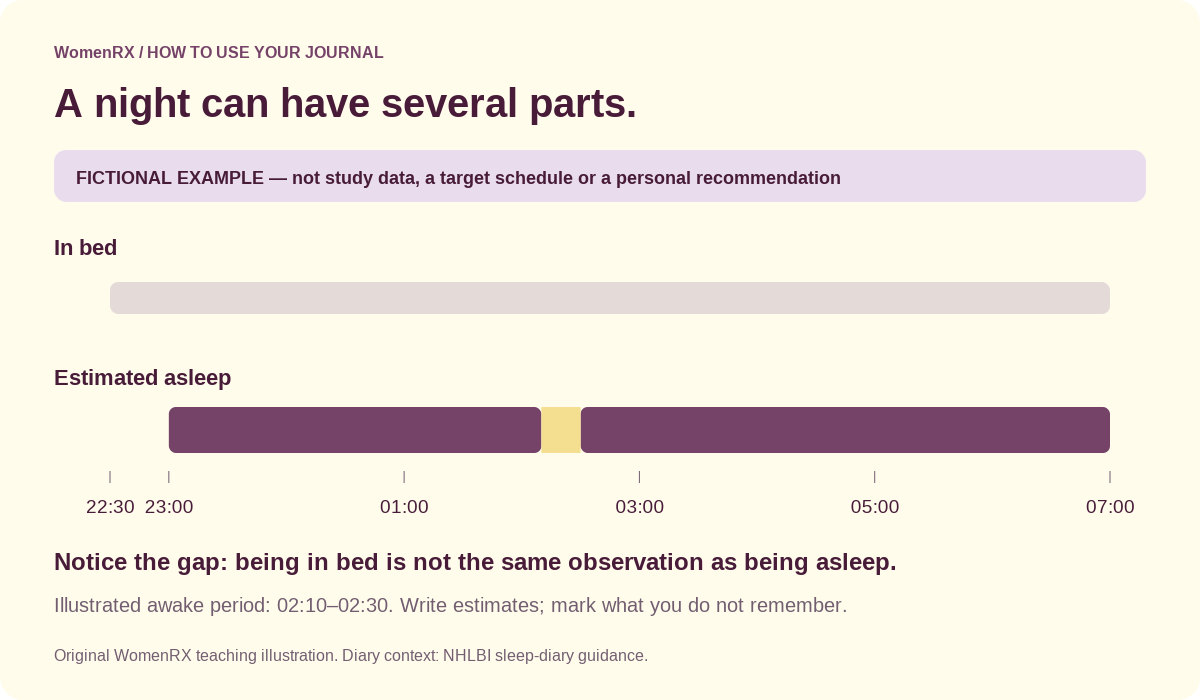
One night, several observations
In bed: 22:30. Estimated sleep: 23:00.
Recalled awake period: 02:10–02:30. Up: 07:00.
Fictional example only. Write your own estimates and mark uncertainty in the journal.
Keep a short record you can actually finish
NHLBI recommends recording sleep quantity and quality, medicines, alcohol, caffeine and daytime sleepiness, then taking the record to a doctor.2 The WomenRX journal turns that idea into a small, repeatable task across seven nights.
In the morning, note approximately when you got into bed and got up, how long you recall being awake after falling asleep, and what you noticed. A few words are enough: “felt hot,” “noise outside,” “needed the bathroom,” “worrying about tomorrow,” or “I do not know.” Add relevant context to discuss, such as a medicine change or when you had caffeine; do not use the diary as a reason to alter a prescribed medicine by yourself.
A missed entry does not invalidate the rest. The aim is a record you can discuss, not a performance score. Keeping the same few fields is more useful than adding so many measures that you abandon it after one night.
Bring the daytime symptoms too
If a partner has noticed loud snoring, breathing pauses or gasping, tell the clinician. NHLBI lists these among sleep-apnea symptoms and also describes daytime sleepiness and fatigue. They deserve a conversation rather than an assumption that menopause explains everything.3
Also describe what the sleep problem changes during the day: concentration, work, mood, or whether you feel safe driving. Do not wait for a complete seven-night diary if symptoms are severe or you need help sooner. The journal supports a conversation; it is not a gate you must pass before asking for care.
Leave with a specific next step
Before the appointment ends, ask what needs assessment, what options fit the suspected cause, and how you will judge whether the plan helped. Bring the same record to follow-up so you can compare the concern you started with, rather than relying only on whether one recent night was better.
You do not have to establish whether hormones explain the change before seeking support. Your job is to describe the pattern as clearly as you can. The clinical team's job is to decide what that pattern means and what should happen next.