Which Sleep Changes Are Worth Trying First?
A brief rough patch, persistent insomnia, and sleep interrupted by another problem call for different first steps.
For a recent stretch of poor sleep, start with regular sleeping hours and go to bed when you feel sleepy. If trouble falling or staying asleep keeps returning and affects your days, ask about cognitive behavioral therapy for insomnia (CBT-I), a more targeted treatment. If a symptom, medicine, or other sleep disorder may be involved, that possible cause deserves attention too. 123
First, match the change to the problem
Insomnia can mean lying awake before you fall asleep, waking during the night, or waking too early. It can also leave you sleepy, irritable, or struggling to focus during the day. The most useful first step depends less on finding a perfect bedtime routine than on what’s keeping you awake. 1
A recent rough patch: try a small, steady change
If poor sleep began during a stressful stretch, try keeping your sleeping hours regular, even after a bad night, and go to bed when you feel sleepy. These are relatively simple changes to try. General sleep-habit changes often help short-term insomnia, though they won’t address every reason for poor sleep. 12
You don’t need to adopt a long list of rules at once. Start with a change you can realistically keep, then pay attention to whether you’re sleeping and functioning better. If changing your habits hasn’t helped, or poor sleep is making daily life hard to manage, it’s reasonable to seek an evaluation rather than keep adding rules. 2
Insomnia that persists: move beyond sleep hygiene
When trouble falling or staying asleep continues, ask about CBT-I. It’s a structured treatment for insomnia, distinct from a list of general sleep tips, and is described as a first-line treatment for chronic insomnia. That makes it a stronger next choice than repeatedly adjusting your bedtime routine when the routine isn’t helping. 136
Trouble sleeping for months, sleep problems that make daily life hard to manage, or no improvement after habit changes are reasons to get the problem assessed. An assessment can also help identify something other than insomnia that needs attention. 12
Menopause can be part of the picture
Menopause is listed as a possible contributor to insomnia. If sleep trouble occurs around menopause, mention that timing when discussing persistent or disruptive sleep problems. A potential contributor may need attention alongside insomnia care, rather than another bedtime rule alone. 12
Pregnancy, postpartum care, and menstrual symptoms: name the interruption
Consider three different examples: a symptom waking you during pregnancy, postpartum caregiving cutting into the time you have to sleep, or menstrual symptoms interrupting a night that would otherwise be restful. In each case, ask whether you have the chance to sleep but can’t, or whether something is interrupting that chance. A regular bedtime won’t remove an interruption. Medical conditions and family pressures can contribute to sleep trouble, and an underlying problem may need attention when insomnia is its symptom. 1
These examples don’t point to one treatment for pregnancy, postpartum sleep, or menstrual symptoms. If the disruption persists or makes daily life hard to manage, an assessment is more useful than continuing to add bedtime rules. 2
Where trackers and supplements fit
Wearables aren’t a necessary first step for insomnia. In a review of randomized trials involving adults with insomnia, wearable interventions improved some sleep measures but did not improve overall insomnia severity. They’re better viewed as optional adjuncts than replacements for insomnia treatment. 4
Magnesium is also a less dependable starting point. A review of randomized trials in adults found inconsistent sleep results and rated the certainty of evidence low to very low; it did not support oral magnesium as a routine treatment for insomnia. 5
Finally, take daytime sleepiness seriously. If you’re too drowsy to stay alert while driving, don’t drive. Insomnia-related drowsiness can create a driving risk. 1
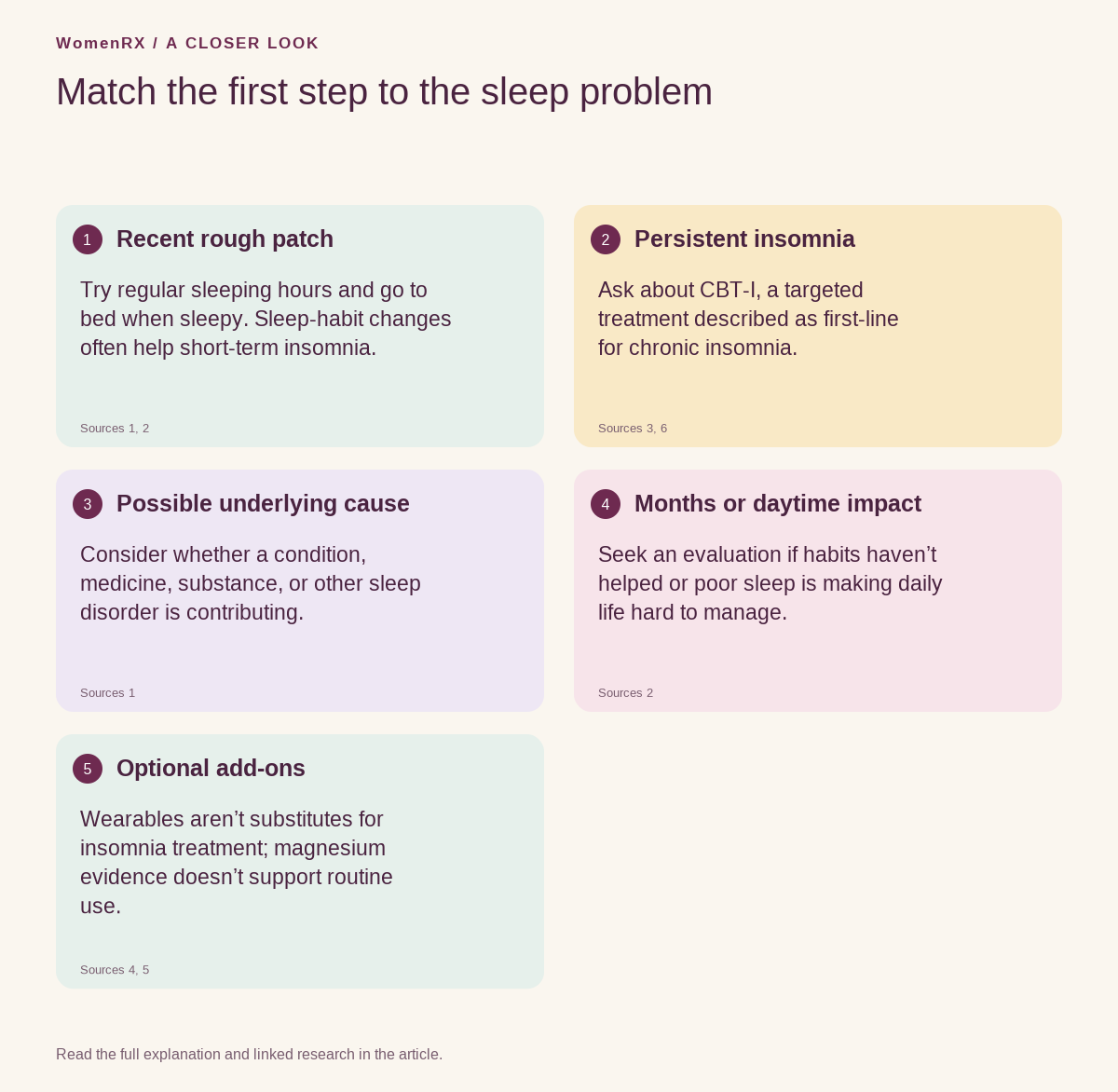
Match the first step to the sleep problem
Recent rough patch: Try regular sleeping hours and go to bed when sleepy. Sleep-habit changes often help short-term insomnia.12
Persistent insomnia: Ask about CBT-I, a targeted treatment described as first-line for chronic insomnia.36
Possible underlying cause: Consider whether a condition, medicine, substance, or other sleep disorder is contributing.1
Months or daytime impact: Seek an evaluation if habits haven’t helped or poor sleep is making daily life hard to manage.2
Optional add-ons: Wearables aren’t substitutes for insomnia treatment; magnesium evidence doesn’t support routine use.45
Read the figure as text
Each option addresses a different reason sleep may be difficult; a simple habit change isn’t a substitute for targeted insomnia care.- Recent rough patch: Try regular sleeping hours and go to bed when sleepy. Sleep-habit changes often help short-term insomnia.12
- Persistent insomnia: Ask about CBT-I, a targeted treatment described as first-line for chronic insomnia.36
- Possible underlying cause: Consider whether a condition, medicine, substance, or other sleep disorder is contributing.1
- Months or daytime impact: Seek an evaluation if habits haven’t helped or poor sleep is making daily life hard to manage.2
- Optional add-ons: Wearables aren’t substitutes for insomnia treatment; magnesium evidence doesn’t support routine use.45
Sources you can check
- Insomnia | MedlinePlusAccessed 2026-09-25Return to first citation
- Insomnia - NHSAccessed 2026-09-25Return to first citation
- The effect of internet-based acceptance and commitment therapy on sleep quality and insomnia in adults: a systematic review and meta-analysis.Fu J, Zhang X, Qiu Y, Luo Q, Liu R, Liu J, Yue Y, Gu J, Tong M, Zhou Y, Yang F. · Scientific reports · 2026Return to first citation
- Effectiveness of Wearable Digital Therapeutics in Improving Sleep Outcomes Among Individuals With Insomnia: Systematic Review and Meta-Analysis of Randomized Controlled Trials.Zhu W, Chen M, Guo Y, Zhang B, Luo C. · Journal of medical Internet research · 2026Return to first citation
- Magnesium Supplementation for Sleep in Adults: A Systematic Review of Randomized Controlled Trials.Lopresti AL, Smith SJ, Drummond PD. · Journal of dietary supplements · 2026Return to first citation
- Perioperative sleep optimisation and brain health in older adults (SLEEP-BOOST): protocol for a randomised controlled trial.Charles AE, Castillo Suárez AA, Chhajed M, Jimenez Gallardo M, Sanchez Valdes K, Li P, Hu K, Wong PM, Winkelman J, Gao L. · BMJ open · 2026Return to first citation