Sleep and Food: What’s Worth Changing First?
Caffeine and alcohol are clearer places to start than a special “sleep-promoting” food or a strict rule about when to eat.
If food and drink may be affecting your sleep, test one change at a time. Caffeine can keep affecting you for four to six hours, and it’s listed as a possible contributor to sleep problems; alcohol is also a possible cause of insomnia. Evidence about late eating is less clear, and it doesn’t establish a magic bedtime snack. 2 3 6
Start with what you can actually test
A practical first step is to look at caffeine, then alcohol, then meal timing. These factors don’t have equally strong evidence: caffeine and alcohol are recognized contributors to sleep problems, while research on evening meals is harder to interpret. The food associations in the nutrition review don’t establish a reliable fix for poor sleep. 1 3 6 7
For a short personal experiment, keep a simple note of when you had caffeine or alcohol, when you went to bed, and how the night and following day felt. Change one factor at a time so you can tell whether it seems to matter for you. This is a way to observe your own pattern, not a diagnostic test.
Caffeine: notice the clock, not just the amount
Caffeine is a stimulant. MedlinePlus says it reaches its peak level in the blood within about an hour, and its effects may continue for four to six hours. Coffee, tea, chocolate, energy drinks, and some medicines can all contribute to your intake. The amount in a drink can vary, too. 2
If you regularly have caffeine later in the day, try moving that serving earlier or leaving it out for a few nights. You don’t have to overhaul your whole diet to test whether timing matters. If you use caffeine in a medication, check the product information rather than changing a medicine on your own. Caffeine is listed as a possible cause of insomnia. 2 3
Alcohol can affect sleep
Alcohol is listed among substances that can contribute to insomnia. That makes it worth noticing whether nights with alcohol tend to be followed by more trouble falling or staying asleep for you. Try comparing a few evenings with and without it, while keeping other routines as similar as you reasonably can. 1 3
This comparison won’t prove alcohol is the cause, but it can help you decide whether changing that habit is worthwhile. The cited evidence doesn’t establish a specific amount or timing that guarantees better sleep, so there’s no precise cutoff to promise here.
Late eating: skip the rigid rule
A population-based virtual study of 2,050 adults found an association between a combined evening diet that included ultra-processed foods, caffeine and/or alcohol and a poorer sleep-quality score. Because those factors were grouped together, the finding can’t tell us which one mattered, or whether a late meal itself was responsible. The study was observational, so it also can’t show that the eating pattern caused the sleep difference. 6
That’s not a strong basis for declaring that everyone should stop eating a set number of hours before bed. If a large or late meal seems to make you uncomfortable or disrupt your routine, you can test a smaller or earlier meal and see what changes. Otherwise, there’s no need to force a strict cutoff based on this evidence.
Don’t make a “sleep food” do too much
A nutrition review discusses foods and nutrients associated with sleep, but it doesn’t establish that a particular food treats insomnia or reliably improves an individual woman’s sleep. A balanced diet can be part of general health, but adding a bedtime food isn’t a substitute for addressing ongoing insomnia or another sleep problem. 7 3
When the problem may be bigger than food
If trouble falling or staying asleep keeps affecting your daytime functioning, food changes may not be enough. For chronic insomnia in adults, the American Academy of Sleep Medicine recommends multicomponent cognitive behavioral therapy for insomnia (CBT-I); the American College of Physicians also recommends CBT-I as the initial treatment. 4 5
Some symptoms point toward a sleep problem that a food experiment can’t assess. Loud snoring, gasping or choking during sleep, or uncomfortable tingling sensations in the legs that ease when you move them are reasons to raise the issue with a clinician. 1
These habit tests are a starting point, not a way to explain every disrupted night. If you’re breastfeeding, a small amount of caffeine you consume passes to your baby, so include drinks and medicines when checking your caffeine intake. 2 If you’re caring for a baby, consider whether you have enough opportunity to sleep or have trouble sleeping when you do. During pregnancy or around menopause, too, bring persistent sleep problems or daytime effects to a clinician rather than assuming food is the cause. 1 3
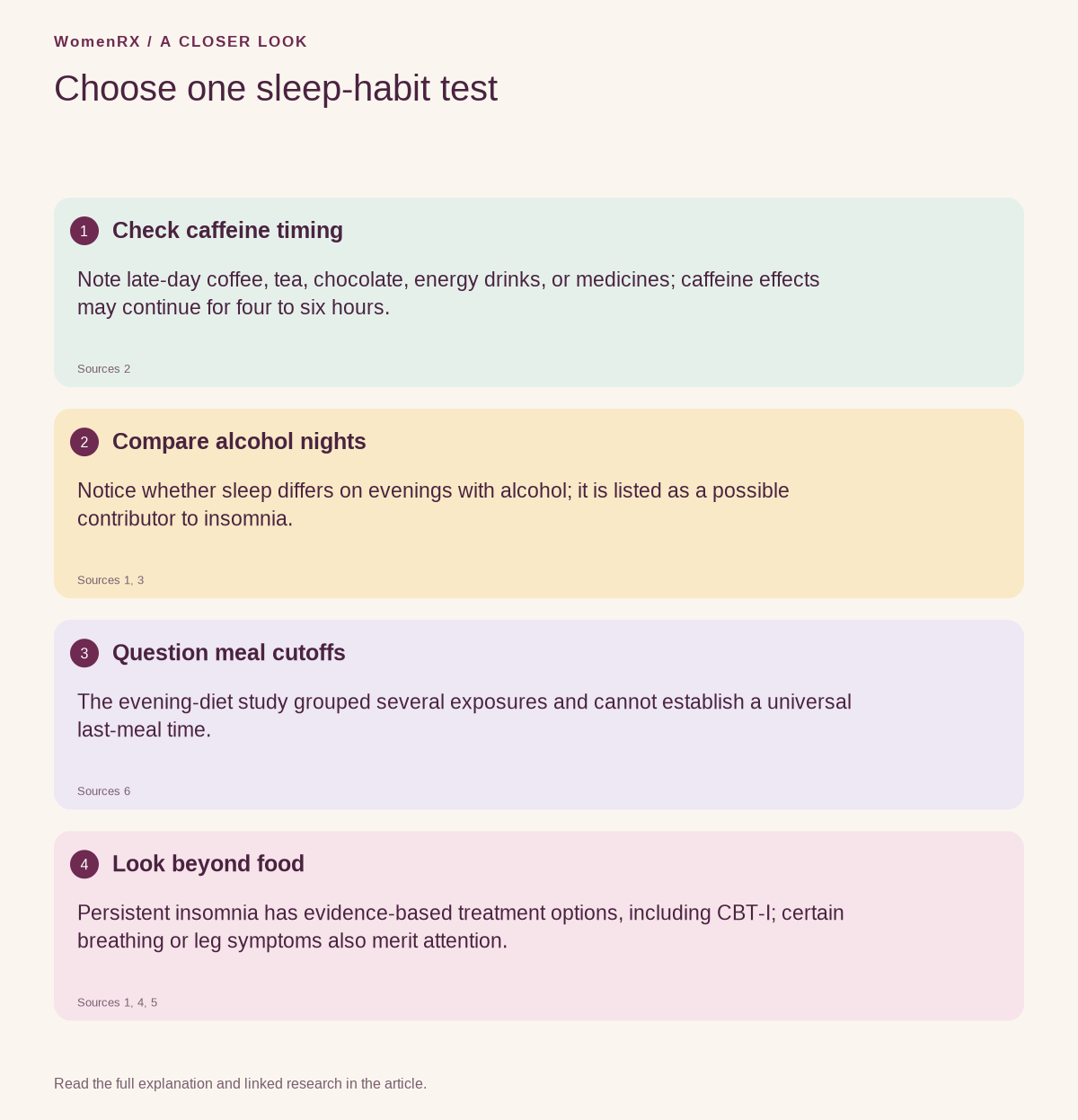
Choose one sleep-habit test
Check caffeine timing: Note late-day coffee, tea, chocolate, energy drinks, or medicines; caffeine effects may continue for four to six hours.2
Compare alcohol nights: Notice whether sleep differs on evenings with alcohol; it is listed as a possible contributor to insomnia.13
Question meal cutoffs: The evening-diet study grouped several exposures and cannot establish a universal last-meal time.6
Look beyond food: Persistent insomnia has evidence-based treatment options, including CBT-I; certain breathing or leg symptoms also merit attention.145
Read the figure as text
Use this checklist to prioritize a change by how directly the evidence connects it with sleep, and to keep a personal trial focused.- Check caffeine timing: Note late-day coffee, tea, chocolate, energy drinks, or medicines; caffeine effects may continue for four to six hours.2
- Compare alcohol nights: Notice whether sleep differs on evenings with alcohol; it is listed as a possible contributor to insomnia.13
- Question meal cutoffs: The evening-diet study grouped several exposures and cannot establish a universal last-meal time.6
- Look beyond food: Persistent insomnia has evidence-based treatment options, including CBT-I; certain breathing or leg symptoms also merit attention.145
Sources you can check
- Sleep Disorders | MedlinePlusAccessed 2026-09-25Return to first citation
- Caffeine: MedlinePlusAccessed 2026-09-25Return to first citation
- Insomnia | MedlinePlusAccessed 2026-09-25Return to first citation
- Behavioral and psychological treatments for chronic insomnia disorder in adults: an American Academy of Sleep Medicine clinical practice guideline.Edinger JD, Arnedt JT, Bertisch SM, Carney CE, Harrington JJ, Lichstein KL, Sateia MJ, Troxel WM, Zhou ES, Kazmi U, Heald JL, Martin JL. · Journal of clinical sleep medicine : JCSM : official publication of the American Academy of Sleep Medicine · 2021Return to first citation
- Management of Chronic Insomnia Disorder in Adults: A Clinical Practice Guideline From the American College of Physicians.Qaseem A, Kansagara D, Forciea MA, Cooke M, Denberg TD, Clinical Guidelines Committee of the American College of Physicians. · Annals of internal medicine · 2016Return to first citation
- The Interplay Between Evening Latency and Sleep-Disturbing Diet on Sleep Quality Among Adults.Soares LL, Longo-Silva G, Lima MO, de Melo JS, Leal VS, de Menezes RCE. · Journal of human nutrition and dietetics : the official journal of the British Dietetic Association · 2025Return to first citation
- [Nutrition in improving sleep quality and fighting insomnia].Ortega RM, Jiménez-Ortega AI, Peral-Suárez Á, Martínez-García RM, González-Rodríguez LG. · Nutricion hospitalaria · 2025Return to first citation