Perimenopause Sleep: What Food Changes May Help?
Food may be worth experimenting with, but no bedtime snack or diet has been proven to treat perimenopausal insomnia.
A one-change-at-a-time experiment can help you notice whether an evening habit affects your sleep. Caffeine can make you feel more awake, so changing when you have it may be worth testing. 1 Research on diet and menopausal sleep doesn’t establish particular foods as treatments for perimenopausal insomnia. 4 Dietary modification isn’t recommended as a treatment for hot flashes or night sweats, and waking can happen without a hot flash. 3 4
First, notice what’s waking you
Sleep can become disrupted during the menopause transition, but not every difficult night has the same cause. Hot flashes or night sweats may wake you. Research reviewed in a 2025 article also describes physiological sleep arousal in women transitioning to menopause that occurred independently of self-reported hot flashes. So if you wake without feeling overheated, that doesn’t rule out a menopause-related change, and it doesn’t mean food is necessarily the cause. 4
That distinction matters: a food change might be worth testing for your own sleep, but it shouldn’t be treated as a fix for hot flashes. The North American Menopause Society’s 2023 position statement does not recommend dietary modification as a treatment for menopause-related vasomotor symptoms, which include hot flashes and night sweats. 3
Which food-related changes are worth testing?
Caffeine may be worth testing if you have it later in the day. Caffeine stimulates the central nervous system and can make you feel more awake. That gives you a plausible reason to see whether changing your own caffeine pattern helps. Caffeine’s stimulating effect alone doesn’t establish a perimenopause-specific cutoff time. 1
Meal timing is an open question, not a proven sleep strategy. The menopause-focused diet review discusses overall eating patterns and specific foods, but it doesn’t establish a meal-timing rule for perimenopausal sleep. If you suspect that a late meal or going to bed hungry affects your own sleep, you could test one change at a time. There’s no basis here for saying everyone should eat earlier or add a bedtime snack. 4
Alcohol can be an optional personal experiment. If you drink in the evening and suspect a connection with your waking, you could compare similar evenings with and without alcohol. Treat that as an observation about your own routine, not proof that alcohol caused your waking or an established menopause-specific treatment.
Overall eating patterns have more suggestive evidence than a magic bedtime food. A 2025 review describes emerging associations between better diet quality and aspects of sleep. It reports that a Mediterranean-style pattern has the strongest evidence for improving sleep quality, while also emphasizing that well-designed trials are needed, especially in menopausal women. Association doesn’t establish that changing your diet will fix your sleep. 4
The same review discusses trials of walnuts and tart cherry juice with modest sleep outcomes, and an association between tryptophan-rich foods such as dairy and sleep. These findings don’t establish that those foods help perimenopausal insomnia. A specific snack may be enjoyable, but there’s no basis here to call it a proven sleep treatment. 4
Try one change without turning dinner into a project
Pick one habit that feels relevant, rather than changing caffeine, meal timing, alcohol, and snacks all at once. For example, if afternoon coffee is part of your routine, try having it earlier while keeping other habits fairly steady. If you suspect meal timing matters to you, change that pattern alone for a while. If you suspect evening alcohol matters, compare similar evenings with and without it. These are ways to learn about your own pattern, not clinically tested perimenopause protocols.
Make a brief note of when you had the food or drink, whether you woke, and whether you noticed a hot flash or night sweat. The point isn’t to diagnose insomnia from a diary. It’s to avoid giving credit to a new bedtime food when several things changed at once. If there’s no clear difference, you don’t need to keep restricting foods in pursuit of a sleep benefit the evidence hasn’t established.
When food isn’t the main answer
If sleep remains difficult or is affecting your days, don’t assume you need a stricter diet. Perimenopausal sleep disruption can occur with or without perceived hot flashes, and dietary strategies aren’t established treatments for insomnia or vasomotor symptoms. 3 4
A clinician can help sort out whether hot flashes, ongoing insomnia, or another factor may be involved and discuss options suited to your symptoms. If hot flashes are a major part of the problem, treatments with evidence for vasomotor symptoms are a more relevant conversation than relying on a food or supplement. 2 3
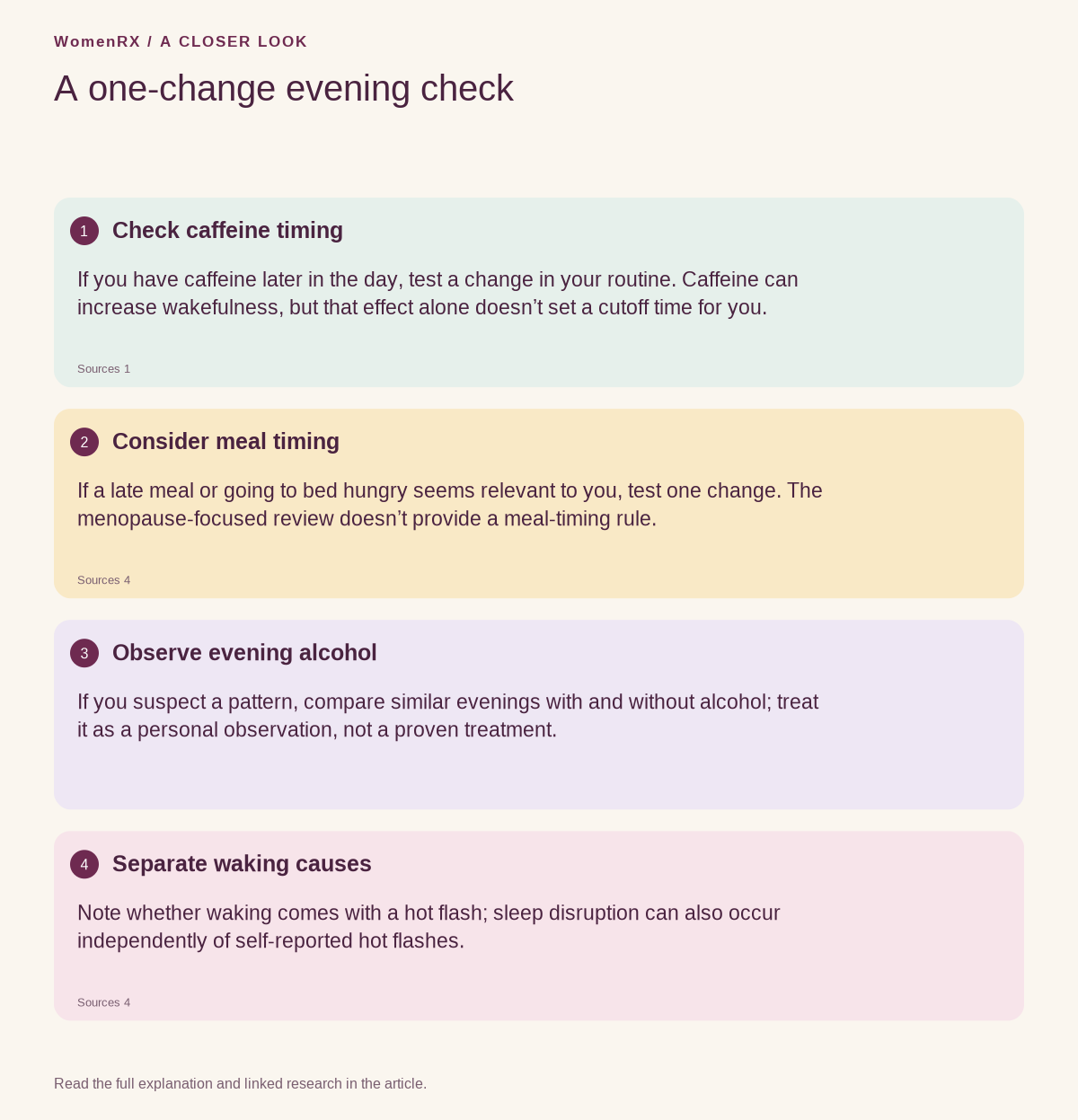
A one-change evening check
Check caffeine timing: If you have caffeine later in the day, test a change in your routine. Caffeine can increase wakefulness, but that effect alone doesn’t set a cutoff time for you.1
Consider meal timing: If a late meal or going to bed hungry seems relevant to you, test one change. The menopause-focused review doesn’t provide a meal-timing rule.4
Observe evening alcohol: If you suspect a pattern, compare similar evenings with and without alcohol; treat it as a personal observation, not a proven treatment.
Separate waking causes: Note whether waking comes with a hot flash; sleep disruption can also occur independently of self-reported hot flashes.4
Read the figure as text
Use this checklist to choose one personal experiment and keep it separate from claims that food treats perimenopausal insomnia or hot flashes.- Check caffeine timing: If you have caffeine later in the day, test a change in your routine. Caffeine can increase wakefulness, but that effect alone doesn’t set a cutoff time for you.1
- Consider meal timing: If a late meal or going to bed hungry seems relevant to you, test one change. The menopause-focused review doesn’t provide a meal-timing rule.4
- Observe evening alcohol: If you suspect a pattern, compare similar evenings with and without alcohol; treat it as a personal observation, not a proven treatment.
- Separate waking causes: Note whether waking comes with a hot flash; sleep disruption can also occur independently of self-reported hot flashes.4
More questions, answered
Is a bedtime snack a proven treatment for perimenopause insomnia?
No. Some food studies report modest sleep outcomes or associations, but they don’t establish a bedtime snack as a treatment for perimenopausal insomnia. 4
Can changing what I eat stop hot flashes at night?
Dietary modification isn’t recommended as a treatment for menopause-related vasomotor symptoms in the North American Menopause Society’s 2023 position statement. Food changes shouldn’t replace discussing persistent, disruptive hot flashes with a clinician. 3
Sources you can check
- Caffeine: MedlinePlusAccessed 2026-09-25Return to first citation
- The 2022 hormone therapy position statement of The North American Menopause Society.“The 2022 Hormone Therapy Position Statement of The North American Menopause Society” Advisory Panel. · Menopause (New York, N.Y.) · 2022Return to first citation
- The 2023 nonhormone therapy position statement of The North American Menopause Society.Menopause (New York, N.Y.) · 2023Return to first citation
- Dietary interventions to support and improve sleep disturbances and insomnia disorder in menopause: From bench to bedside.Musgrave RH, Nowakowski S, Watermeyer TJ, Arentson-Lantz EJ, Elder GJ. · Post reproductive health · 2025Return to first citation