Magnesium for Sleep: What It May and May Not Change
Magnesium has shown possible benefits on some sleep measures, but it isn’t an established treatment for insomnia or a reliable way to sleep longer.
Magnesium may modestly improve some sleep-related measures for some adults, but results differ across studies and the overall certainty is low to very low. A change in perceived sleep quality or insomnia symptoms doesn’t necessarily mean you’ll spend more time asleep. If sleep disruption persists, consider what may be causing it, including symptoms, health conditions, or medicines, rather than relying on magnesium alone. 24
“Better sleep” can mean different things
You might mean falling asleep more easily, waking less often, feeling more rested, or getting more total sleep. These are related, but they’re not interchangeable. A supplement that changes a sleep-quality rating doesn’t necessarily treat insomnia or increase the hours you sleep.
A 2026 systematic review assessed 12 randomized trials of magnesium for sleep, insomnia, or poor sleep in adults. The studies varied in who took part, the magnesium products used, treatment periods, and the way sleep was measured. Results were inconsistent, and the review rated the certainty of evidence as low to very low. Its conclusion: current evidence doesn’t support oral magnesium as a routine insomnia treatment. 4
One small trial helps illustrate why the specific outcome matters. It enrolled 46 adults ages 60 to 75 with primary insomnia and low magnesium intake. After eight weeks, participants assigned to magnesium improved on some measures, including insomnia severity, sleep efficiency, and time to fall asleep. But total sleep time did not differ significantly between the magnesium and placebo groups. That result is a possible signal in a particular group, not proof that magnesium reliably lengthens sleep. 6
A different randomized trial studied 80 adults ages 35 to 55 who reported sleep problems. It found changes in several subjective measures and wearable-derived sleep estimates with magnesium L-threonate. The participants were described as having self-reported sleep problems, so the trial doesn’t establish that this product treats diagnosed insomnia. 7
What the studies can tell women
Some sleep trials included women, but that alone doesn’t show whether magnesium works differently for women. The small older-adult trial included 23 women and 23 men, and its reported results don’t give a separate estimate for women. In another trial, 197 of the 290 participants who completed the study were women. That study involved people with diabetes and insomnia and compared magnesium, potassium, and their combination with placebo; the reported findings don’t establish a women-specific magnesium effect. 56
The reviewed adult trials don’t establish that magnesium improves sleep during pregnancy. Nor do these findings show that it treats menopause-related sleep disruption. Menopause can contribute to insomnia, but that doesn’t mean magnesium addresses the reason you’re waking. 34
Look for what’s keeping you awake
If you’re waking because you feel hot, have pain, or notice sleep changes after starting a medicine, magnesium may not address the underlying reason. Insomnia can be related to medical conditions, medicines, caffeine, tobacco, or alcohol. Menopause is another possible contributor. 23
That distinction can help you choose a useful next step. If the problem is ongoing difficulty falling or staying asleep, or daytime tiredness is making it hard to function, consider an assessment that looks at your sleep history and possible causes. For chronic insomnia, cognitive behavioral therapy is one treatment option; treating a health problem that contributes to insomnia may also help when possible. 2
A practical check before trying a supplement
Don’t assume that trouble sleeping means you have a magnesium deficiency. Magnesium status is difficult to assess: a blood serum test is commonly used, but it doesn’t reliably reflect the body’s total magnesium stores. 1
Also, a small trial can’t answer every safety question. The older-adult study excluded people with renal disease and people taking several medicines, including loop diuretics, cyclosporine, digoxin, and amphotericin. Those exclusions don’t prove a specific interaction, but they do limit how confidently the trial’s results apply to people in those groups. If you have kidney disease or take prescription medicines, check whether a magnesium supplement is suitable for you before starting one. 6
The practical takeaway is that magnesium might affect some sleep measures for some adults, but it isn’t a dependable, established insomnia treatment. When sleep remains disrupted, working out what is waking you is more useful than assuming one supplement will fit every sleep problem. 24
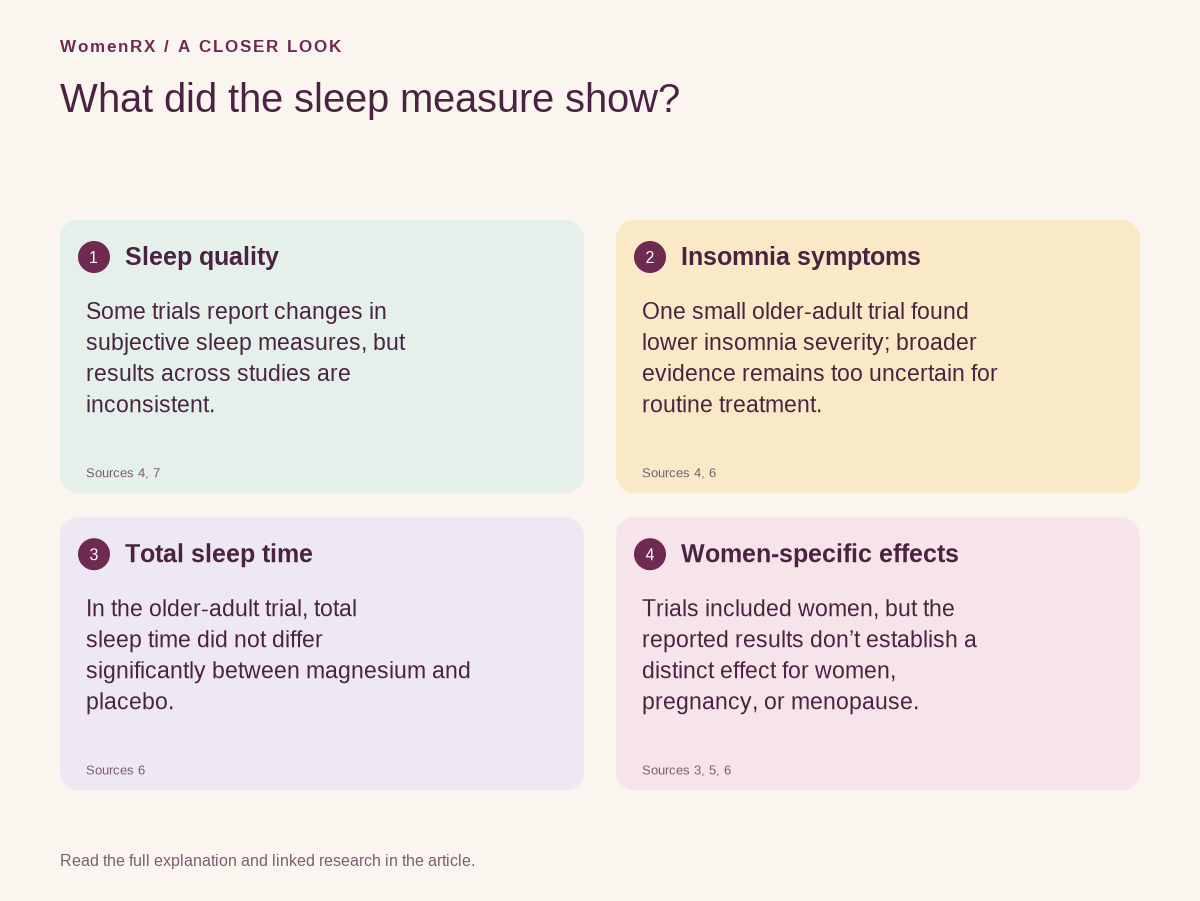
What did the sleep measure show?
Sleep quality: Some trials report changes in subjective sleep measures, but results across studies are inconsistent.47
Insomnia symptoms: One small older-adult trial found lower insomnia severity; broader evidence remains too uncertain for routine treatment.46
Total sleep time: In the older-adult trial, total sleep time did not differ significantly between magnesium and placebo.6
Women-specific effects: Trials included women, but the reported results don’t establish a distinct effect for women, pregnancy, or menopause.356
Read the figure as text
A change in one sleep outcome doesn’t automatically mean magnesium treats insomnia or increases total sleep time.- Sleep quality: Some trials report changes in subjective sleep measures, but results across studies are inconsistent.47
- Insomnia symptoms: One small older-adult trial found lower insomnia severity; broader evidence remains too uncertain for routine treatment.46
- Total sleep time: In the older-adult trial, total sleep time did not differ significantly between magnesium and placebo.6
- Women-specific effects: Trials included women, but the reported results don’t establish a distinct effect for women, pregnancy, or menopause.356
More questions, answered
Does magnesium make you sleep longer?
That hasn’t been established. In one small trial of older adults with insomnia, some sleep measures improved, but total sleep time didn’t differ significantly between the magnesium and placebo groups. Broader trial findings are inconsistent. 46
Does magnesium help with menopause-related sleep problems?
The findings don’t establish that magnesium treats menopause-related sleep disruption. Menopause can contribute to insomnia, but the trials described don’t show a specific magnesium benefit for that cause. 34
Sources you can check
- Magnesium - Health Professional Fact SheetAccessed 2026-09-25Return to first citation
- Insomnia | MedlinePlusAccessed 2026-09-25Return to first citation
- Insomnia - NHSAccessed 2026-09-25Return to first citation
- Magnesium Supplementation for Sleep in Adults: A Systematic Review of Randomized Controlled Trials.Lopresti AL, Smith SJ, Drummond PD. · Journal of dietary supplements · 2026Return to first citation
- Effects of magnesium and potassium supplementation on insomnia and sleep hormones in patients with diabetes mellitus.Khalid S, Bashir S, Mehboob R, Anwar T, Ali M, Hashim M, Waseem H, Basharat S. · Frontiers in endocrinology · 2024Return to first citation
- The effect of magnesium supplementation on primary insomnia in elderly: A double-blind placebo-controlled clinical trial.Abbasi B, Kimiagar M, Sadeghniiat K, Shirazi MM, Hedayati M, Rashidkhani B. · Journal of research in medical sciences : the official journal of Isfahan University of Medical Sciences · 2012Return to first citation
- Magnesium-L-threonate improves sleep quality and daytime functioning in adults with self-reported sleep problems: A randomized controlled trial.Hausenblas HA, Lynch T, Hooper S, Shrestha A, Rosendale D, Gu J. · Sleep medicine: X · 2024Return to first citation