Does Magnesium Change Hormones? The Evidence in Context
A few PCOS trials measured hormone levels, but they don’t show that magnesium reliably “balances hormones” or improves fertility.
Magnesium can be involved in processes that interact with hormones, but that doesn’t mean a supplement reliably changes hormone levels or symptoms. In women with PCOS, small trials have produced mixed results, and a larger review found no significant improvement in sex-hormone measures with magnesium. Those findings don’t establish benefits for menstrual symptoms, pregnancy, menopause, or fertility. 1 2 3
“Hormones” can mean several different things
A supplement might be said to affect hormones because it changes a lab result, eases a symptom, or improves fertility. Those are separate outcomes. A change in one blood hormone doesn’t automatically mean a woman’s cycle, symptoms, or chance of pregnancy will change.
The most directly relevant magnesium research here involves women with polycystic ovary syndrome (PCOS), not women broadly across the menstrual cycle or menopause. That makes PCOS trials useful for examining a specific claim, but not a basis for saying magnesium balances women’s hormones generally.
What the PCOS studies found
In one randomized, placebo-controlled trial, 60 women with PCOS took magnesium or placebo for eight weeks. The magnesium group had a statistically significant change in luteinizing hormone (LH) compared with placebo. But the between-group difference in testosterone change was only marginally significant, and several other hormone measures did not change significantly. DHEA rose in both groups. These results are signals from a small, short trial, not proof of a dependable hormone effect. 1
A second eight-week trial assigned 84 women with PCOS to magnesium, melatonin, both, or placebo. The combination group had a greater decrease in testosterone than placebo, but that result cannot show magnesium alone caused the change: melatonin was part of the combination. 2
A 2025 systematic review and meta-analysis of 25 randomized trials involving 1,600 women with PCOS assessed several trace elements, including magnesium. It found no statistically significant improvement in the sex hormones it examined with magnesium supplementation. Because the review included multiple minerals and outcomes, its overall participant total should not be mistaken for the number of women in magnesium trials. Still, its findings temper the more encouraging signals from individual small studies. 3
Taken together, this evidence does not support expecting magnesium on its own to produce a reliable or clinically meaningful shift in sex hormones. It also doesn’t establish a fertility benefit: hormone measurements are not the same as improved ovulation, pregnancy, or live-birth outcomes.
What this means beyond PCOS
These PCOS findings don’t answer whether magnesium changes menstrual symptoms in women without PCOS. The cited trials focused on hormone and metabolic measurements, not on showing that magnesium relieves period symptoms. Nor do they establish an effect during pregnancy or after menopause. The combination trial excluded pregnant and lactating participants, and these studies do not test menopause outcomes. 1 2 3
So if a supplement claim promises to “balance hormones,” ask what that means in practice: Which hormone was measured? In whom? Did the study measure a symptom or reproductive outcome that matters to you, or only a lab value? For magnesium, the clearest clinical evidence in this set is limited to PCOS research, and the results are mixed.
A realistic expectation
Magnesium is a nutrient, not an established hormone treatment. The research here offers no solid basis for taking it specifically to regulate a cycle, improve fertility, or ease menopause symptoms. A small lab change in one PCOS trial is worth distinguishing from a demonstrated benefit in everyday life. If you’re considering magnesium for a particular symptom, look for evidence on that symptom and population rather than relying on a broad promise about hormones.
What a hormone result can, and can’t, show
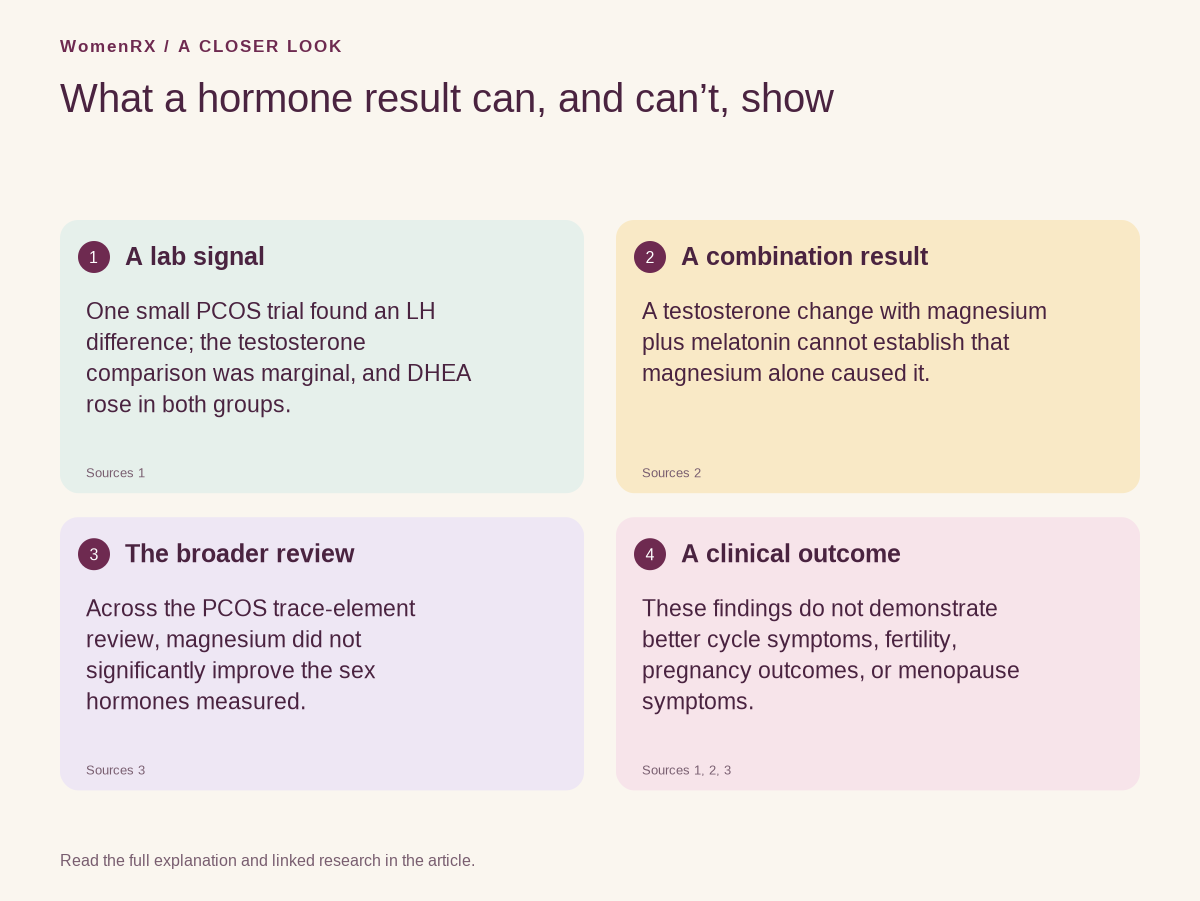
A lab signal: One small PCOS trial found an LH difference; the testosterone comparison was marginal, and DHEA rose in both groups.1
A combination result: A testosterone change with magnesium plus melatonin cannot establish that magnesium alone caused it.2
The broader review: Across the PCOS trace-element review, magnesium did not significantly improve the sex hormones measured.3
A clinical outcome: These findings do not demonstrate better cycle symptoms, fertility, pregnancy outcomes, or menopause symptoms.123
Read the figure as text
These evidence layers distinguish a measured hormone change from a treatment benefit, using magnesium research in PCOS as the example.- A lab signal: One small PCOS trial found an LH difference; the testosterone comparison was marginal, and DHEA rose in both groups.1
- A combination result: A testosterone change with magnesium plus melatonin cannot establish that magnesium alone caused it.2
- The broader review: Across the PCOS trace-element review, magnesium did not significantly improve the sex hormones measured.3
- A clinical outcome: These findings do not demonstrate better cycle symptoms, fertility, pregnancy outcomes, or menopause symptoms.123
More questions, answered
Does magnesium improve fertility in women with PCOS?
The trials described here measured hormone and metabolic outcomes, not whether magnesium improved pregnancy or live-birth rates. They therefore don’t establish a fertility benefit. 1 2 3
Sources you can check
- Clinical and Metabolic Responses to Magnesium Supplementation in Women with Polycystic Ovary Syndrome.Farsinejad-Marj M, Azadbakht L, Mardanian F, Saneei P, Esmaillzadeh A. · Biological trace element research · 2020Return to first citation
- Metabolic and hormonal effects of melatonin and/or magnesium supplementation in women with polycystic ovary syndrome: a randomized, double-blind, placebo-controlled trial.Alizadeh M, Karandish M, Asghari Jafarabadi M, Heidari L, Nikbakht R, Babaahmadi Rezaei H, Mousavi R. · Nutrition & metabolism · 2021Return to first citation
- The effects of trace element supplementation on glycolipid metabolism in PCOS: a systematic review and meta-analysis.Yang L, Gao Y, Zhao W, Qi Y, Duo X, Wang H. · Frontiers in nutrition · 2025Return to first citation