Sleep and Food During Menopause: What Can You Test?
Caffeine timing is a reasonable place to start, but no particular food or meal schedule is established as a treatment for menopause-related insomnia.
If you want to test a food-related change, start with caffeine timing: it can keep you feeling alert for several hours, and it can come from more than coffee. Adult studies link some evening eating patterns with poorer sleep, but they don’t show that changing meal timing treats insomnia during menopause. Track caffeine, meals, awakenings, and hot or sweaty waking, while staying alert to other causes of disrupted sleep. 2 6 7
Food can be a clue, not a menopause sleep treatment
Caffeine is a reasonable thing to look at if you’re having trouble falling asleep or staying asleep. It stimulates the central nervous system, and its effects can last four to six hours. How strongly you feel those effects varies. Caffeine can come from tea, chocolate, energy products, and some medicines as well as coffee. 2
Meal timing is less clear. Two observational studies of adults aged 18 to 65 found associations between evening eating patterns or a diet containing caffeine or alcohol and poorer sleep measures. These findings don’t show that late meals caused sleep problems or that moving dinner earlier will improve sleep. The studies weren’t specific to menopause, and they don’t report results for a menopause subgroup. 6 7
A 2023 North American Menopause Society position statement does not recommend dietary modification as a treatment for menopause-related vasomotor symptoms, based on Level III evidence. That recommendation concerns hot flashes and related symptoms, not insomnia itself. It does reinforce why a particular diet shouldn’t be presented as a proven fix for menopause-related sleep disruption. 5
Try one change at a time
A short tracking exercise can help you see whether a pattern is worth testing. For several days, jot down when you have caffeine, when you eat your last meal, when you go to bed, and when you wake during the night. Note whether you woke hot or sweaty, too. Then try one change, such as having caffeine earlier, while keeping the rest of your routine as steady as you reasonably can. This is a personal experiment, not a validated test or a guarantee of better sleep.
Check beyond your coffee cup. Caffeine may be added to some pain, cold, or alertness medicines, as well as energy drinks and snacks. If a medicine contains caffeine, don’t change how you take it based on a sleep experiment; ask a pharmacist or your care team about the product and your options. 2
If your notes suggest that late eating is linked with a rough night, you could test an earlier dinner or a different evening meal. There’s no established menopause-specific cutoff time, meal schedule, or bedtime food to follow. The adult studies show associations, not proof that a strict schedule treats insomnia. 6 7
Check what may be waking you
A hot flash can wake you and leave you sweaty, but menopause isn’t the only possible explanation for night sweats. If you regularly wake with soaking-wet clothes or bedding, get it checked. The same goes for night sweats accompanied by a very high temperature, cough, diarrhea, or unexplained weight loss. 3
Insomnia can also be connected to health conditions, medicines, caffeine, alcohol, or another sleep disorder. For example, tingling or prickling legs that ease when you move them, or a bed partner noticing repeated limb jerks, can be clues to a sleep disorder. Regularly taking more than 30 minutes to fall asleep is another sign worth raising if it’s part of a persistent problem. 1 4
If sleep trouble continues, a food log doesn’t have to be your only next step. Treatment depends on what’s disrupting sleep. MedlinePlus notes that cognitive behavioral therapy can help relieve anxiety linked to chronic insomnia. 4
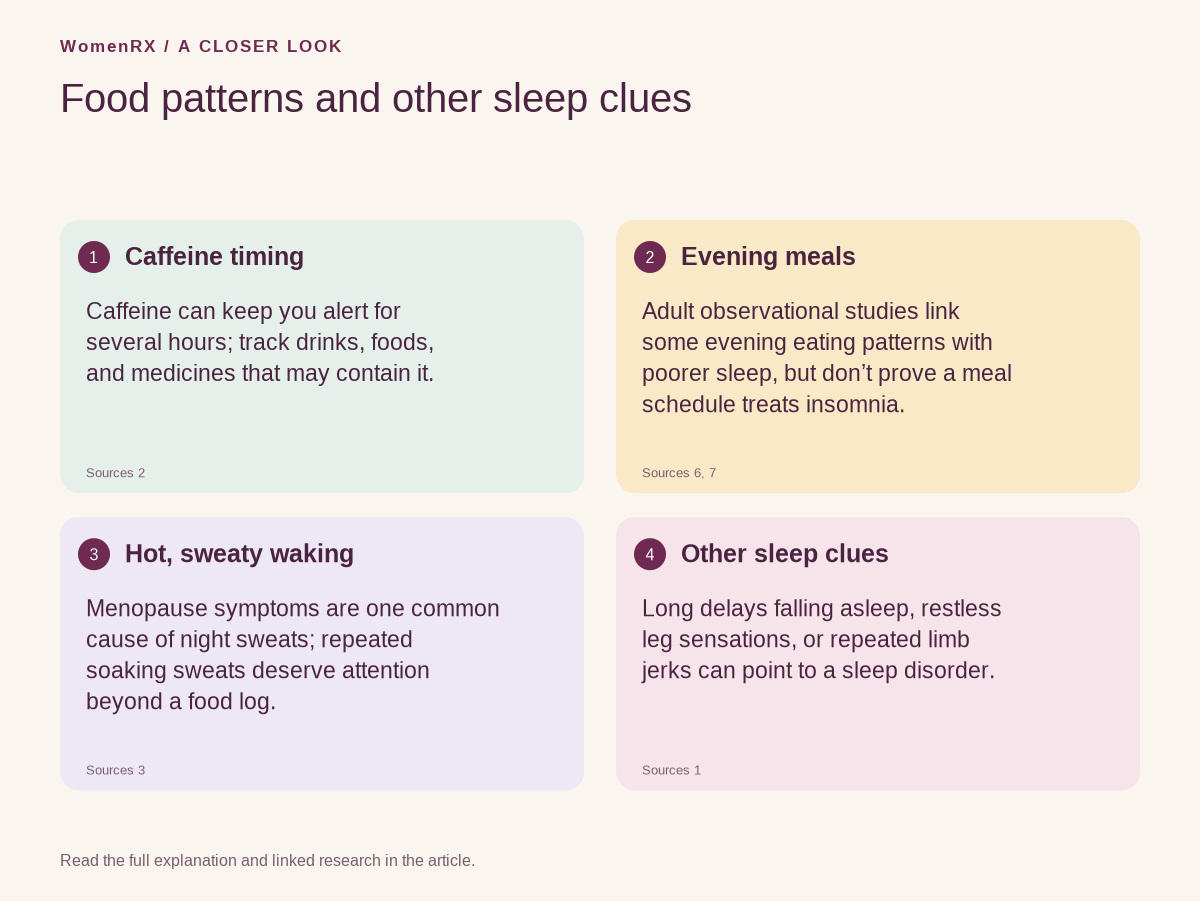
Food patterns and other sleep clues
Caffeine timing: Caffeine can keep you alert for several hours; track drinks, foods, and medicines that may contain it.2
Evening meals: Adult observational studies link some evening eating patterns with poorer sleep, but don’t prove a meal schedule treats insomnia.67
Hot, sweaty waking: Menopause symptoms are one common cause of night sweats; repeated soaking sweats deserve attention beyond a food log.3
Other sleep clues: Long delays falling asleep, restless leg sensations, or repeated limb jerks can point to a sleep disorder.1
Read the figure as text
Separate changes you can test at home from signs that sleep disruption may have another cause.- Caffeine timing: Caffeine can keep you alert for several hours; track drinks, foods, and medicines that may contain it.2
- Evening meals: Adult observational studies link some evening eating patterns with poorer sleep, but don’t prove a meal schedule treats insomnia.67
- Hot, sweaty waking: Menopause symptoms are one common cause of night sweats; repeated soaking sweats deserve attention beyond a food log.3
- Other sleep clues: Long delays falling asleep, restless leg sensations, or repeated limb jerks can point to a sleep disorder.1
More questions, answered
Do you need to cut out all caffeine?
Not necessarily. Caffeine sensitivity varies, and it can come from drinks, foods, energy products, and some medicines. If you suspect it’s affecting your sleep, tracking its sources and timing can help you decide whether a change is worth testing. Check with a pharmacist or your care team before changing a medicine that contains caffeine. 2
Sources you can check
- Sleep Disorders | MedlinePlusAccessed 2026-09-25Return to first citation
- Caffeine: MedlinePlusAccessed 2026-09-25Return to first citation
- Night sweats - NHSAccessed 2026-09-25Return to first citation
- Insomnia | MedlinePlusAccessed 2026-09-25Return to first citation
- The 2023 nonhormone therapy position statement of The North American Menopause Society.Menopause (New York, N.Y.) · 2023Return to first citation
- The Interplay Between Evening Latency and Sleep-Disturbing Diet on Sleep Quality Among Adults.Soares LL, Longo-Silva G, Lima MO, de Melo JS, Leal VS, de Menezes RCE. · Journal of human nutrition and dietetics : the official journal of the British Dietetic Association · 2025Return to first citation
- Association of Evening Eating with Sleep Quality and Insomnia among Adults in a Brazilian National Survey.Nunes MEB, Dos Santos CHB, Lima MO, Pedrosa AKP, de Menezes RCE, Longo-Silva G. · Sleep science (Sao Paulo, Brazil) · 2024Return to first citation