What Pilates Can, and Can’t, Show You During Menopause
Small studies in postmenopausal women suggest possible symptom benefits, but the trials discussed here don’t establish Pilates as a weight-loss method or a reliable route to broad fitness gains.
Pilates may suit you if you enjoy its controlled movement and want an activity you can stick with. Small studies in postmenopausal women suggest possible improvements in some menopause symptoms and quality of life, but the trials discussed here don’t establish that Pilates improves fitness broadly or causes weight loss. If bone health is a goal, include weight-bearing activity and strength training in your plan, too. 2 4 1
Pilates can be a reasonable movement choice during menopause, especially if you enjoy it enough to keep showing up. The more careful answer is that the small menopause-specific trials discussed here offer some early signals for symptom relief, but they don’t establish that Pilates reliably improves overall fitness, changes body composition, or leads to weight loss.
What menopause-specific Pilates studies measured
Two small trials focused on postmenopausal women and measured symptoms and quality of life, rather than a broad set of fitness outcomes. In a trial of 30 women, an eight-week Pilates program was compared with menopause information sessions. The study reported better scores for menopause symptoms, quality of life, and sexual function in the Pilates group. Body mass index was recorded, but it wasn’t a primary outcome; the reported results don’t establish weight loss. 4
A separate randomized trial included 40 postmenopausal women. Its six-week, online Pilates program was done twice a week. Compared with the control group, participants had greater improvement on measures of somatic and psychological menopause symptoms, quality of life, depression, and state anxiety. The trial did not find a between-group difference in urogenital symptoms, sexual quality of life, or trait anxiety. These results are encouraging, but the small sample and short program mean they’re not proof that Pilates will ease symptoms for every woman. 2
Symptoms aren’t the same as fitness or weight loss
A change on a menopause symptom or quality-of-life scale is not the same thing as a measured gain in strength, stamina, or body composition. The two trials discussed above don’t establish Pilates as a way to lose weight, and they don’t give a clear picture of its effects on overall fitness in menopausal women. A systematic review covering several forms of exercise in perimenopausal and postmenopausal women reported benefits for sleep and psychological well-being, but it included aerobic exercise, yoga, resistance exercise, Pilates, and other approaches. Its summary doesn’t isolate what Pilates alone contributed. 5
There is a more specific signal for function when the problem is chronic low-back pain. A systematic review of trials in women with that condition reported improvements in pain and function among both menopausal and non-menopausal participants who did Pilates. That supports Pilates as a possible option for women with low-back pain; it does not show that Pilates improves general fitness in all women going through menopause. 3
Match the activity to your goal
If your main goal is finding movement you enjoy, Pilates may be a good fit. The menopause trials discussed here include a six-week online program and an eight-week Pilates program, but they don’t determine which format or routine is best for you. Think of the results as a reason to consider Pilates, not a promise about how you’ll feel or what your body will do. 2 4
If you’re focused on bone health, don’t assume Pilates alone covers every movement goal. MedlinePlus describes regular physical activity for osteoporosis as including weight-bearing exercise, strength training, and balance exercises. Pilates can be one part of an active routine, but these studies don’t show that it can replace those forms of activity. 1
If weight loss is your main goal, the menopause-specific Pilates trials discussed here don’t give you a reliable reason to expect it. You can still choose Pilates because you like it or because it helps you stay active, while being clear that these trials didn’t demonstrate weight loss. 2 4
The practical takeaway: choose Pilates if it feels like a sustainable way for you to move, and judge it by the goal you actually care about. For menopause symptom relief, early trial findings are promising but limited. For weight loss or broad fitness gains, these trials leave the question open.
What Pilates Studies Measured
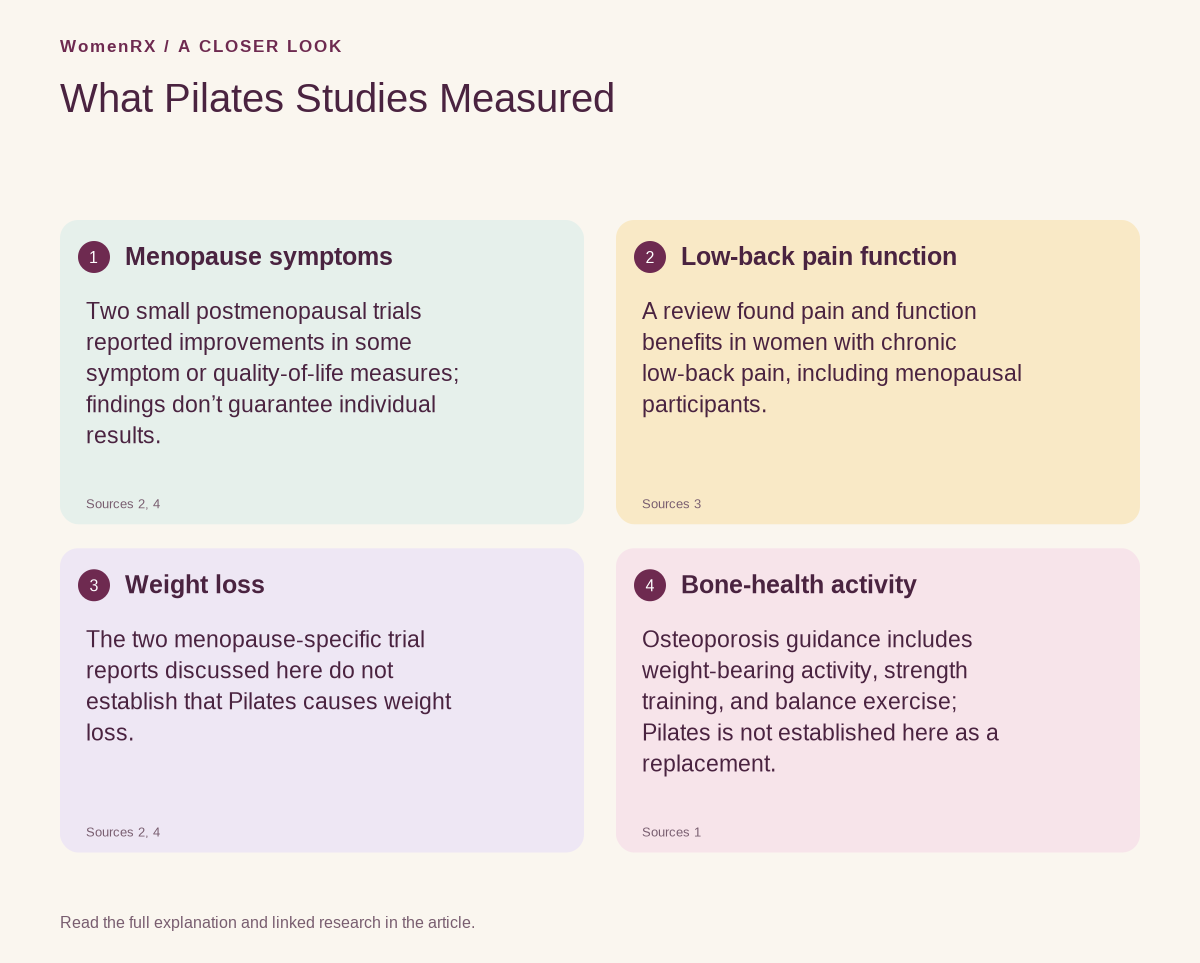
Menopause symptoms: Two small postmenopausal trials reported improvements in some symptom or quality-of-life measures; findings don’t guarantee individual results.24
Low-back pain function: A review found pain and function benefits in women with chronic low-back pain, including menopausal participants.3
Weight loss: The two menopause-specific trial reports discussed here do not establish that Pilates causes weight loss.24
Bone-health activity: Osteoporosis guidance includes weight-bearing activity, strength training, and balance exercise; Pilates is not established here as a replacement.1
Read the figure as text
The evidence differs by outcome: two small menopause trials focused on symptoms, while a separate review addressed function in women with chronic low-back pain.- Menopause symptoms: Two small postmenopausal trials reported improvements in some symptom or quality-of-life measures; findings don’t guarantee individual results.24
- Low-back pain function: A review found pain and function benefits in women with chronic low-back pain, including menopausal participants.3
- Weight loss: The two menopause-specific trial reports discussed here do not establish that Pilates causes weight loss.24
- Bone-health activity: Osteoporosis guidance includes weight-bearing activity, strength training, and balance exercise; Pilates is not established here as a replacement.1
More questions, answered
Does Pilates improve bone density after menopause?
The menopause-specific Pilates trials discussed here don’t establish an effect on bone density. MedlinePlus lists weight-bearing activity, strength training, and balance exercise as parts of regular physical activity for osteoporosis, so don’t treat Pilates as a proven bone-density treatment. 1 2 4
Is there evidence for Pilates during perimenopause?
The Pilates trials discussed here studied postmenopausal women. A review included both perimenopausal and postmenopausal women, but it combined multiple exercise types and doesn’t isolate Pilates’ effect in perimenopause. 2 4 5
Sources you can check
- Osteoporosis | MedlinePlusAccessed 2026-09-25Return to first citation
- Effects of Tele-Pilates Exercise on Menopausal and Urogenital Symptoms and Psychosocial Outcomes in Postmenopausal Women: A Randomized Controlled Trial.Arslan EGB, Tufekci B, Acar M, Cetindag EN, Sahin E. · International urogynecology journal · 2026Return to first citation
- Efficacy of Pilates on chronic low back pain in women: A systematic review and meta-analysis.Zhang J, Su Y. · Journal of back and musculoskeletal rehabilitation · 2026Return to first citation
- Investigating the effects of Pilates exercises on menopausal symptoms and sexual dysfunction in postmenopausal women: A randomized controlled trial.Yiğit Kocamer M, Atilgan E. · Medicine · 2025Return to first citation
- Menopause and movement: exercise for better sleep and psychological well-being-a systematic review.Choudhary A, Bansal K. · Menopause (New York, N.Y.) · 2025Return to first citation