Can Symptoms Show That Progesterone Is Low During Menopause?
Symptoms can point to a menopause-related change, but they can’t identify low progesterone on their own.
No. Sleep changes, mood shifts, and other symptoms can happen during perimenopause, but they don’t show that progesterone is the cause. Progesterone rises after ovulation, and ovulation becomes less predictable during the transition, so a single result needs cycle context. After menopause, symptoms still can’t reveal which hormone is responsible. Treatment decisions are based on the problem being treated, not symptoms alone. 1 4 5
Why progesterone changes as periods become irregular
Progesterone is produced after ovulation. During perimenopause, ovulation becomes less consistent: some cycles ovulate and others don’t, and ovulation may happen later than it used to. That means progesterone can vary from one cycle to another, rather than falling in a smooth, predictable line. 1
In a five-year study that followed 108 participants with repeated daily urine samples, anovulatory cycles became more common as participants moved through perimenopause. Most cycles in late perimenopause were anovulatory, but about one in four cycles longer than 60 days still involved ovulation. A long or irregular cycle, then, doesn’t tell you by itself whether ovulation happened or what your progesterone level was. 1
After menopause, defined as 12 months without a menstrual period for reasons other than another cause, reproductive hormone levels change, including a decrease in progesterone. But a low level expected after menopause isn’t the same as a diagnosis that explains a particular symptom. 4
Symptoms don’t identify the hormone behind them
Sleep disruption and mood changes can occur during the menopause transition, but they have more than one possible connection to hormonal change. In a small study of 45 perimenopausal women, progesterone levels were not associated with the measured sleep outcomes after researchers accounted for night sweats and depressive symptoms. More awakenings were associated with estradiol in the postmenopausal range and higher FSH in that study. Those associations don’t prove a cause, and the findings don’t explain every person’s sleep. They do show why waking at night isn’t proof of low progesterone. 5
The timing of a symptom can also matter. For example, symptoms that reliably occur before a period aren’t evidence of too little progesterone. A review of premenstrual syndrome in perimenopause describes PMS as associated with ovulatory cycles and proposes that some people are sensitive to progesterone after ovulation. That is a different possibility from a hormone deficiency. 2
What a progesterone test can tell you
A progesterone result is easier to interpret when it’s considered alongside whether ovulation occurred and where the person is in the cycle. Because ovulation may be irregular or delayed in perimenopause, a single result without that context can’t establish that common symptoms are caused by low progesterone. 1
If testing is being considered, a useful question is: What decision would this result change? A clinician may need to understand a specific cycle or evaluate a particular concern, but a number alone doesn’t explain a symptom such as poor sleep or a mood change. Be sure to mention if your cycles are unpredictable or if you’re using hormone medication, since those details affect what the result represents.
Treatment need is a separate question
Hormone treatment is considered in relation to symptoms and goals, not simply to correct a number. The North American Menopause Society’s position statement identifies hormone therapy as an effective treatment for bothersome hot flashes and night sweats, with the balance of benefits and risks depending on factors such as age, time since menopause, and the type of therapy. It does not frame treatment as something to start based on a symptom-based progesterone diagnosis. 3
Progesterone or another progestogen may also have a different job in a treatment plan: when systemic estrogen is used by someone with a uterus, a progestogen may be included to protect the uterine lining. That purpose is distinct from treating a presumed progesterone deficiency. 2
For a conversation about symptoms, it may help to describe what’s bothering you, when it happens, and whether it follows a cycle pattern. Then ask what the proposed treatment is meant to address, whether hormone testing would change the plan, and how the benefits and risks fit your situation. Those questions keep the focus on the problem you want help with, rather than treating a symptom list as a hormone test.
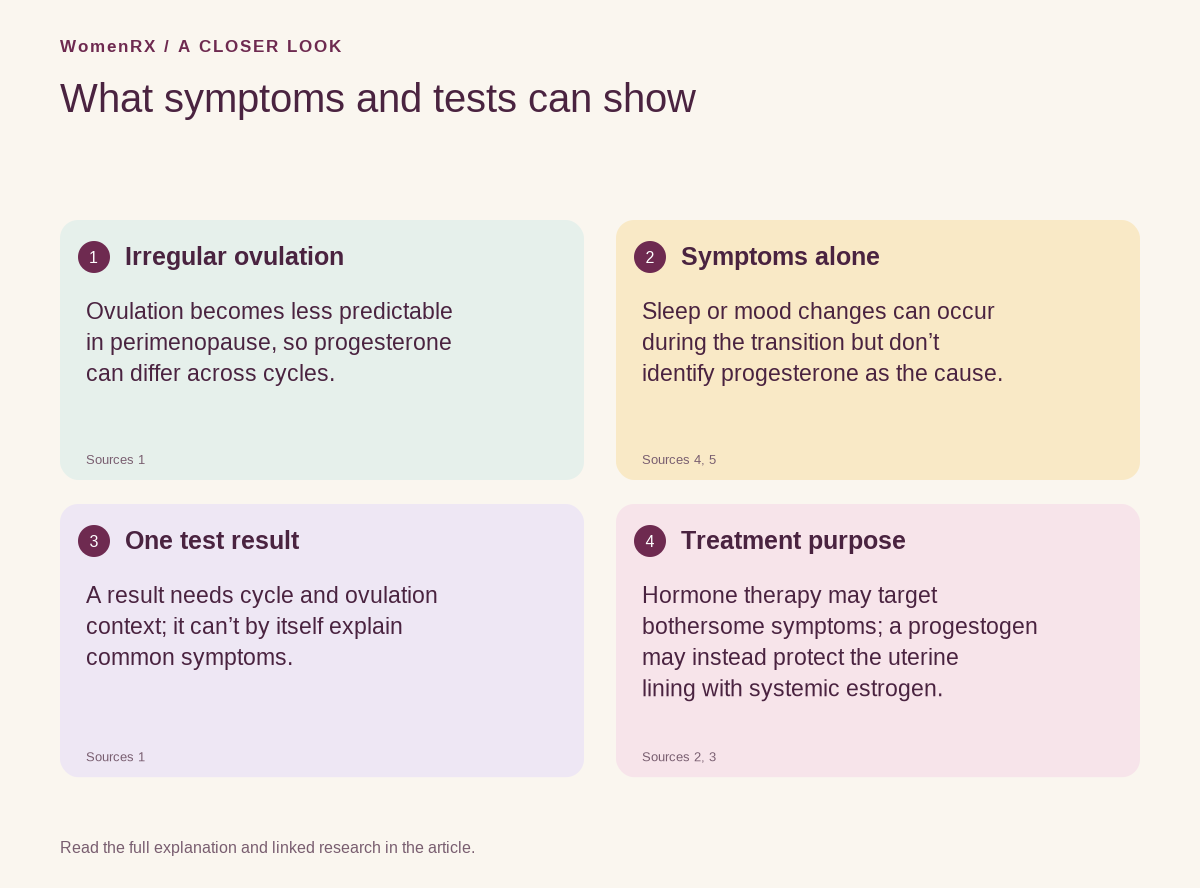
What symptoms and tests can show
Irregular ovulation: Ovulation becomes less predictable in perimenopause, so progesterone can differ across cycles.1
Symptoms alone: Sleep or mood changes can occur during the transition but don’t identify progesterone as the cause.45
One test result: A result needs cycle and ovulation context; it can’t by itself explain common symptoms.1
Treatment purpose: Hormone therapy may target bothersome symptoms; a progestogen may instead protect the uterine lining with systemic estrogen.23
Read the figure as text
The menopause stage and cycle context help explain what a symptom or progesterone result can, and cannot, establish.- Irregular ovulation: Ovulation becomes less predictable in perimenopause, so progesterone can differ across cycles.1
- Symptoms alone: Sleep or mood changes can occur during the transition but don’t identify progesterone as the cause.45
- One test result: A result needs cycle and ovulation context; it can’t by itself explain common symptoms.1
- Treatment purpose: Hormone therapy may target bothersome symptoms; a progestogen may instead protect the uterine lining with systemic estrogen.23
More questions, answered
Does low progesterone cause poor sleep during perimenopause?
Poor sleep can happen during perimenopause, but it doesn’t establish low progesterone as the cause. In one small study, progesterone wasn’t associated with the measured sleep outcomes after accounting for night sweats and depressive symptoms; the study does not show what treatment would help an individual. 5
Can progesterone be low after menopause even if I have no symptoms?
Progesterone levels decrease after menopause, but a hormone level and the presence of symptoms are separate questions. Symptoms alone can’t show which hormonal change, if any, is responsible. 4
Sources you can check
- Progesterone and ovulation across stages of the transition to menopause.O'Connor KA, Ferrell R, Brindle E, Trumble B, Shofer J, Holman DJ, Weinstein M. · Menopause (New York, N.Y.) · 2009Return to first citation
- PMS in the perimenopause.Hassan I, Ismail KM, O'Brien S. · The journal of the British Menopause Society · 2004Return to first citation
- The 2022 hormone therapy position statement of The North American Menopause Society.“The 2022 Hormone Therapy Position Statement of The North American Menopause Society” Advisory Panel. · Menopause (New York, N.Y.) · 2022Return to first citation
- Estrogen deficiency in the menopause and the role of hormone therapy: integrating the findings of basic science research with clinical trials.Yang JL, Hodara E, Sriprasert I, Shoupe D, Stanczyk FZ. · Menopause (New York, N.Y.) · 2024Return to first citation
- Disruption of Sleep Continuity During the Perimenopause: Associations with Female Reproductive Hormone Profiles.Coborn J, de Wit A, Crawford S, Nathan M, Rahman S, Finkelstein L, Wiley A, Joffe H. · The Journal of clinical endocrinology and metabolism · 2022Return to first citation