Does Low Progesterone Explain Symptoms After Menopause?
Progesterone normally declines after menopause, but a low level alone doesn’t identify what’s causing a symptom or show that replacing it will help.
A lower progesterone level is an expected part of the hormonal changes around menopause, not a diagnosis by itself. Menopause guidance focuses on symptoms and treatment goals rather than using hormone levels to explain them. Progesterone may have a specific role when estrogen therapy is used to protect the uterine lining in someone with a uterus; that’s different from replacing it just to restore a premenopausal level. 5 6 1
A low level can be expected after menopause
Menopause brings changes in several hormones, including a decline in progesterone. That expected shift doesn’t, by itself, show that a symptom is caused by low progesterone. A review of hormone testing notes that progesterone reference intervals are incomplete and that measuring progesterone generally doesn’t help guide care for menopausal symptoms. 5 6
If you’re dealing with hot flashes, sleep disruption, mood changes, or vaginal discomfort, the more useful starting point is the symptom itself: what it feels like, how it affects you, and what treatment is supported for that concern. A low progesterone result does not demonstrate that progesterone is causing the symptoms or that progesterone alone will treat them. The practical question is what symptom a proposed treatment is meant to address. 5 2
Progesterone has a specific role with estrogen therapy
For someone with a uterus who uses systemic estrogen, a progestogen may be included to protect the uterine lining from excessive growth. Progesterone is one type of progestogen. In this setting, its purpose is tied to the estrogen treatment and uterine protection, not simply to bring a blood test back to a premenopausal level. 1 4
That’s a different question from whether progesterone is the right treatment for a particular symptom. If progesterone or hormone therapy is suggested, ask what it is intended to help and how you’ll know whether it’s working.
Match the discussion to the symptom
For bothersome hot flashes or night sweats, hormone therapy is the most effective treatment, according to the North American Menopause Society. Whether it’s a good fit depends on individual circumstances, including age, time since menopause, health history, and preferences. The Society describes the benefit-risk balance as less favorable for women who start hormone therapy more than 10 years after menopause or after age 60, so timing belongs in the discussion. 2
If hormone therapy isn’t a fit or isn’t your preference, the Society’s nonhormone statement lists options with evidence for vasomotor symptoms, including cognitive behavioral therapy, clinical hypnosis, and certain prescription medicines. These options address hot flashes and night sweats; they aren’t a catch-all treatment for every postmenopausal symptom. 3
Vaginal or urinary symptoms call for a different conversation. For bothersome genitourinary symptoms not relieved by over-the-counter therapies, the Society describes options that include low-dose vaginal estrogen, vaginal dehydroepiandrosterone, and oral ospemifene for appropriate women. A low progesterone result doesn’t tell you which option is right for you. 2
Bring the symptom and the goal to your appointment
You might say, for example, “My main concern is waking up with hot flashes. What treatments have evidence for that?” Or, “Vaginal dryness is making sex uncomfortable. What could help with that symptom?” These examples keep the conversation focused on the problem you want to solve rather than on a hormone number.
If progesterone or hormone therapy is suggested, useful questions include:
- What symptom or treatment goal is this meant to address?
- Is progesterone being used alone or with estrogen?
- If estrogen is part of the plan, does my uterus affect whether I need a progestogen for uterine-lining protection?
- How do my health history and time since menopause affect the benefits and risks?
- How will we review whether the treatment is helping?
Menopause hormone therapy should be individualized, with benefits and risks reviewed over time. A low lab result alone doesn’t establish a treatment goal. 2 5
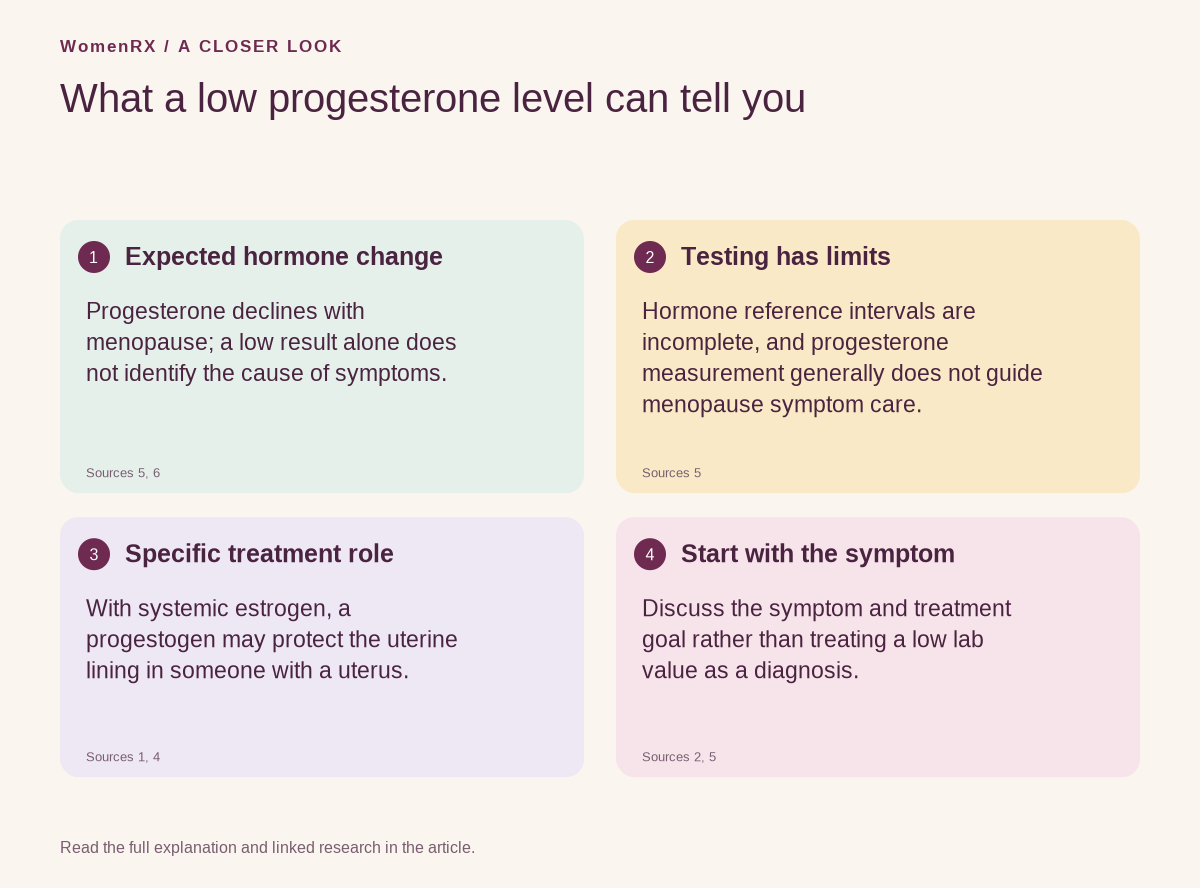
What a low progesterone level can tell you
Expected hormone change: Progesterone declines with menopause; a low result alone does not identify the cause of symptoms.56
Testing has limits: Hormone reference intervals are incomplete, and progesterone measurement generally does not guide menopause symptom care.5
Specific treatment role: With systemic estrogen, a progestogen may protect the uterine lining in someone with a uterus.14
Start with the symptom: Discuss the symptom and treatment goal rather than treating a low lab value as a diagnosis.25
Read the figure as text
Separate an expected hormone change from progesterone’s specific role in some estrogen therapy plans and from what a low result cannot establish.- Expected hormone change: Progesterone declines with menopause; a low result alone does not identify the cause of symptoms.56
- Testing has limits: Hormone reference intervals are incomplete, and progesterone measurement generally does not guide menopause symptom care.5
- Specific treatment role: With systemic estrogen, a progestogen may protect the uterine lining in someone with a uterus.14
- Start with the symptom: Discuss the symptom and treatment goal rather than treating a low lab value as a diagnosis.25
More questions, answered
Should progesterone be tested to explain symptoms after menopause?
A progesterone measurement generally doesn’t guide care for menopausal symptoms, and reference intervals remain incomplete. A low result alone doesn’t identify the cause of a symptom or show that progesterone treatment will help. 5
Is progesterone the same as estrogen in menopause hormone therapy?
No. They have different roles. A progestogen may be paired with systemic estrogen for uterine-lining protection in someone with a uterus; that is distinct from using progesterone simply to raise a low blood level. 1 4
Sources you can check
- PROMETRIUM (PROGESTERONE) CAPSULE [ACERTIS PHARMACEUTICALS, LLC] | US prescribing information and patient instructionsAccessed 2026-09-25Return to first citation
- The 2022 hormone therapy position statement of The North American Menopause Society.“The 2022 Hormone Therapy Position Statement of The North American Menopause Society” Advisory Panel. · Menopause (New York, N.Y.) · 2022Return to first citation
- The 2023 nonhormone therapy position statement of The North American Menopause Society.Menopause (New York, N.Y.) · 2023Return to first citation
- Benefits of Levonorgestrel Intrauterine Device Use vs. Oral or Transdermal Progesterone for Postmenopausal Women Using Estrogen Containing Hormone Therapy.Clark K, Westberg SM. · Innovations in pharmacy · 2019Return to first citation
- A Comprehensive Review of Estradiol, Progesterone, Luteinizing Hormone, and Follicle-Stimulating Hormone in the Context of Laboratory Medicine to Support Women's Health.Greene DN, Ahmed SB, Daccarett S, Kling JM, Lorey TS, Rytz CL, Smock KJ, Winston-McPherson G. · Clinical chemistry · 2025Return to first citation
- Estrogen deficiency in the menopause and the role of hormone therapy: integrating the findings of basic science research with clinical trials.Yang JL, Hodara E, Sriprasert I, Shoupe D, Stanczyk FZ. · Menopause (New York, N.Y.) · 2024Return to first citation