Are progesterone supplements a proven treatment for menopause symptoms?
A progesterone prescription, a compounded hormone, and a supplement marketed for “hormone support” aren’t interchangeable, and the label alone can’t establish what a product does.
No: supplements marketed for hormone support aren’t established progesterone treatments for menopause symptoms. Some small, varied trials have studied prescription progestogens, including oral micronized progesterone, for hot flashes, but the evidence is limited and doesn’t show that an over-the-counter supplement contains progesterone or works the same way. Check the actual ingredients and product type before using one, especially if you take other medicines or prescribed hormones. 2 1

First, identify what kind of product you have
The word progesterone on a product or in its marketing doesn’t tell you what’s inside. A regulated progesterone medicine, a custom-compounded hormone preparation, and a dietary supplement marketed for “hormone support” are different categories. Don’t assume a supplement contains progesterone, raises your progesterone level, or has the same effects as a prescription medicine. The ingredients and product type need to be checked. 1 3
FDA-approved hormone products, including progesterone products, are reviewed for safety and effectiveness. Compounded bioidentical hormone preparations are custom-formulated drug preparations, not the same thing as those FDA-approved products. “Bioidentical” or “natural” describes how products may be marketed; the words alone don’t establish that a particular preparation is effective or safer. 3
A supplement is different again. Menopause products may contain supplements, herbs, or over-the-counter creams, and results from research on these products are mixed. There’s also little information on their long-term safety, and some can cause harmful side effects or interact with medicines. 1
What the progesterone research does, and doesn’t, show
There is some clinical research on progestogens used by themselves for menopause symptoms, but it doesn’t establish a broad benefit for products sold as supplements. A systematic review identified seven randomized trials involving 601 people. The trials used different medicines, formulations, treatment durations, and doses, so their results weren’t consistent. Three of the seven reported improved hot flashes. 2
In the largest study of oral micronized progesterone included in that review, hot flashes improved by 58.9% among 133 participants, compared with 23.5% with placebo. That result applies to the studied oral medicine and trial, not to supplements with different ingredients. The review found no improvement in mood symptoms across the trials. 2
Side effects matter, too. In five of the seven trials, headaches or vaginal bleeding were significant; treatment discontinuation ranged from 6% to 21%. The review concluded that the best route and dose of progestogen-only treatment hadn’t been established. 2
So the useful distinction is not simply “hormones work” versus “hormones don’t work.” There is limited, uneven evidence for certain prescription progestogen treatments, while a product marketed for hormone support needs its own ingredient-specific evidence. Menopause hormone therapy overall is an effective treatment for hot flashes, but that doesn’t prove every hormone-related product, or progesterone alone, will work for you. 2 4
A practical label check before you buy or take it
Look for the product’s actual name and full ingredient list. Ask whether it is a prescription medicine, a custom-compounded preparation, or a supplement. If the label uses broad phrases such as “hormone balance” or “hormone support,” those phrases don’t tell you whether progesterone is an active ingredient or whether the product has been shown to relieve your particular symptom.
If it is a supplement, check each listed ingredient rather than treating the product name as evidence. Research on menopause supplements is mixed, and some supplements can interact with medicines. The risk can’t be assessed from the phrase “hormone support” alone. A pharmacist can review the full ingredient list alongside your current medicines; if you already use prescribed hormones, include those in the review before adding another product. 1
If it is compounded, verify that it was prescribed and find out exactly what was compounded. Don’t assume that custom formulation or “bioidentical” wording makes it interchangeable with an FDA-approved medicine. 3
If what you’re considering is prescription progesterone, ask what symptom it is intended to address and what evidence supports that use. The trials of progesterone-only treatment for hot flashes are promising in some respects but limited and inconsistent; they don’t settle the best approach for every person or symptom. Menopause treatment decisions are individualized, with benefits and risks depending on the therapy and the person. 2 4
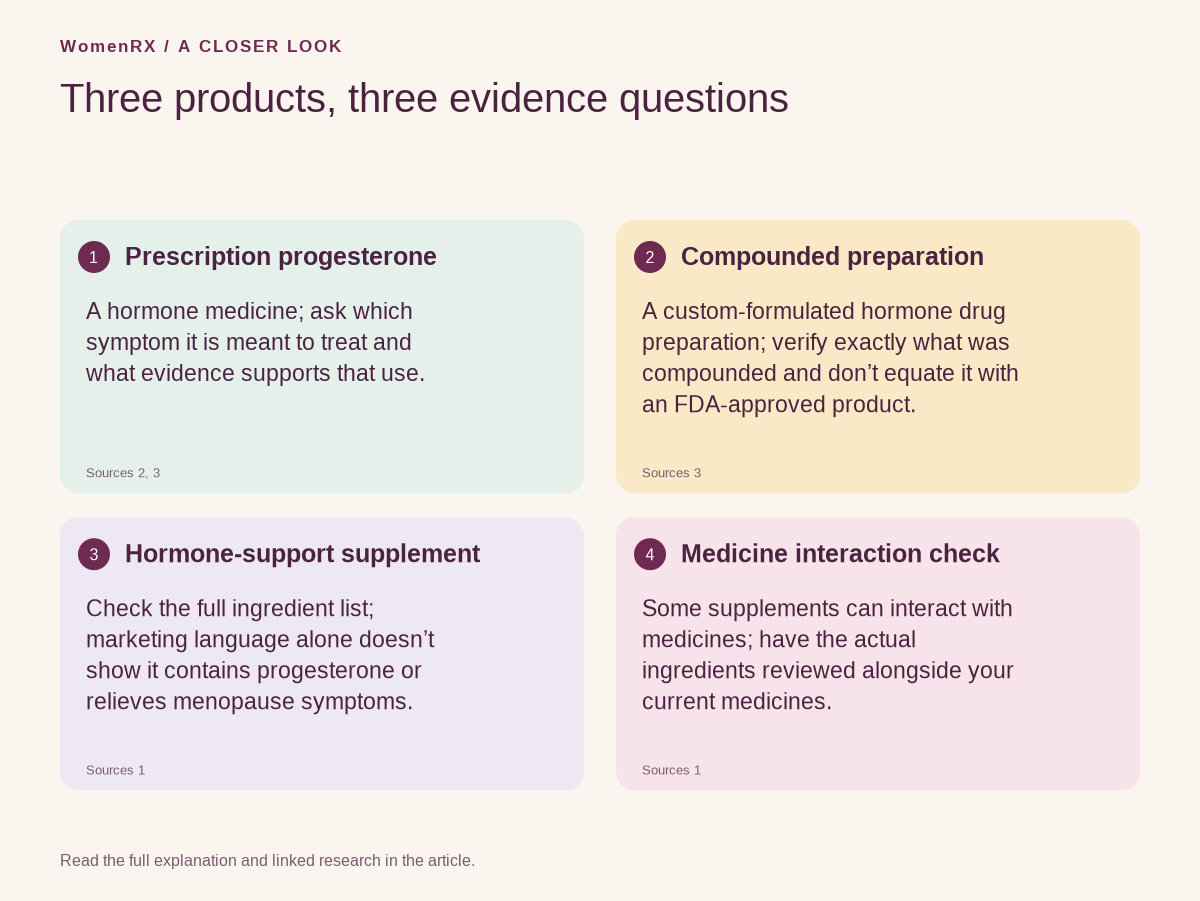
Three products, three evidence questions
Prescription progesterone: A hormone medicine; ask which symptom it is meant to treat and what evidence supports that use.23
Compounded preparation: A custom-formulated hormone drug preparation; verify exactly what was compounded and don’t equate it with an FDA-approved product.3
Hormone-support supplement: Check the full ingredient list; marketing language alone doesn’t show it contains progesterone or relieves menopause symptoms.1
Medicine interaction check: Some supplements can interact with medicines; have the actual ingredients reviewed alongside your current medicines.1
Read the figure as text
Identify the product category first. The category and its actual ingredients determine what claims and safety questions make sense.- Prescription progesterone: A hormone medicine; ask which symptom it is meant to treat and what evidence supports that use.23
- Compounded preparation: A custom-formulated hormone drug preparation; verify exactly what was compounded and don’t equate it with an FDA-approved product.3
- Hormone-support supplement: Check the full ingredient list; marketing language alone doesn’t show it contains progesterone or relieves menopause symptoms.1
- Medicine interaction check: Some supplements can interact with medicines; have the actual ingredients reviewed alongside your current medicines.1
More questions, answered
Can progesterone by itself help with hot flashes?
Some trials of prescription progestogens, including oral micronized progesterone, found fewer hot flashes, but a systematic review found mixed results across seven trials and said the optimal treatment approach hadn’t been established. That evidence doesn’t show that an over-the-counter hormone-support supplement will help. 2
Can a menopause supplement interact with my medicines?
Some supplements can interact with medicines, but the interaction depends on the product’s actual ingredients. Check the full ingredient list with a pharmacist, and include prescribed hormones and other medicines in that review. 1
Sources you can check
- Menopause | Menopause Symptoms | MedlinePlusAccessed 2026-09-25Return to first citation
- Efficacy of progestin-only treatment for the management of menopausal symptoms: a systematic review.Dolitsky SN, Cordeiro Mitchell CN, Stadler SS, Segars JH. · Menopause (New York, N.Y.) · 2020Return to first citation
- The Clinical Utility of Compounded Bioidentical Hormone Therapy: A Review of Safety, Effectiveness, and UseNational Academies of Sciences, Engineering, and Medicine; Health and Medicine Division; Board on Health Sciences Policy; Committee on the Clinical Utility of Treating Patients wit... · 2020Return to first citation
- The 2022 hormone therapy position statement of The North American Menopause Society.“The 2022 Hormone Therapy Position Statement of The North American Menopause Society” Advisory Panel. · Menopause (New York, N.Y.) · 2022Return to first citation