Can progesterone be used without estrogen during menopause?
Progesterone alone has been studied for hot flashes and sleep, but its evidence is less consistent than its established role alongside estrogen.
Yes, progesterone can be used without estrogen, but whether it helps depends on the symptom. Some studies found improvement in hot flashes or sleep; the results are mixed, and mood benefits haven’t been established. Progesterone’s separate role in protecting the uterine lining when estrogen is used does not show that it will relieve symptoms on its own. 1 2 3
Two reasons to consider progesterone, with different evidence
If you’re thinking about progesterone alone, first separate symptom relief from uterine-lining protection. They’re different treatment goals.
When a woman with a uterus uses systemic estrogen, progesterone may be added to reduce estrogen-related growth of the uterine lining. In a randomized trial of postmenopausal women with a uterus, endometrial hyperplasia developed over up to three years in 6% of those taking oral progesterone with conjugated estrogen, compared with 64% taking that estrogen alone. This tells us why progesterone accompanied estrogen in that trial. It does not tell us whether progesterone alone treats hot flashes, sleep problems, or mood changes. 1
Without a uterus, that uterine-lining reason for adding progesterone doesn’t apply. Your symptoms may still need treatment, but evidence from combined estrogen-progesterone therapy can’t answer whether progesterone alone is the right choice. 1
Hot flashes: a possible benefit, not a consistent one
A systematic review identified seven randomized trials of progestin-only treatment for menopause-related hot flashes or mood symptoms, involving 601 participants. “Progestin” is the broader category here: the trials included micronized progesterone as well as other medications, and they used different formulations, routes, and treatment lengths. Three of the seven trials reported improvement in hot flashes or other vasomotor symptoms among postmenopausal women. 3
The largest trial of oral micronized progesterone in that review reported a 58.9% improvement in vasomotor symptoms with treatment, versus 23.5% with placebo, among 133 participants. Those figures describe improvement in symptoms, not the percentage of women who improved. A larger trial of transdermal progesterone, involving 230 participants, found no improvement. A positive oral trial therefore doesn’t mean a progesterone cream or patch will work the same way. 3
The tradeoff is that benefit is uncertain while side effects are possible. Across the seven varied progestin-only trials, five reported significant side effects, including headaches and vaginal bleeding; 6% to 21% of participants discontinued treatment because of side effects. Those ranges aren’t a prediction of what will happen with a particular progesterone product. 3
Sleep: some encouraging results, with a catch
A review of nine randomized trials involving 388 participants found that micronized progesterone improved some measured sleep outcomes. In a pooled analysis of four trials, the result favored progesterone for the time it took to fall asleep, but did not show clear benefits for total sleep time or sleep efficiency. Eight of the nine trials enrolled postmenopausal women. 2
The catch for someone considering progesterone alone is that some sleep studies also gave estradiol. Relief of hot flashes may have contributed to better sleep in some studies, too. The review supports a closer look at progesterone for sleep; it doesn’t establish that progesterone by itself reliably fixes insomnia. 2
That distinction matters in everyday life. For example, waking because of night sweats is a different question from lying awake when hot flashes aren’t part of the problem. If poor sleep persists without an obvious connection to night sweats, it’s worth assessing as a sleep problem in its own right rather than assuming a menopause hormone will address it. 2
Mood and the menopause transition
The progestin-only review found no trial reporting improvement in mood symptoms. That doesn’t prove progesterone could never affect mood, but it doesn’t establish progesterone alone as a treatment for mood changes. 3
A separate randomized trial found a mood benefit from estradiol plus intermittent progesterone in initially well perimenopausal and early postmenopausal women. Because both hormones were part of the treatment, the trial cannot tell us what progesterone alone would have done. If low mood is persistent or interfering with daily life, it deserves attention as its own concern, not an assumption that progesterone will treat it. 4
Most of the relevant hot-flash and sleep evidence concerns postmenopausal women. During perimenopause, when you may still have periods, those postmenopausal findings are a less certain guide. There also isn’t an established progesterone-only formulation or regimen that the varied symptom trials collectively identify as best. 2 3
The useful next question is specific: Am I considering progesterone to treat hot flashes, to help with sleep, or to accompany estrogen because I have a uterus? The answer changes which evidence applies. 1 2 3
Which progesterone evidence answers which question?
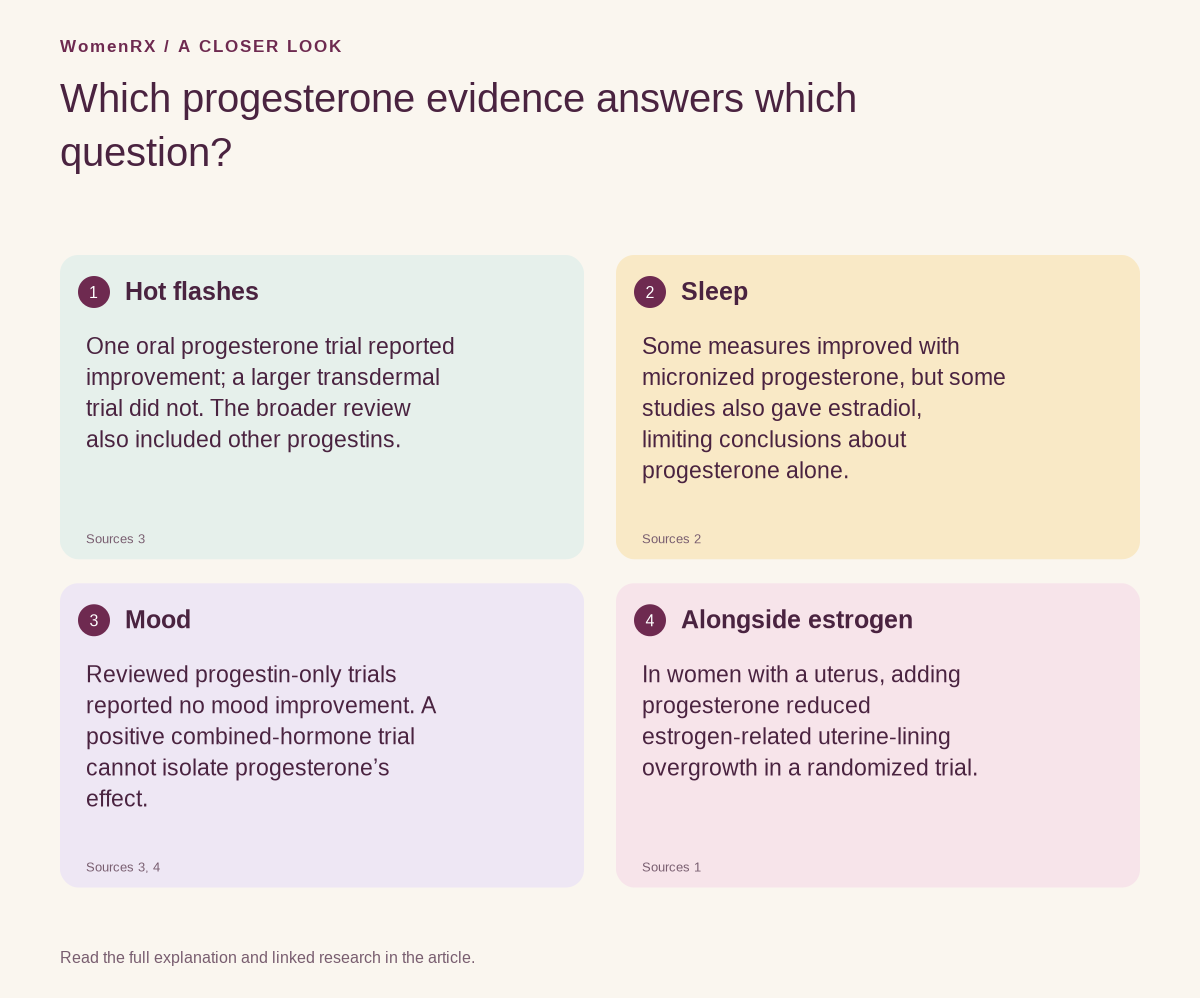
Hot flashes: One oral progesterone trial reported improvement; a larger transdermal trial did not. The broader review also included other progestins.3
Sleep: Some measures improved with micronized progesterone, but some studies also gave estradiol, limiting conclusions about progesterone alone.2
Mood: Reviewed progestin-only trials reported no mood improvement. A positive combined-hormone trial cannot isolate progesterone’s effect.34
Alongside estrogen: In women with a uterus, adding progesterone reduced estrogen-related uterine-lining overgrowth in a randomized trial.1
Read the figure as text
The treatment tested matters as much as the symptom studied.- Hot flashes: One oral progesterone trial reported improvement; a larger transdermal trial did not. The broader review also included other progestins.3
- Sleep: Some measures improved with micronized progesterone, but some studies also gave estradiol, limiting conclusions about progesterone alone.2
- Mood: Reviewed progestin-only trials reported no mood improvement. A positive combined-hormone trial cannot isolate progesterone’s effect.34
- Alongside estrogen: In women with a uterus, adding progesterone reduced estrogen-related uterine-lining overgrowth in a randomized trial.1
Sources you can check
- PROMETRIUM (PROGESTERONE) CAPSULE [ACERTIS PHARMACEUTICALS, LLC] | US prescribing information and patient instructionsAccessed 2026-09-25Return to first citation
- Efficacy of Micronized Progesterone for Sleep: A Systematic Review and Meta-analysis of Randomized Controlled Trial Data.Nolan BJ, Liang B, Cheung AS. · The Journal of clinical endocrinology and metabolism · 2021Return to first citation
- Efficacy of progestin-only treatment for the management of menopausal symptoms: a systematic review.Dolitsky SN, Cordeiro Mitchell CN, Stadler SS, Segars JH. · Menopause (New York, N.Y.) · 2020Return to first citation
- Efficacy of Transdermal Estradiol and Micronized Progesterone in the Prevention of Depressive Symptoms in the Menopause Transition: A Randomized Clinical Trial.Gordon JL, Rubinow DR, Eisenlohr-Moul TA, Xia K, Schmidt PJ, Girdler SS. · JAMA psychiatry · 2018Return to first citation