Your First Pilates Class: How to Choose
For a first class, prioritize clear instruction, a manageable level, and modifications that match your movement goal, not the promise that one format is best.
Mat-based Pilates and equipment-based classes are different formats; apparatus such as a reformer, Cadillac, or chair can support or resist movement, and a chair may add balance challenges. Research on the formats examines different populations and outcomes, so it doesn't establish which beginner format is better. Look for clear instruction, gradual progression, and options that fit your goal. 1 3 4
Start with the kind of support you want
Mat-based and equipment-based Pilates are different formats, but a format label alone doesn't tell you whether a particular class will suit a beginner. A systematic review of mat-based Pilates for adults aged 50 and older with chronic musculoskeletal conditions included seven studies and 397 participants, 73% of whom were women. It found benefits for some pain and function outcomes, and Pilates was generally as effective as other exercise. That supports mat classes as a reasonable option to consider, not as a guaranteed fit or a uniquely better workout. 4
Equipment-based Pilates uses apparatus such as a reformer, Cadillac, or chair. Springs and supports can change how a movement feels: some apparatus can assist or resist movement, while a chair may challenge balance and trunk control. Those differences can help you decide what sounds more approachable, but the small apparatus comparison doesn't compare mat with equipment classes or establish which format works better for beginners. 1
A small study of 15 sedentary middle-aged women compared single sessions on three apparatuses and found different immediate flexibility results. It doesn't tell you which class will best meet your longer-term goal. 1
Match the class to your first goal
Pick one practical goal to guide your search. You might want to learn the movements, feel steadier, work on flexibility, or find a class that accommodates a particular movement limitation. Tell the studio what you're hoping to do and ask what a beginner session actually includes. A “beginner” label alone doesn't tell you how much explanation, individual attention, or choice you'll get.
If you have a specific concern such as ongoing back pain, look for an instructor who can describe how they adapt movements and when they recommend individual guidance. In one four-week study of adults with chronic low-back pain, participants attended reformer sessions led by a physiotherapist with Pilates experience. The results apply to that supervised program and group; they don't prove that any reformer class treats back pain. 2
A quick checklist before you book
- Level: Is the class genuinely introductory, and can you ask questions or pause to learn a movement?
- Instruction: Does the instructor explain how to set up and use equipment, if there is any?
- Progression: Does the class build from simpler movements, with options before more challenging versions? One study of healthy women aged 18 to 40 used equipment in a staged progression, but that research protocol isn't a universal teaching standard. 3
- Modifications: Can the instructor offer another position, range of motion, or piece of equipment if a movement doesn't work for you?
- Access: Does the room, equipment, and class pace feel workable for your body and comfort level?
Before enrolling, you could ask: “Is this class suitable for someone new to Pilates?” “How do you offer modifications?” and “Can you help me choose a version that fits my movement goal?” For pregnancy, postpartum recovery, a recent injury, or a condition that affects movement, ask whether the instructor has relevant experience and what individualized guidance is available. If you're in perimenopause or postmenopause and have particular comfort or movement needs, raise those with the instructor too. A general beginner class label can't answer those questions for you.
Choose the class you'll be able to return to
You don't need to pick the format with the most impressive equipment. Choose a class where you can understand the instructions, work at a comfortable level, and get useful alternatives when needed. For older adults with chronic musculoskeletal conditions, the review found group-class adherence was good, while home-exercise adherence was poor. That finding suggests enjoyment and the class experience may matter for sticking with exercise, though it doesn't predict what will work for you personally. 4
If your first class feels too fast or confusing, that may be a mismatch with the class, not a sign that Pilates isn't for you. Try a different beginner level, instructor, or format, and judge it by whether the teaching and movement options suit your goal.
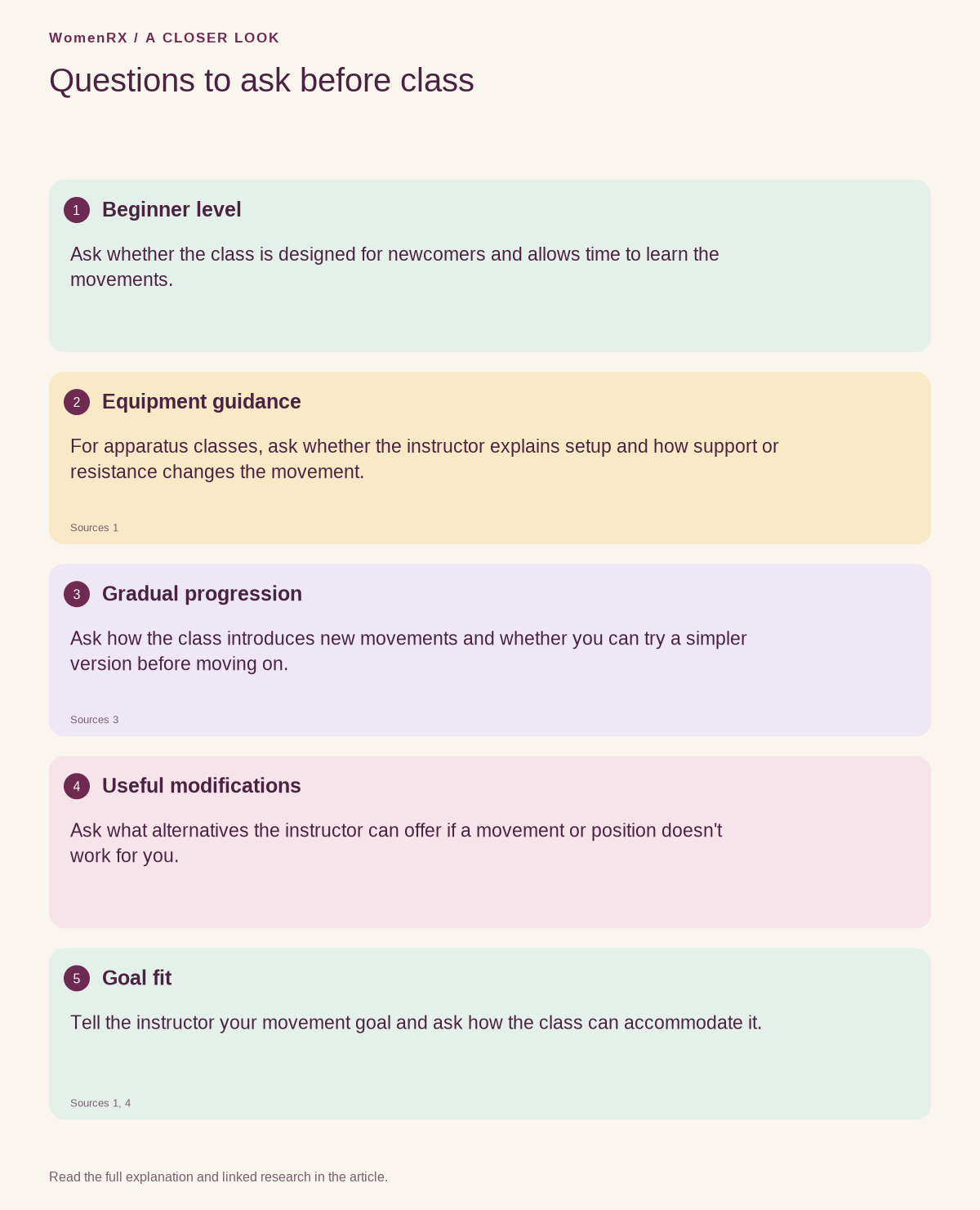
Questions to ask before class
Beginner level: Ask whether the class is designed for newcomers and allows time to learn the movements.
Equipment guidance: For apparatus classes, ask whether the instructor explains setup and how support or resistance changes the movement.1
Gradual progression: Ask how the class introduces new movements and whether you can try a simpler version before moving on.3
Useful modifications: Ask what alternatives the instructor can offer if a movement or position doesn't work for you.
Goal fit: Tell the instructor your movement goal and ask how the class can accommodate it.14
Read the figure as text
Use these prompts to consider a class's level, teaching, and options, while keeping the research limits on progression and goal fit in mind.- Beginner level: Ask whether the class is designed for newcomers and allows time to learn the movements.
- Equipment guidance: For apparatus classes, ask whether the instructor explains setup and how support or resistance changes the movement.1
- Gradual progression: Ask how the class introduces new movements and whether you can try a simpler version before moving on.3
- Useful modifications: Ask what alternatives the instructor can offer if a movement or position doesn't work for you.
- Goal fit: Tell the instructor your movement goal and ask how the class can accommodate it.14
More questions, answered
Is mat or reformer Pilates better for flexibility?
A small crossover study of 15 sedentary middle-aged women didn't compare mat with reformer Pilates, so it can't answer that question. A reformer session produced greater immediate flexibility improvement than Cadillac or chair sessions. The study measured short-term responses, not long-term progress. 1
Should I choose Pilates instead of other exercise?
Not necessarily. In a systematic review of adults aged 50 and older with chronic musculoskeletal conditions, Pilates was generally as effective as other exercise for the outcomes studied. Choose a class that fits your needs and that you can keep attending. 4
Sources you can check
- Acute Effects of Reformer, Cadillac, and Chair Pilates Apparatuses on Cardiac Autonomic Modulation and Flexibility in Sedentary Middle-Aged Women.Güngör AK, Topçu H, Şahin Ş, Bayram G, Aldhahi MI. · Healthcare (Basel, Switzerland) · 2026Return to first citation
- Pilates-Based Training and Its Influence on Muscle Viscoelasticity and Health-Related Outcomes in Chronic Low Back Pain: A Comparative Study.Aydoğdu O, Çoban O, Aydoğdu YT, Yıldız A, Sarı Z. · Healthcare (Basel, Switzerland) · 2026Return to first citation
- Comparative effectiveness of 10-week equipment-based pilates and diaphragmatic breathing exercise on heart rate variability and pulmonary function in young adult healthy women with normal BMI - a quasi-experimental study.Adıgüzel S, Aras D, Gülü M, Aldhahi MI, Alqahtani AS, Al-Mhanna SB. · BMC sports science, medicine & rehabilitation · 2023Return to first citation
- A systematic review of the effectiveness of Pilates on pain, disability, physical function, and quality of life in older adults with chronic musculoskeletal conditions.Denham-Jones L, Gaskell L, Spence N, Pigott T. · Musculoskeletal care · 2022Return to first citation